You start the day knowing exactly what is overdue rather than feeling vaguely behind.
Independent and owner-run businesses
One person, or three, wearing every hat — where the constraint is attention rather than headcount.
The problem
Nothing here is too big for a spreadsheet, and that is exactly the trap. The spreadsheet does not tell you that the job you quoted last month is still unbilled, because finding that out requires reading three tabs and remembering what you meant last March.
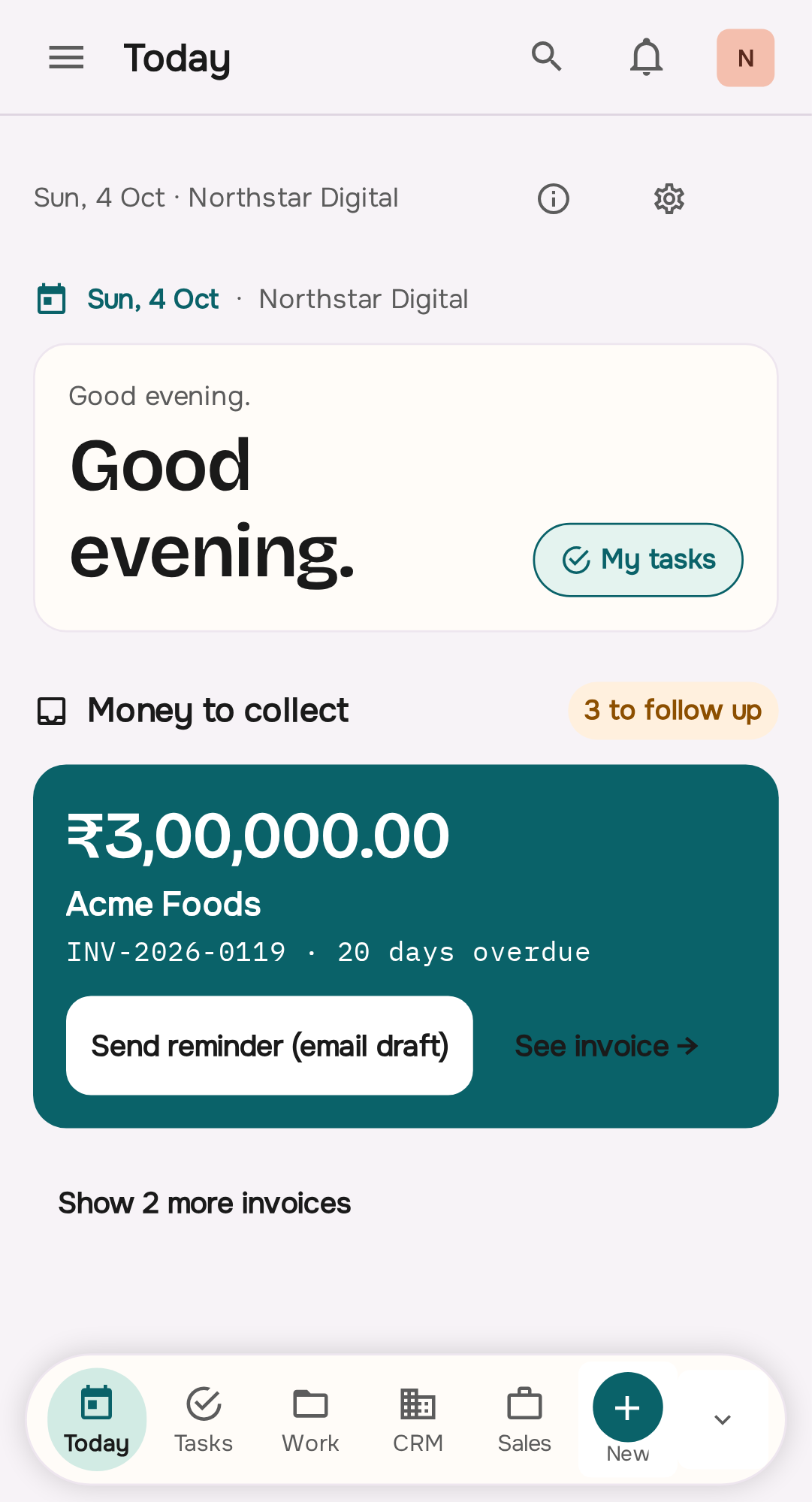
A working day
You do the selling, the delivery, the billing, and the collection — in that order, until the day runs out and the oldest of them quietly slips.
How NoxOrigin fits this business
Every business runs the same sequence, from first contact to money in. NoxOrigin keeps each step tied to the last: Customer → Opportunity → Quote → Project → Work → Invoice → Payment.
The steps are the same. What changes is the words you use for them, the pressure at each one, and who is responsible for it. This is how it reads for independent businesses.
Enquiry
Customer → Opportunity
The lead is real and the follow-up is due, and neither is in a system with a reminder.
Agreement
Quote
Agreeing a price in a message thread is fine until you need to invoice against it.
Job
Project
A job needs a name and a date, even if that job is three hours long.
Work
Work
The follow-up you promised yourself is the one that gets lost.
Bill
Invoice
Unbilled work is invisible until the money is needed.
Collect
Payment
Asking for money you are owed feels awkward, which is why it needs a system rather than willpower.
Know
Reports
Knowing which work to stop doing is the most valuable report a small business has.
What changes
What is different by next week.
Every job becomes an invoice, automatically, instead of a memory you intend to revisit.
You can see which kind of work you should stop accepting.
Bringing in a second person does not mean moving everything to a new system first.
The business stops living entirely inside one person's head and one person's phone.
Who does what
Different people need different parts of the same information.
Everyone is looking at the same information. What changes is which part of it they are responsible for.
- Owner / operatorDoes everything, in one system, with Today as the only screen that matters in the morning.
- Helper / familyGets a PIN and exactly the access their job needs, not the owner's login.
- AccountantReceives clean records instead of a folder of bills to reconstruct.
What software should not decide
NoxOrigin keeps the facts. You still make the decisions.
Keeping the facts in one place ends the argument about what happened. It does not make the decisions that were always yours to make.
- What to say no to, and to whom.
- Whether a price rise is overdue.
- Who in the family or the team gets a key to what.
- Whether to take on the work that looks like revenue but is not profit.
Where to look next
The product areas this depends on.
Before you look at pricing.
Is this too much software for a small business?
It is one workspace with a connected record, not fourteen tools. The Starter plan exists for exactly this size. The parts you do not use stay out of the way.
Can I migrate from spreadsheets?
Migration is scoped work rather than a self-serve import promise. We map what your current process actually does before moving it, because most spreadsheet damage is done by a conversion nobody reviewed.
What if I am not technical?
Bring the process you already use. Onboarding is about mapping your operation onto the chain, not teaching you a new way of thinking.
Do I need every module?
No. Start with the loop that currently breaks — usually customer to invoice — and add the rest when that loop is honest.