An enquiry that is not buildable gets closed with a reason on the record, so it does not return next month as a fresh lead and get argued again.
Interior design studios and turnkey execution teams
Studios that charge a design fee and then, usually, a much larger execution job — one principal, a designer or two, and a site team spending the rest of the year finishing what the drawing promised.
The problem
The enquiry arrives as a photo and a budget. Some of them are buildable and some never will be — the carpet area and the budget do not meet, the society will not allow the work, the possession date is two years out — and the only way to find out is a fifteen-minute conversation, which is exactly the step that gets dropped when three studios are chasing the same client. So the studio takes it anyway, and the design fee is small next to the value it is actually competing for. Then the gap between what the drawing showed and what the site did becomes a stage bill nobody argued about at the time, and a third of the enquiry list turns out to be people still collecting references, quietly counted as pipeline.
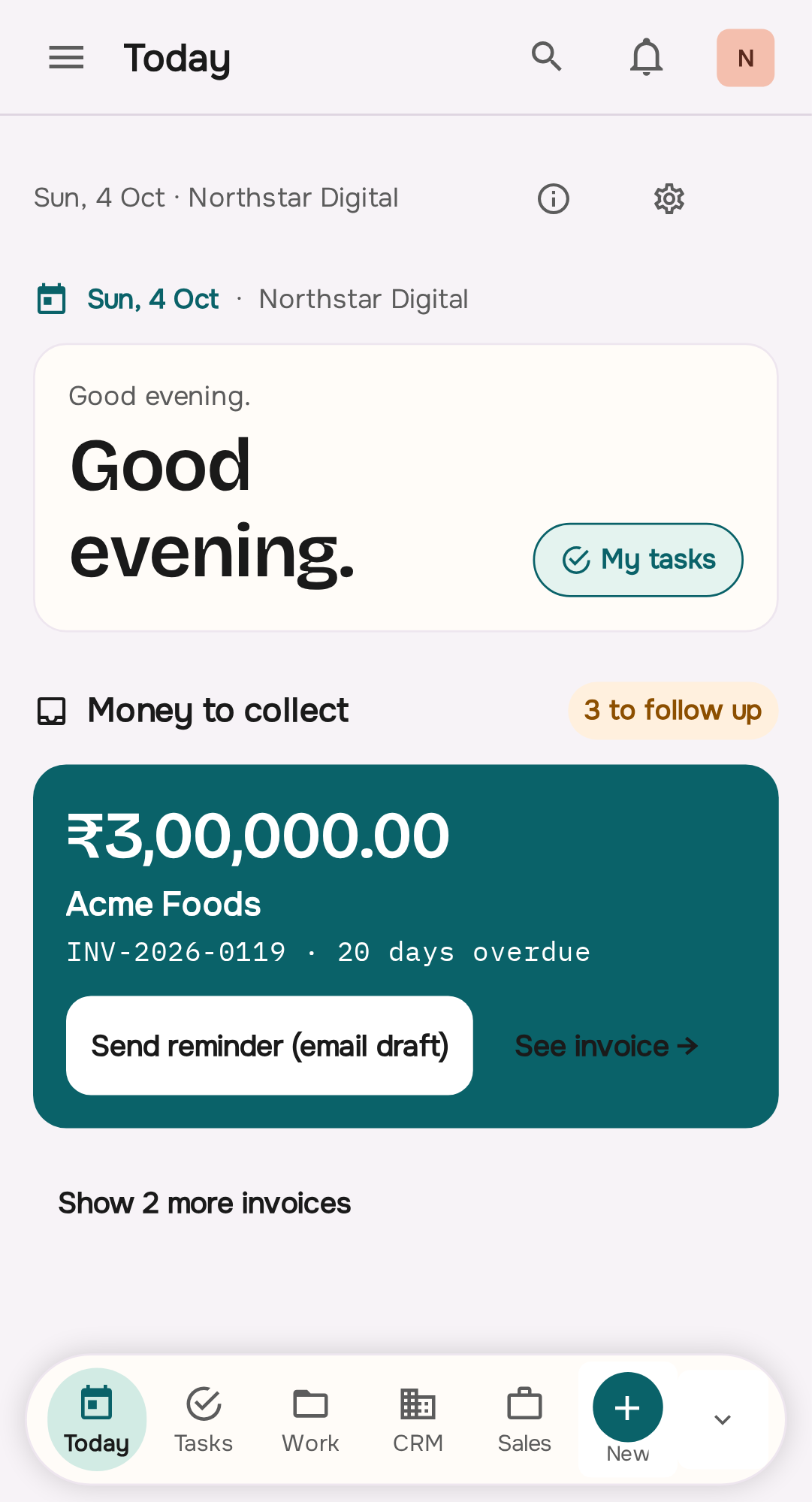
A working day
Two messages from last night, a measurement on a site at eleven, a client asking for one more revision of a layout they have already seen, a vendor asking which finish was actually approved, and a stage bill that has to go out against a scope which has changed twice since the design fee was collected. The day is not difficult because the work is complicated. It is difficult because the drawing, the site, and the money are three conversations that started at different times.
How NoxOrigin fits this business
Every business runs the same sequence, from first contact to money in. NoxOrigin keeps each step tied to the last: Customer → Opportunity → Quote → Project → Work → Invoice → Payment.
The steps are the same. What changes is the words you use for them, the pressure at each one, and who is responsible for it. This is how it reads for interior design studios.
Enquiry
Customer → Opportunity
An interiors enquiry is a question before it is a purchase — carpet area, budget band, possession date, whether drawings exist — and the only version that answers it is a conversation rather than an auto-reply. The first real job in the record is deciding whether it is buildable at all, and recording that decision either way.
Site measurement or brief
Quote
A measurement and a brief produce the two numbers the studio works from: what the design costs, and roughly what executing it will cost. The second is the figure the client will repeat to another studio while deciding, so it belongs in a priced scope with line items rather than in a message that cannot be produced again in a month.
Design proposal
Project
Once the concept is agreed it stops being a drawing and becomes the structure of the job — client, team, dates, and the scope those drawings were drawn from. It is the only version of the design the site team will ever see, so it has to be the version that carries the client context with it.
Design fee
Work
The design fee buys layouts, renders, revisions, and site drawings, and it is the one invoice in this trade that clients ask to see itemised. So the design effort has to be held as work against the project, because an invoice reading “two revisions” with nothing behind it is the easiest line in the business to query and the hardest to defend.
Site execution
Invoice
Execution is billed in stages against a value many times the design fee, and each stage bill goes to a client who remembers the design conversation rather than the commercial terms. Every one of them has to trace to the agreed scope plus the additional items already quoted, or it becomes an argument about money at exactly the moment the site needs to keep moving.
Stage billing and variations
Payment
Stage payments arrive in instalments, often before the stage they relate to is finished, and the credit does not say which stage it settled. A part payment with a date promised against it is a different fact from a part payment, and only the first of those helps when the final stage is being disputed.
Studio economics
Reports
Design fee against execution value, per project, is the report that tells a studio which kind of work it should be selling. Most cannot produce it, because the fee was booked by the person who sold it and the project by the person who delivered it, and the two never met on one record.
What changes
What is different by next week.
The design fee becomes an invoice that traces back to the design work recorded against the project, which is what makes a query about revisions survivable.
A change the client asks for during execution is a new quote on the same project, so the stage bill is the agreed scope plus agreed additional items rather than a negotiation during execution.
A principal can see the design fee and the execution value for the same project side by side, which is the only reliable way to find out whether the studio earns on the work it is best known for.
A site manager reads the approved scope and the additional items already agreed in one place, instead of discovering on site that a finish was changed verbally three weeks ago.
Who does what
Different people need different parts of the same information.
Everyone is looking at the same information. What changes is which part of it they are responsible for.
- Principal / founderQualifies the enquiry, prices the design, signs off the concept, and reads studio economics across jobs.
- Lead designerRuns the brief, the layouts, and the revisions, and raises the additional items a client asks for once execution has started.
- Site / execution managerRuns the site against the approved scope, coordinates vendors and materials, and reports the progress the stage bill is written from.
- Studio coordinator / accountsSchedules measurements, raises the design-fee and stage invoices, records the receipts, and works the outstanding list by age.
What software should not decide
NoxOrigin keeps the facts. You still make the decisions.
Keeping the facts in one place ends the argument about what happened. It does not make the decisions that were always yours to make.
- Which enquiry to disqualify early, and how early — turning away a project you cannot serve well is the right call, and a wrong disqualification costs a client who might have referred work for years.
- Whether to take a design-only engagement on a job you already expect to execute badly, for the fee.
- How far to move on the rate for a client who keeps referring, and what that quietly does to the rate the next client is quoted.
- Whether a client asking to drop a line from a stage bill is a one-time concession or the opening move in a negotiation about the final stage.
- Whether a project running over is worth finishing to the current specification, or whether changing the specification and raising a new quote is the more honest answer.
Free tools
What this trade tends to ask, answered with a calculator.
Slow lead response cost calculator for interior design studios
A rupee range on the wait before the first serious conversation, and honest about the enquiries it counts as recoverable that were never buildable at all.
Quote estimator calculator
Pricing an execution job from materials, cost, and the margin you actually need — before the quote goes out rather than after the site has started.
Where to look next
The product areas this depends on.
Customers & CRM
The message, the referral, and the walk-in as one record — including the enquiries closed as not buildable, with the reason kept.
Quotes, Billing & Finance
Where the design fee and the stage bills are raised, with the additional items already quoted and attached.
Scope Management
The agreed scope, the work it became, and the invoiced value on the same project, so additional items are visible before they are billed.
Reports & Economics
Design fee against execution value per project — the report that shows which work actually pays.
Before you look at pricing.
Does it hold a milestone or deliverable register for the design, and can a client sign off a drawing?
No, and we would rather say it than let the word “project” imply it. There is no milestone record, no deliverable record, and no e-signature in NoxOrigin, and it does not draft or sign a design contract. What the project carries is the client, the team, the dates, and the work assigned against it — which answers what is being worked on and by whom, and is honestly less than a full delivery register. A drawing register with client approval on each issued sheet is a different piece of software, and a signed contract belongs in a contract-lifecycle tool.
Does it track hours against a design project, or is that how the design fee gets priced?
There is no timesheet record in NoxOrigin and no payroll module, so it will not produce utilisation figures or bill you from captured hours. The work record gives you the assigned items and the people on them, which is what lets a design-fee invoice point at the work behind it rather than at a number of revisions. If you bill hourly and need hours captured per person, that is a different product, and this will not pretend to be it.
A lot of our enquiries are not buildable — budget, society rules, possession date. Can it tell us which ones those were?
It cannot judge that, and the lead response calculator on this site is explicit about the same limit: some of the deals a model counts as recoverable were never recoverable at all. What it can do is keep the decision. When a project is closed as not viable, the reason sits on the record, so the same enquiry is not re-argued next month and the count of what came in stays honest rather than flattering. Deciding which enquiries deserve a studio's hours is yours.
Execution runs for months and the client keeps changing things. How is that handled?
As a new quote raised against the same project and agreed before the additional work happens, rather than an edit to the original scope or a line that turns up on the final bill. There is no change-request record, no milestone record, and no deliverable record in the product, so the supported pattern is: agree the additional scope, quote it, attach it to the same project, and invoice against the two together. Two adjacent things to be straight about as well — expenses are not part of the platform subscription, and purchasing and site procurement sit in the Commerce area.
Does it file our GST returns or handle statutory compliance?
No. Invoices are GST-compliant with a tax breakup, and the rate and place of supply are configured for your business during setup rather than assumed, but NoxOrigin prepares invoices and reports — it does not file GST returns or any other return, and it is not a replacement for the accounting package that does. Your own compliance position should be confirmed with your adviser rather than inferred from a tax breakup on an invoice.