Client profitability software that judges a relationship on money, not on volume.
NoxOrigin reads quoted, billed, collected, and outstanding value together on the client record. That is how an account gets called your best while most of its work is still unpaid — and how a month that looks strong turns out to contain a large share of work nobody invoiced.
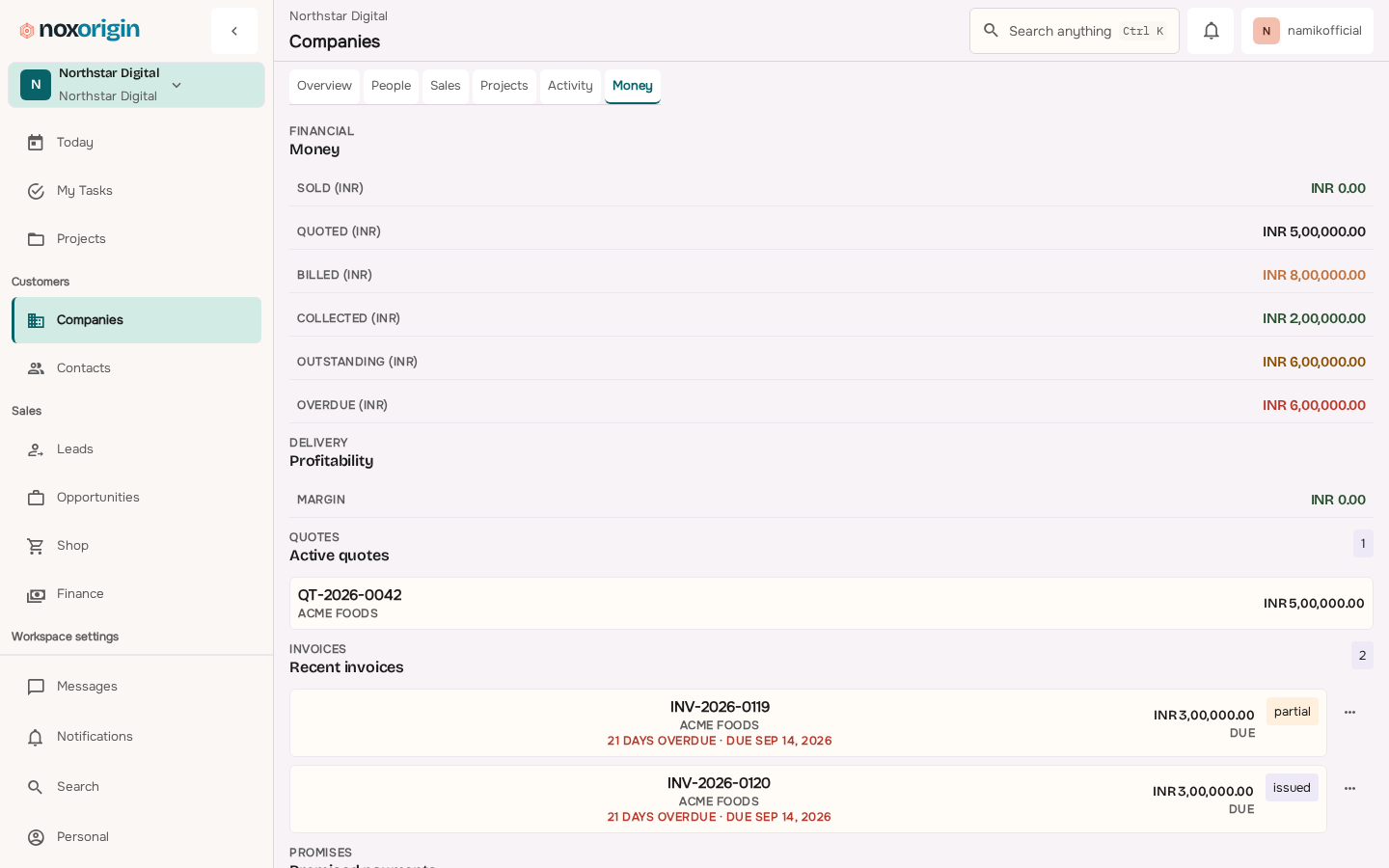
The four states a client review needs
A client is not a revenue figure. It is a set of states that were collapsed into one number somewhere in a spreadsheet, usually by someone who has since left.
Quoted
What you put in front of them. Without it as a record, there is no baseline to compare later billing against.
Billed
What you issued. The gap between quoted and billed is the work that was agreed and never invoiced.
Collected
What actually arrived. The gap between billed and collected is your receivables, which is usually the number a business cannot see.
Outstanding
What is still owed, by whom, and since when — read by age so an old invoice is an exception rather than a rounding error.
A client money review you can run monthly
A sequence rather than a dashboard, because a dashboard does not tell anyone what to do.
Keep one client record
Company, contacts, ownership, activity, and sales context sit together, so the money states have something reliable to attach to.
Quote against that record
Quoted value accumulates on the relationship rather than in an inbox, which is what gives the comparison a left-hand side.
Invoice and record collection
Billed and collected stay two different states on purpose, because the difference between them is the receivables nobody can otherwise see.
Read the four states side by side
For one client: what was quoted, what was billed, what was collected, what remains outstanding. Four facts, read together rather than in sequence.
Age the outstanding
The oldest line stops hiding inside a healthy-looking total, and any recorded payment promise gives the follow-up a date to refer to.
Act on the relationship, not the total
Renegotiate terms, chase a specific invoice, or reconsider work you keep quoting below what it costs — with a client and a number in front of you.
Where this is the wrong tool
The honest limits of a commercial view of your own client records.
It is not a lifetime-value model
These are current records, not a forecast. Nothing here projects what a client will be worth next year or discounts future value — that would need assumptions you have to own.
It does not cost each client’s work
Client money is a commercial view. Where one client consumes far more delivery effort than another, the numbers alone can mislead, and NoxOrigin will not invent the missing cost side for you.
It is not a BI or warehouse tool
Reporting reads from NoxOrigin records. If you want bespoke dashboards, a data warehouse, or SQL over years of history, plan to work from exports and the API instead.
A split client record breaks the answer
If the same legal entity exists as two client records, the states split and the relationship looks like two smaller ones. Consolidating the record comes before the reporting does.
The customer record the money states attach to
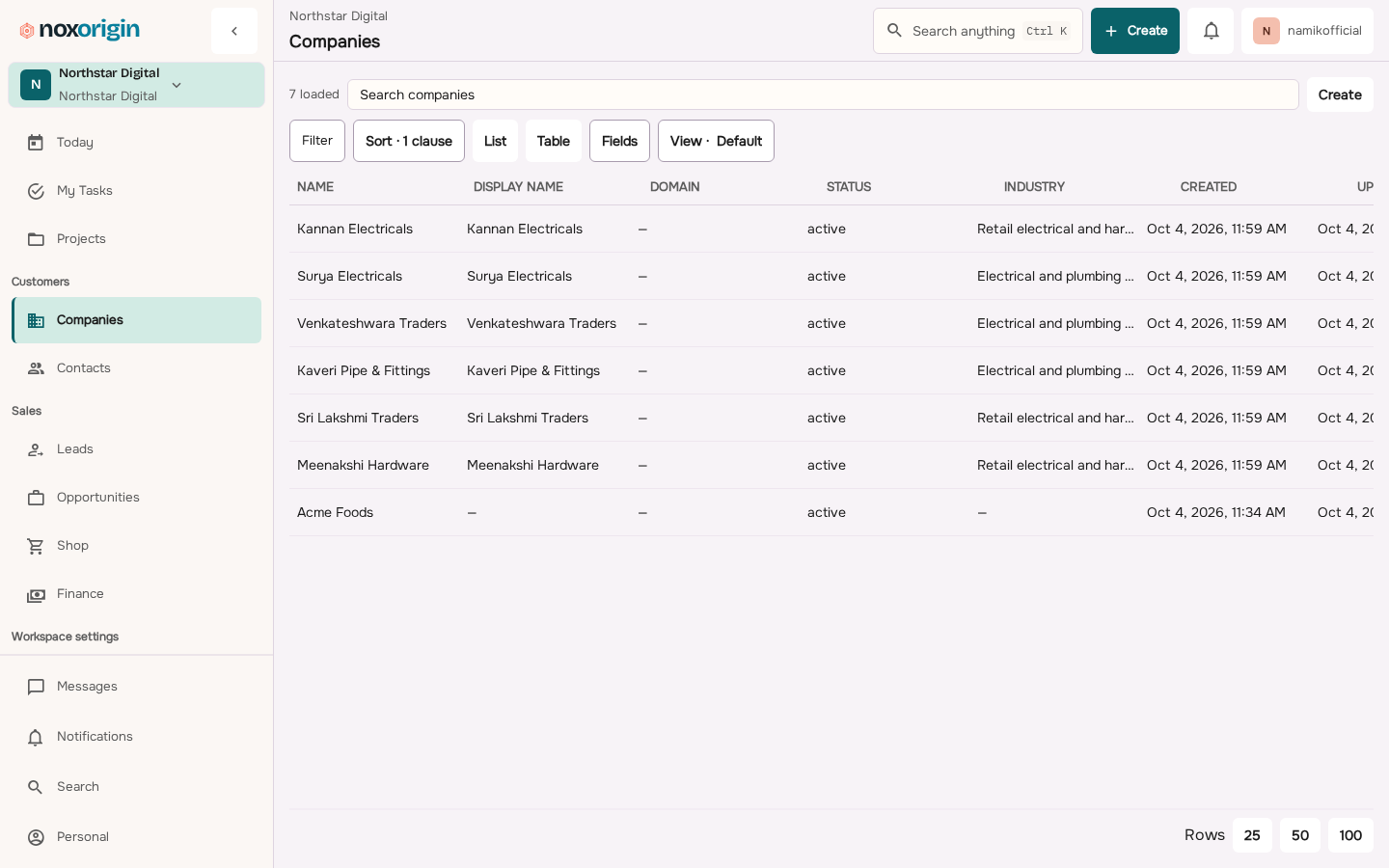
Companies, contacts, ownership, and activity beside the commercial record — so a new person can read the relationship without being briefed.
Run it on the plan that matches your client count
Growth is ₹1,600/month or ₹15,000/year, includes a 30-day trial, 10 users, 50 active projects, and 10,000 contacts. Client money and receivables ageing are part of the reporting that comes with the workspace, not an add-on.
Client profitability questions
What is client profitability software?
It is the practice of judging a customer relationship by more than the revenue attached to it. NoxOrigin keeps quoted, billed, collected, and outstanding value as four separate states on the client record, so you can see what the relationship was worth, what has actually arrived, and what is still sitting on the books.
Why is this different from a revenue report?
A revenue figure counts money that was quoted, money that was billed, and money that arrived as if they were the same fact. Separating the states is what makes the difference between them visible — the gap between billed and collected is receivables, and the gap between quoted and billed is work that was agreed and never invoiced.
Can I see outstanding value by client and by age?
Yes. Receivables are read per client and by ageing, so an amount that has been outstanding for months shows up as an exception instead of being averaged away inside a total that looks acceptable. The list is only useful if somebody owns it, which is a decision rather than a feature.
Does this tell me which clients I should drop?
It gives you the states a decision needs, not the decision. Client money is reviewable per relationship, which is what makes profitability discussable — but weighing it against delivery effort, strategic value, and how much chasing a client costs is judgement, and NoxOrigin does not make it for you.
Who can see the client money view?
Reading reports is a permission. An admin role can review reporting for a branch or a client without holding the permissions that raise quotes, invoices, or payments, so the commercial picture is not locked away with the finance login.
Does this replace my accounting package?
No. Client money, receivables ageing, and operational reporting read from the NoxOrigin records. Statutory accounting, ledgers, and filing stay with the tools built for them.
Find out which clients are actually paying, and which are still waiting.
We will walk through a client money review on your own workflow — quoted, billed, collected, outstanding — and say plainly where the data has to come from.