Customer data cleanup software that flags the duplicates and holds the ones it must not guess about.
The same customer gets created from a phone call, from a WhatsApp thread, and from an import that did not check. One record holds a differently spelled name and no tax registration number; the other holds the registration number and ₹80,000 outstanding. Detection can tell you they are candidates for the same entity. Deciding that is a judgement about money and about tax, and it is yours to make, one pair at a time, in writing.
How one customer becomes two records
None of the four differences below is decisive on its own, which is exactly why the merge cannot be a rule. Each one is a reason a person has to look.
The name is not the same
One record holds the trading name, the other a shortened or misspelled version of it. A name field carries no evidence either way, and everything downstream splits with it: the invoice history, the payment history, the ageing, and every report that reads per customer.
The phone number is not the same
The number that matters is the one the customer answers today; the other is a number somebody once wrote down. Comparing two numbers tells you very little, which is why name-plus-phone matching alone finds candidates rather than answers.
The tax registration number is on one record only
A registration number present in one system and absent in the other is the strongest signal that these records are not obviously the same, and also the signal whose loss is hardest to repair afterwards. Which registration number belongs to the entity is a question for your chartered accountant; NoxOrigin stores what you tell it and files nothing.
The second one came from an import
An import that does not check for an existing record will cheerfully create a second customer with the same legal name and no history behind it. The fix is not deleting it — the invoice it carries is real. The fix is deciding what has to move into the older record.
A cleanup routine that ends with a decision, not a batch
Six steps, and step four is the one that decides whether this cleanup is safe: some pairs are not resolved at all.
Search before you create, and check afterwards anyway
Looking first prevents the duplicate you can see. The rest arrive through imports, counters, and the person who was certain it was a different customer.
Let detection produce candidates
A similar name, the same phone, a shared address fragment, an invoice pattern that overlaps. A candidate is a proposal for a human to look at, never a decision.
Have a person decide, and write the reason down
Same entity or not, and if it is, which record survives. The reason is recorded because the next person to look at the same pair will ask the same question.
Hold the pair that disagrees on tax registration or carries a balance
No merge, no delete. It becomes an exception with a named owner, so the ambiguity stays visible instead of being resolved by whoever was in a hurry.
Move what has to move, and let the money re-derive
Invoices, payments, contacts, and documents attach to the surviving record. The outstanding balance is then derived from those records rather than typed across as a figure.
Keep the exception list short enough to be worked
A list with a name against each line gets finished. A list nobody owns is just a second copy of the data problem, in a different shape.
Two records, one customer
Every figure below is constructed for this page. It is arithmetic you can check by hand, not a NoxOrigin result and not a number from a customer account — replace all of it with your own before drawing any conclusion from it.
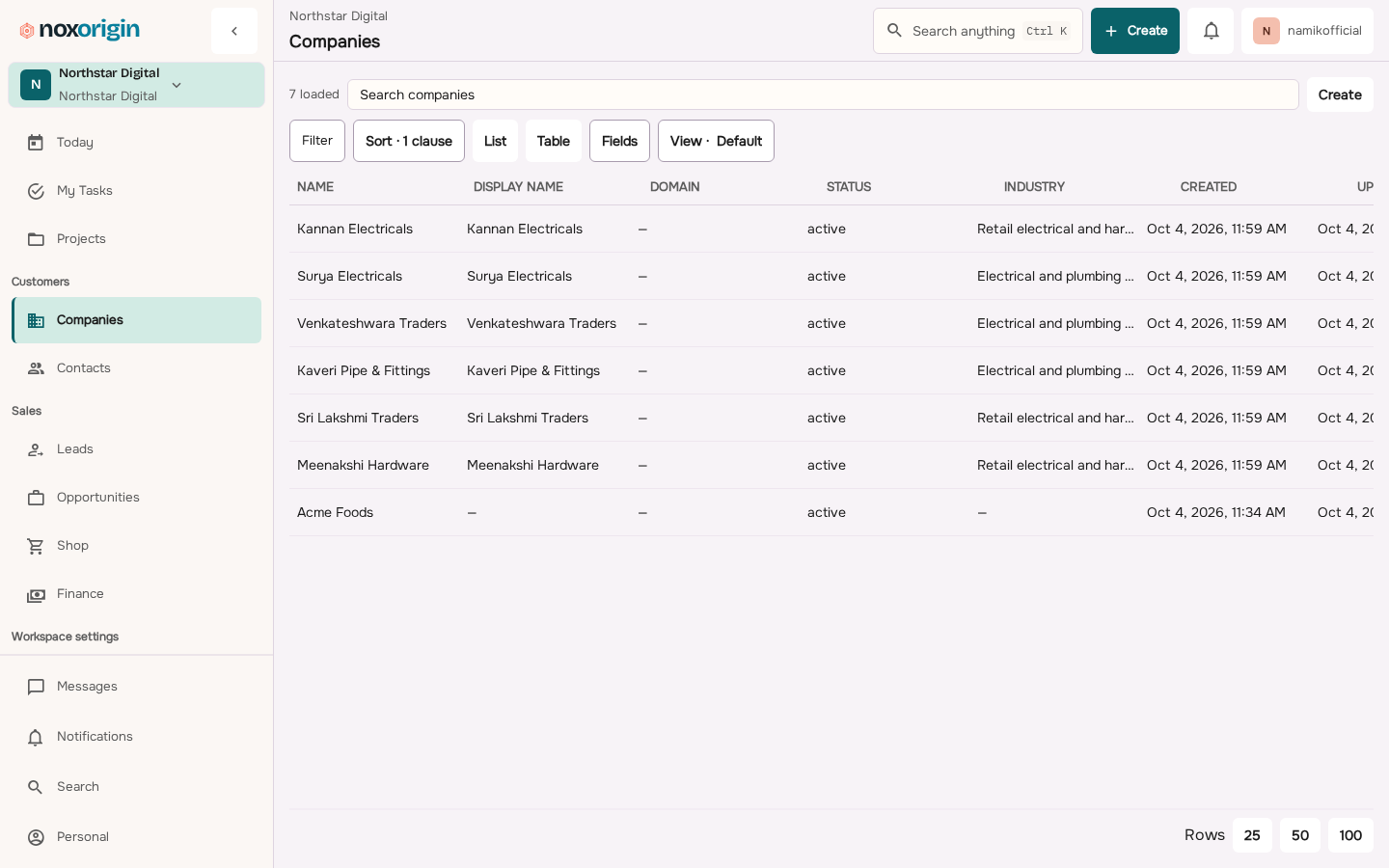
Record A, created from a call
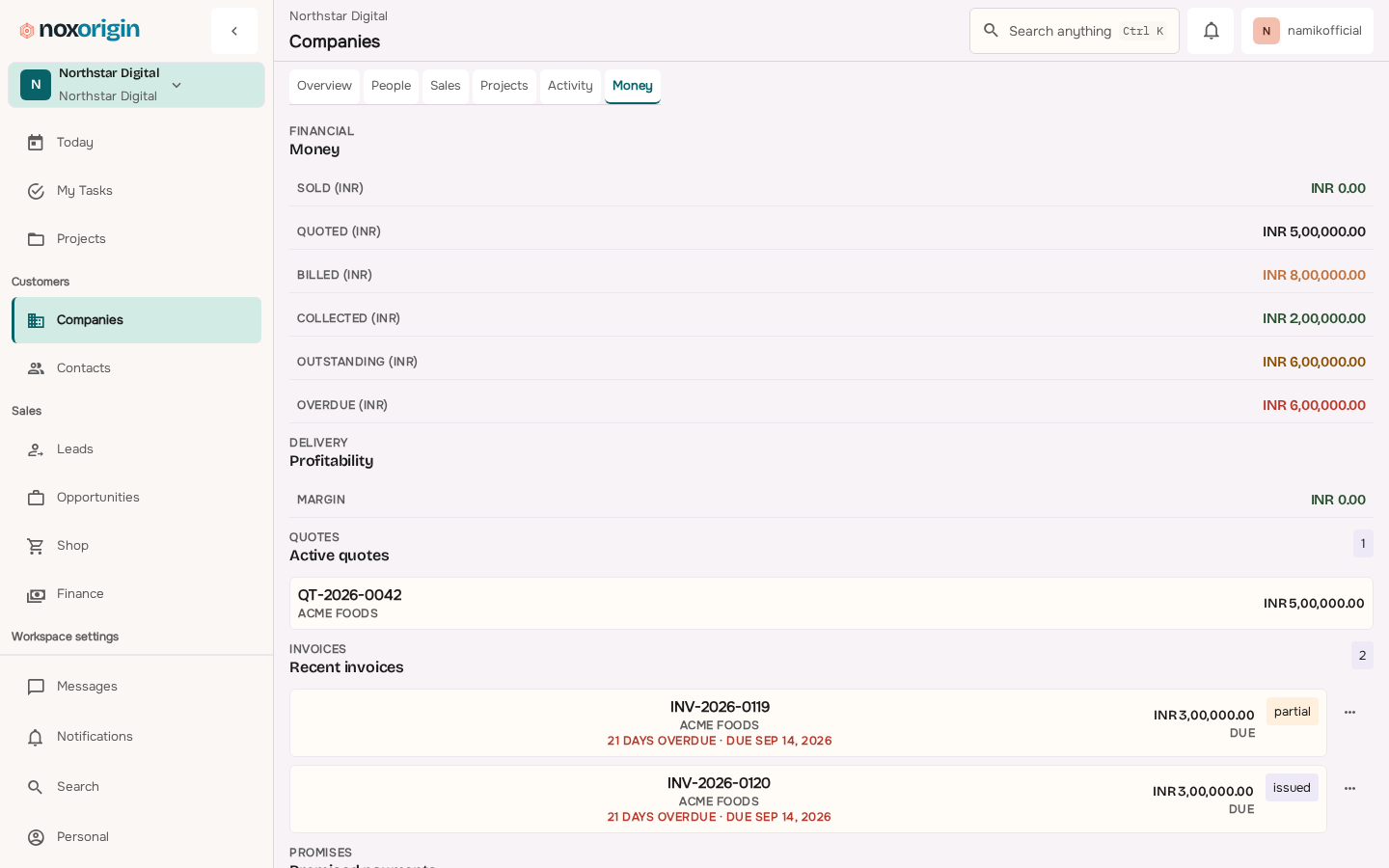
Two invoices: ₹1,00,000 and ₹1,40,000, so billed ₹2,40,000. Two payments allocated: ₹1,00,000 and ₹60,000, so collected ₹1,60,000. Outstanding ₹2,40,000 − ₹1,60,000 = ₹80,000, and all of it sits on the second invoice: ₹1,40,000 − ₹60,000 = ₹80,000. Tax registration number present.
Record B, created by the import
One invoice of ₹45,000. One payment allocated against it, ₹45,000. Outstanding ₹45,000 − ₹45,000 = ₹0 — derived from the allocation, not read from a paid field. Tax registration number absent, phone number different, name spelled differently.
What a merge would have to produce
Billed ₹2,40,000 + ₹45,000 = ₹2,85,000. Collected ₹1,60,000 + ₹45,000 = ₹2,05,000. Outstanding ₹80,000 + ₹0 = ₹80,000, and the same figure read the other way: ₹2,85,000 − ₹2,05,000 = ₹80,000. If the two sides do not reconcile after the merge, the merge is wrong — which is why the balance is re-derived from invoices and allocations rather than carried over as a number.
Why this pair is held rather than merged
The two records disagree on the tax registration number, and one of them carries an open balance. Under the policy above, that is an exception with a named owner: somebody establishes which registration number is correct with the chartered accountant, chases the ₹80,000 on the invoice that actually carries it, and only then resolves the pair. Nothing about that pair is decided by the software.
The asymmetry that makes it defensible
A held pair costs one review of two records. A wrong merge costs a return and a customer statement built on a record that no longer exists, with an audit entry as the only trace of what used to be there. Those are not the same order of cost, and that difference is the entire reason the merge is a decision rather than a rule.
Where this is the wrong tool
A cleanup tool is judged by what it refuses to do, because every one of the items below can be done badly by software and badly by a person in a hurry.
Nothing merges automatically
Detection flags candidates, a person reviews, and no record is merged without a human decision. Merge behaviour is a setup decision your team makes and reviews, not a default buried in the product. There is no automatic merging, no similarity score that merges itself, and no batch merge of everything above a chosen confidence level.
It is not a data-quality suite
No spelling correction engine, no address standardisation service, no enrichment from an outside directory, and no bulk field-level repair across every record. Correcting one field on a hundred customers is still a hundred edits, and that is the honest cost of doing it properly.
It does not reconcile two systems for you
Matching a customer sitting in your accounting package against the same customer in NoxOrigin is a mapping exercise with a worksheet written before the import, not a button. And money has to arrive as invoices and payments so the balance is derived — the moment you type an opening balance in instead, the derivation that made the record trustworthy is gone.
It is not a statutory or tax tool
NoxOrigin does not file GST returns or any other statutory return, and it does not decide which tax registration number belongs to a given legal entity. Registrations, returns, ledgers, and what a figure means for a return stay with your chartered accountant and your accounting package.
Why a split record hides money
Quoted, billed, collected, and outstanding sit on the customer record. One customer held as two records produces two half-pictures — which is the reason the merge is worth a person’s afternoon, and not worth a rule’s certainty.
Run it on the plan that matches your customer count
Growth is ₹1,600/month or ₹15,000/year, includes a 30-day trial, 10 users, 50 active projects, and 10,000 contacts. Customer records, the duplicate candidates, and the exception list are part of the workspace rather than an add-on. These are NoxOrigin platform plans — NoxCRM, Nox-Billings, and Nox-Tickets remain available as scoped custom deployments, priced separately.
Customer data cleanup questions
What is customer data cleanup software?
It is the practice of finding the same customer entered more than once, deciding which record survives, and making sure that everything attached to the other one actually moves with it — including the pairs you deliberately leave alone. The work is mostly decisions rather than typing, and the decisions are about money and about who a legal entity is.
Does it merge duplicate records automatically?
No. Detection flags candidates, a person reviews them, and nothing merges on its own. What happens to a flagged pair is a setup decision your team makes once and the system then follows; there is no automatic merging, no match-confidence score that resolves itself, and no threshold above which everything gets merged in a batch.
Which pairs are held as exceptions rather than resolved?
A pair that disagrees on the tax registration number, or that carries an open balance on either side, is held for a named owner instead of being merged. Those are the two where a wrong decision is expensive to undo: the registration number is what a return is built on, and the open balance is the difference between one record and two. Holding costs minutes. A wrong merge costs months.
What happens to the money when two records become one?
The outstanding balance is not a figure that gets carried across. Invoices and payments stay what they are, and paid is a projection of the allocations against those invoices rather than a stored field, so the balance on the surviving record is derived from the invoices and payment allocations attached to it. If the figures do not reconcile afterwards, the merge was wrong, and the audit entry says who did it and when.
What about the same customer sitting in two different systems?
That is a different problem from a duplicate inside one system, and no merge control solves it. It is solved by writing the field mapping down before the import — what the source field is called, where it goes, what it is transformed into, and the rule that validates it — and then importing against that worksheet. We have written up the mapping sheet, and the reasoning behind it is separate from this page.
Will it clean up the wrong data as well?
No. It surfaces problems because it reads real records, so spelling variants, missing numbers, and mismatched addresses will show up in the review, and correcting those is data entry with somebody's name on it. It also cannot settle a tax question: NoxOrigin does not file GST returns or any other statutory return, and which registration number belongs to a given entity is a question for your chartered accountant.
Find the second copy of a customer before it becomes a fact.
Bring the two records you are least sure about. We will show you what detection flags, which pairs it refuses to decide for you, and what has to move when a pair is finally resolved.