Day-end reporting software that produces a comparison instead of a retelling.
Counter and service businesses close the day against what the system says should be there: shifts, payment mix, expected cash, counted cash, variance, and exceptions. In NoxOrigin most of that is already a consequence of the transactions, so the close becomes a review with a few items on it rather than an evening of reconstruction.
Why closing the shop takes so long
The slow part is rarely the counting. It is assembling the numbers by hand, from a roll, a bank statement, a WhatsApp message, and whoever remembers the refund — then reconstructing why the cash is short.
The day’s takings are a roll of paper
The payment mix only exists if somebody writes it down at closing time, from memory, and it cannot be re-checked by anyone afterwards.
Expected cash is never computed
Without a system total to compare against, “the cash is off” is a feeling. With one, it is a specific number attached to a specific shift.
Discounts given are known to one person
A discount applied to win a sale is visible only to the staff member who gave it, so the margin quietly disappears and nobody sees the pattern.
Stock drift is discovered, not traced
A count that disagrees with the book produces a mystery. Movements recorded against real balances turn it into a specific set of unrecorded events.
A day-end routine that holds up on a busy Saturday
The routine works because each step has an owner and a recorded result, not because the software is clever.
Open the shift with an opening cash figure
Recording the opening balance at shift start is what makes the closing comparison possible, rather than reconstructing what the drawer should have held.
Ring the day up as recorded events
Each sale carries its payment method, so the day’s payment mix is a consequence of the transactions instead of a separate exercise at closing time.
Record the movements that happen outside the counter
Damaged goods, samples, stock taken for another site, a purchase received but never entered. Agree the rule before go-live, because a count is only as good as the rule for what should have moved.
Close the shift and compare the cash
Closing cash is compared against the system totals, and the variance is recorded rather than explained informally at the back of the shop.
Produce the day-end summary
Shift totals, payments, and variances come out of the close, so the owner can read the day without asking the shift supervisor to retell it.
Work the exceptions, not the whole day
The oldest outstanding invoice, the discount that needed approval, the transfer that has not been confirmed, the variance worth explaining. That list is short, which is the only reason it gets read.
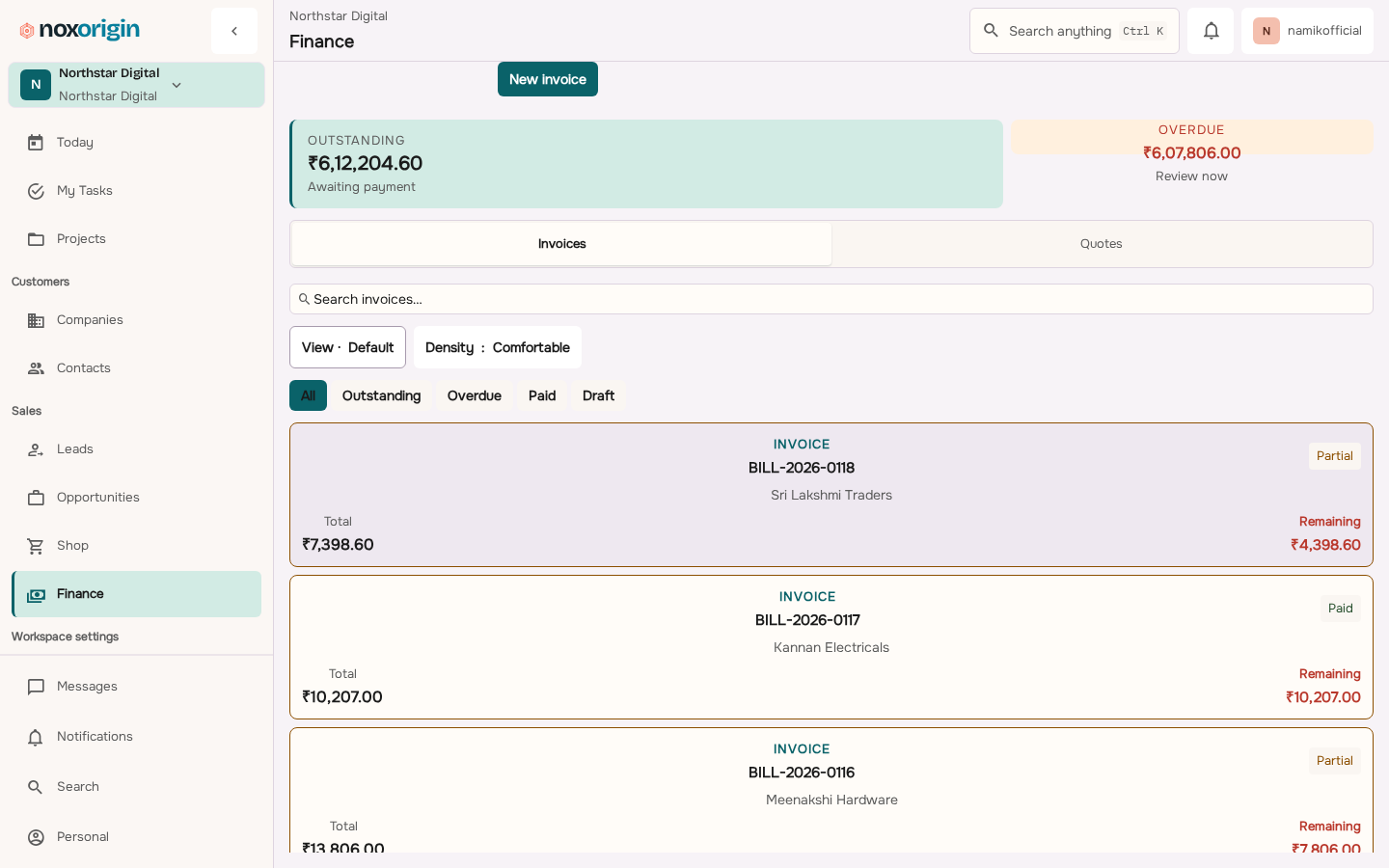
Day-end status, exceptions, and audit in one place
Shown from a dedicated Nox-Billings deployment, which remains available as a scoped custom deployment for counter businesses. In the unified NoxOrigin app, the same shift, close, and reconciliation records live in Commerce.
Where this is the wrong tool
Day-end is a specific routine with a specific scope, and neighbouring needs are better served elsewhere.
It is not management or statutory reporting
This is the operational close of a trading day. A monthly P&L, cash-flow statement, and statutory filing are produced by your accounting package, and pretending otherwise would waste an evening.
It is not for a business without a counter
A consultancy does not have a day end in this sense. If your working question is which work is due and which invoice is late, the relevant surfaces are Today and receivables ageing, not a shift close.
It does not bank-reconcile for you
UPI and card settlement comparison is a routine you run against the provider’s figures. The system gives you the counter total and the variance; the settlement itself lives with your bank.
It does not fix the discipline problem
Deciding who closes, who reviews, and what happens when a shift is closed late or reopened is a training decision written down in advance. Software cannot supply the habit.
Practise the routine before you buy anything
The day-end arithmetic is worth doing by hand once. If the routine does not survive a realistic evening, no software will fix it.
Day-end reporting questions
What does a day-end report actually contain?
Sales and collections for the day, totals per shift, the payment mix by method, expected cash against counted cash, the variance, adjustments and approvals taken during the day, and the exceptions worth a look. The point is that most of it is already a consequence of the transactions, so closing the day is a comparison rather than a reconstruction.
Is day-end fully self-serve?
It is best treated as part of the operating routine rather than a switch you flip. In the unified NoxOrigin app, day-end is part of the Commerce area for businesses that sell at a counter. On a dedicated Nox-Billings deployment, the day-end capability is set up and validated with you as assisted setup — which means the shift, close, and variance routine is agreed against your actual counters rather than assumed.
What if the cash does not match?
That is the point of recording it. Expected cash is computed from the system totals and compared with what was counted, so the difference becomes a number in a review the owner can inspect, next to the payment mix that produced it. The conversation can then be about the process rather than about the drawer.
Does this work if the counter loses connectivity?
Transactions are recorded with offline queues and sync recovery rather than being held hostage to a live connection. The behaviour is validated during rollout against your actual counters, devices, and connectivity, so connectivity assumptions are part of setup rather than something we assume on your behalf.
What about UPI settlement arriving the next morning?
UPI and card totals are part of the day’s payment mix at close, and the settlement comparison happens afterwards against what the provider actually paid. The gap between the counter total and the settlement is a normal timing difference that has to be recorded as a variance rather than argued about. We have written the routine up separately.
Does day-end reporting replace my accounting package?
No. It produces the sale, the payment mix, the tax treatment, and the day-end summary that a ledger needs. Statutory accounting, reconciliation, and filing stay with the tools built for them. It also does not replace management reporting: this is the operational close of a day, not a monthly P&L.
Close the day against a number instead of a retelling.
Tell us your counters, your payment mix, and who closes the shop. We will show the shift and variance routine as it would actually run at your site.