The fee note can be defended line by line, because the lines came from agreed scope and the work recorded against it.
Professional practices and advisory firms
Consultancies, advisory firms, accountants, and architecture practices where what is being sold is the time of people whose names are on the letterhead.
The problem
The engagement was agreed in a paragraph, delivered by three people at different rates, and billed on an estimate of effort that nobody wrote down. The client queries a line on the fee note, and defending it means reconstructing three people's months out of calendars and recollection. Meanwhile the partner cannot see which engagements are carrying the practice and which are quietly paying for it.
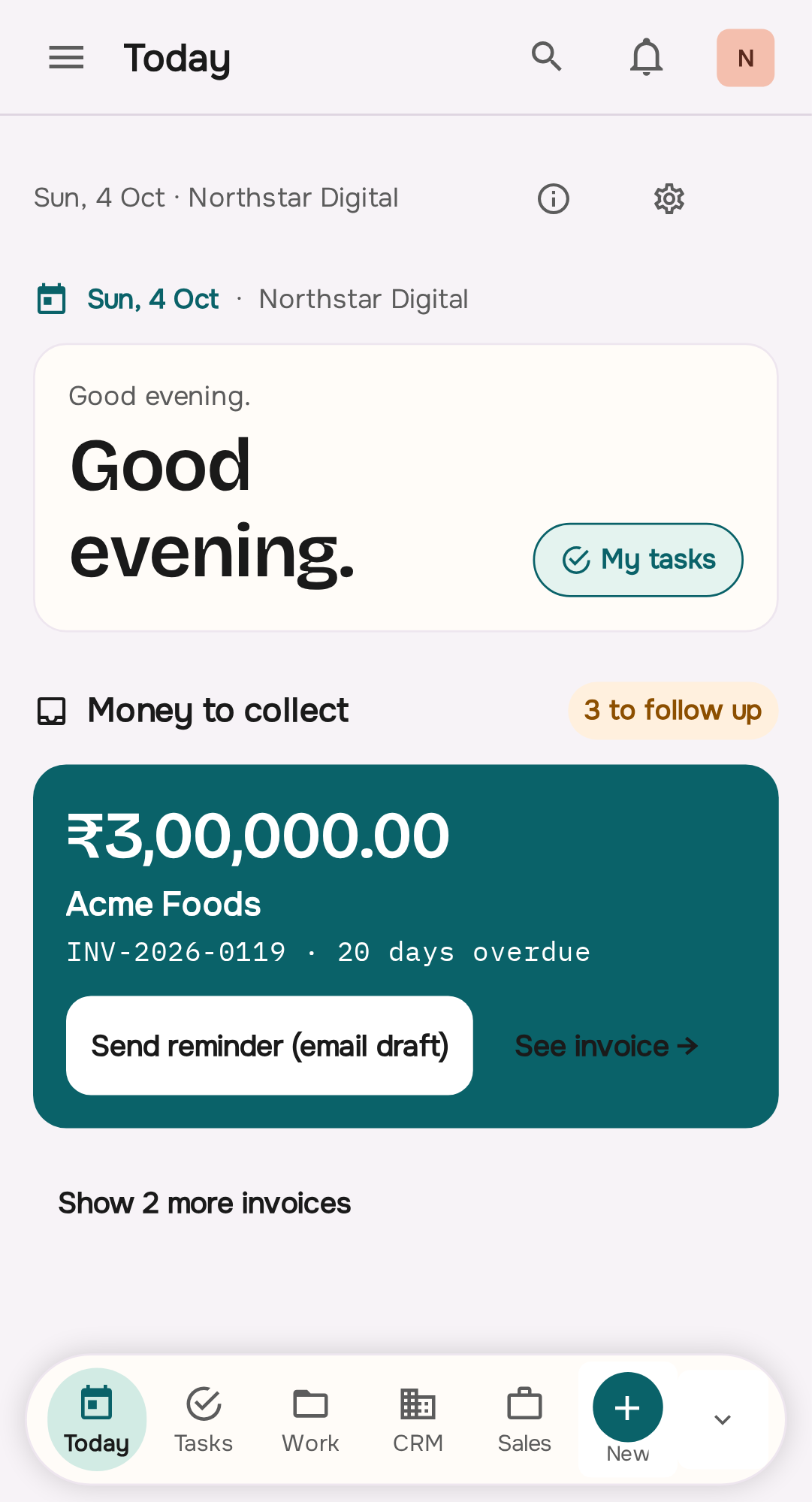
A working day
Two people are in a client workshop, one is reviewing a document that has to leave today, a fee note is due, and an enquiry from a month ago has still not been quoted. The partner's own day is mostly billing, and the day is not long enough for it.
How NoxOrigin fits this business
Every business runs the same sequence, from first contact to money in. NoxOrigin keeps each step tied to the last: Customer → Opportunity → Quote → Project → Work → Invoice → Payment.
The steps are the same. What changes is the words you use for them, the pressure at each one, and who is responsible for it. This is how it reads for professional & advisory.
Enquiry
Customer → Opportunity
A partner's conversation with a finance director becomes a fee proposal within a fortnight, and the notes of what was actually agreed usually live in that partner's phone.
Fee proposal
Quote
A professional fee proposal is a structure — phases, a fixed fee or a rate, and stated assumptions. If it is a Word document, the fixed part and the effort-based part are not related to anything the firm can later check.
Engagement
Project
An engagement has to carry the client, the phases, the people, and the assumptions, because the assumptions are exactly what a later query on the fee note will be about.
Delivery
Work
Every hour eventually becomes a line on an invoice. If the work is not held as assignable items on the engagement, the fee note is written from memory a month after the work happened.
Fee note
Invoice
A professional invoice is read as an argument about value, so its line items have to trace back to the agreed scope rather than to a round number chosen during a conversation.
Settlement
Payment
Fees are paid late and often in instalments, and a part payment with a promised date is a different fact from a part payment. Recording only the second loses the argument that follows.
Practice economics
Reports
Quoted, billed, and collected per client and per engagement tells a partner which relationships to keep. It still does not say whether the fee level was right — that part stays a human judgement.
What changes
What is different by next week.
Unbilled work stops being invisible at month end, because delivery and billing read the same records rather than exchanging summaries.
You can list the clients that consume the most delivery effort and the ones that pay for it, and the two lists are rarely identical.
The fee proposal becomes the structure of the engagement instead of a document that has to be re-typed into the system.
The outstanding list is worked by age, so a fee note from three months ago is an exception rather than a line inside a reassuring total.
Who does what
Different people need different parts of the same information.
Everyone is looking at the same information. What changes is which part of it they are responsible for.
- Partner / principalOwns the relationships, raises the proposals, signs the work off, and reads practice economics.
- Engagement leadRuns the engagement queue, allocates people across engagements, and stops scope expanding without a new proposal.
- Consultant / specialistRecords the work they did against the engagement it belongs to, with enough client context to do it well and none of the fee data.
- Finance / billingRaises fee notes, records receipts against the right engagement, and works the ageing list.
What software should not decide
NoxOrigin keeps the facts. You still make the decisions.
Keeping the facts in one place ends the argument about what happened. It does not make the decisions that were always yours to make.
- How much of a partner's own time belongs to the practice and how much to winning the next one.
- Whether a fixed fee should have been quoted at all, once the scope turns out to have been a guess.
- Which client gets a rate increase and which one stays at the old rate because they refer work.
- Whether an engagement is worth finishing once it is plainly underpriced.
- What counts as an assumption worth writing down, and when writing it down would have changed the conversation.
Where to look next
The product areas this depends on.
Projects & Work
Where the engagement, the people on it, and the work actually done are held.
Quotes, Billing & Finance
Where the fee proposal continues as the invoice.
Customers & CRM
The enquiry that became the engagement, still findable a year later.
Client Profitability
Quoted, billed, collected, and outstanding read together per relationship.
Before you look at pricing.
Does it do timesheets?
No. There is no timesheet record in NoxOrigin, and we would rather say so than imply otherwise. What it holds is the engagement, the agreed scope, the work assigned against it, and the invoice raised from that. If you need hours captured per person with utilisation reporting, that is a different product, and the work record will not pretend to be it.
Can several people work on one engagement?
Yes. Projects carry members, and work is assigned to an individual with a due date, which is what makes an unfinished engagement handoverable when someone leaves mid-way through.
Is this a practice management system?
No. A practice management system in that sense also owns engagement letters, time recording, and regulatory reporting. NoxOrigin is the operating record underneath: client, opportunity, quote, project, work, invoice, payment, and the reporting across them.
Can the delivery team see what has been invoiced?
They can see the commercial context attached to their work, while raising quotes and invoices remains an explicit permission. Billing is money permissions; delivery is the work itself.
Does it replace our accounting package?
No. It owns quotes, GST invoices, payments, and receivables. Statutory accounting, ledgers, and filing stay with the tools built for them, and NoxOrigin's job is to make sure the data they receive is right.