Cash and bank reconciliation software that names the difference instead of arguing about it.
The drawer, the ledger, and the bank are three different numbers, and they will disagree for ordinary reasons — float, a deposit in transit, a value date — and for one that never closes on its own. NoxOrigin makes the difference a line somebody owns. It also needs to be said up front: NoxOrigin does not connect to your bank, does not read statements, and holds no bank credentials. A person brings the settlement figure in, and this page is about what becomes possible once that is true.
Why three numbers called money never match
Not because anything is wrong, in most cases. Because the drawer holds counted cash, the ledger holds what the system was told, and the bank holds what cleared — and those are three different facts with three different timings.
Three different numbers are all called the cash
The drawer count, the system total, and the bank balance are compared to each other as if they were one figure, so a difference that is entirely ordinary gets investigated as though money were missing, and the real difference gets lost in the noise of the argument.
Float is treated as a discrepancy
The change held back at the start of the day is counted as takings and never written down as an opening figure. The drawer is then permanently ‘short’ by the amount of the float, and a standing explanation has been invented to cover a difference that was recorded wrongly.
A deposit in transit reads as a loss
Cheque and UPI settlements land a day or two after the business recorded them, and until then the ledger and the bank disagree by a full amount with no fault anywhere. Without a record of what is in transit, the same cheque is asked about twice and the second enquiry is the expensive one.
The difference nobody owns is the one that never closes
Everything with a rule attached is handled eventually. The amount with nothing behind it is the one that gets written off, because nobody was given it as a job. By then the person who could have identified it has usually moved on.
Day-end status, variance, and exceptions in one review
Expected cash, counted cash, and the variance produced from the transactions rather than assembled at closing time. Shown from a dedicated Nox-Billings deployment, which remains available as a scoped custom deployment for counter businesses; in the unified NoxOrigin app, the same shift, close, and reconciliation records live in Commerce.
A reconciliation routine that runs on an ordinary evening
Six steps, each one producing a recorded result rather than a recollection. The counting is still a person’s job; what changes is that the expectation is computed and the difference is written down.
Open the trading period with a recorded figure
An opening cash figure recorded at shift start is what makes the closing comparison possible, rather than reconstructing afterwards what the drawer should have held.
Record each payment against what it settles
Amount, date, and method recorded against a specific invoice, including part payments, so the money the system believes it has is a projection of allocations rather than a flag somebody set.
Compute expected cash at close, by method
Cash, UPI, card, and credit are separated, so the expectation for the drawer is a number rather than an opinion, and each method can be compared against its own settlement.
Count the drawer and record the variance
The counted figure is entered by a person and the difference is recorded, not explained informally at the back of the shop. A variance nobody wrote down is a variance nobody investigates.
Bring in the settlement figure and classify the difference
Float, deposit in transit, value date, and refunds each have their own line, so the ordinary reasons stop being re-investigated and the unexplained amount stops hiding among them.
Own the ones that do not close themselves
A difference with no rule behind it becomes a dated task with a person against it, which is the only mechanism that has ever reliably closed one.
A worked example, so you can check the arithmetic yourself
Every figure below is constructed for this page. It is not a NoxOrigin result, not taken from a customer account, and not a benchmark. Five of the six differences below have a rule attached to them and close on their own; the sixth does not, and that is the one worth pricing your attention on.
The drawer at close
Opening float ₹2,000 + cash takings recorded for the day ₹96,400 − petty cash paid out from the drawer ₹3,200 = ₹95,200 expected. The counted cash is ₹94,850, so the variance is ₹95,200 - ₹94,850 = ₹350 short. The counting is done by a person; only the expectation is computed.
Float is a standing explanation, not a difference
The ₹2,000 opening float is in the drawer and was never the bank’s money, so a drawer total and a bank balance differ by ₹2,000 every day by design. It only reads as an exception if the opening figure was never recorded — which is why step 01 comes before the counting.
A deposit in transit
A cheque for ₹50,000 is deposited on day 1 and carries a day-3 value date. For those two days the ledger and the bank differ by ₹50,000, and the difference closes on its own when the cheque clears. Nothing was wrong, and nothing was lost.
Value date on a settlement
The counter records ₹1,40,000 of UPI takings on day 1; the provider credits ₹1,38,600 with the same value date, because ₹1,400 was refunded after the cut-off: ₹1,40,000 - ₹1,400 = ₹1,38,600. A timing and refund difference, not a missing amount, and it is identifiable because both halves were written down.
The difference with nothing behind it
A transfer of ₹25,000 credits the bank with no reference, and the ledger holds no receipt to allocate it to: ₹25,000 credited - ₹0 allocated = ₹25,000 unexplained. No float, no transit, and no value date accounts for it, and no rule will.
What closes it, and what the software did not do
It closes when a person identifies whose money it was and allocates it, or when it is written off at month end by somebody who stops looking. NoxOrigin did not fetch it: there is no bank connection, no statement reader, and no credential held anywhere in the product. A person brought the ₹25,000 in. What the system contributed was that it is now a visible, owned, dated line instead of an amount that quietly stopped being asked about.
The ledger side, kept separate from the drawer
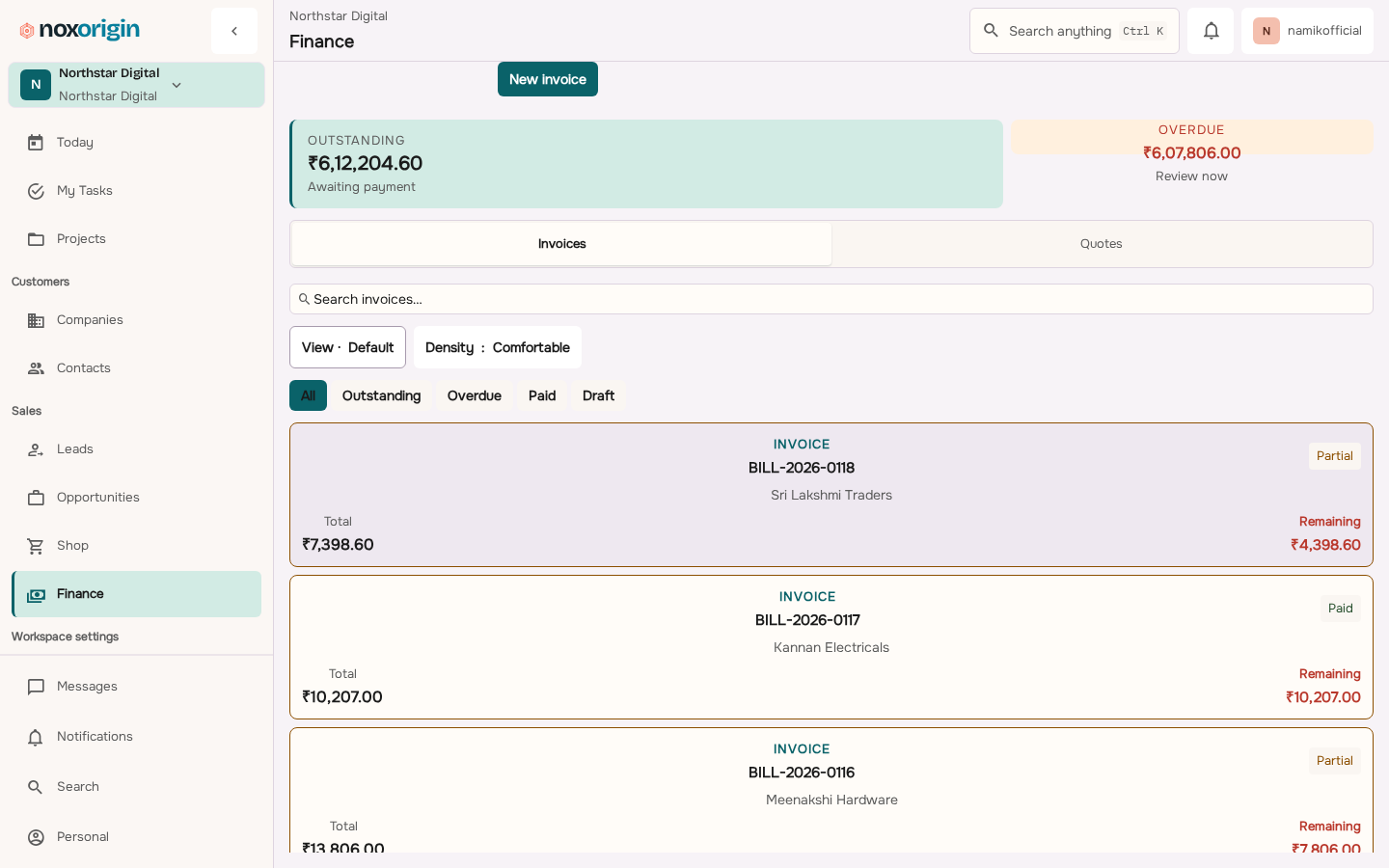
Invoices, quotes, outstanding value, and payment state in the same workspace. Paid is never a stored flag — it is a projection of what has been allocated, so an unallocated credit stays visible instead of quietly settling an invoice.
Where this is the wrong tool
Reconciliation software is bought by people who expect a bank feed. This one does not have one, and the rest of these limits are for the same reason: they belong to tools built for them.
It does not connect to your bank, and never will quietly pretend to
No bank feed, no statement reader, no account aggregator, no scheduled fetch, and no bank credentials are held or requested. A person brings the settlement figure in and records it. This is a real limit, and it is the reason the page above is about the difference rather than about matching lines automatically.
It is not a statutory reconciliation or a period close
No general ledger, no trial balance, no closing entry, no reconciliation prepared to an accounting standard, and no filing. Your chartered accountant owns the statutory position and the tax treatment; a reconciliation produced here is an operational read of your own records.
It is not gateway, chargeback, or settlement-file matching
Provider settlement files, chargeback handling, and payout reconciliation belong to your payment provider. What is useful to you is the counter total and the variance, and the difference between the two is a timing and refund question worked out with the provider’s own figures.
Duplicate money is flagged, never merged by itself
Detection proposes candidates and a person decides which is which. A cashier double-tapping, a retried request, and a genuine second payment of the same amount look identical in the data, and only a person can tell them apart.
Nobody counts the drawer for you
The system computes what should be there; a person counts what is. Shift close and day-end reconciliation are assisted-setup maturity rather than a self-serve switch — the shift boundary, the cut-off, and the variance convention get set up and validated against your actual counter, because a convention that does not match the room produces a variance every night and gets ignored by the second week.
It does not file GST returns or any statutory return
Invoices carry a tax breakup and the rate and place of supply are configured for your business rather than assumed. But NoxOrigin prepares invoices and reports and files nothing. Take the compliance question to your chartered accountant rather than inferring an answer from a tax line on a bill.
Run it on the plan that matches your counter count
Growth is ₹1,600/month or ₹15,000/year, includes a 30-day trial, 10 users, 50 active projects, and 10,000 contacts. These are NoxOrigin platform plans; NoxCRM, Nox-Billings, and Nox-Tickets are scoped custom deployments and are quoted separately.
Cash and bank reconciliation questions
Does NoxOrigin connect to my bank?
No, and this is the most important thing on the page. NoxOrigin does not connect to any bank, does not read statements, and holds no bank credentials. There is no account aggregator, no statement importer, and no scheduled feed. The settlement figure is brought in by a person, which is exactly why the rest of this page is about making the difference findable rather than about automating a fetch we do not do.
What is cash and bank reconciliation software actually for?
For turning three numbers that all get called ‘the cash’ into one comparison. The drawer holds what was counted. The ledger holds what the system says was received. The bank holds what actually cleared. Reconciliation is the work of naming why they disagree, and separating the reasons that resolve themselves from the one that needs a person to decide.
Why do the three numbers disagree for ordinary reasons?
Change float is in the drawer but was never the bank’s money. A deposit in transit is in the ledger and not yet in the bank. Value dating means a cheque or a settlement can carry a date different from the day the business recorded it. A provider settlement can differ from the counter total because a refund fell after the cut-off. Every one of these has a known explanation and closes on its own.
What is the difference that never closes?
The one with no record behind it — a credit that arrives with no reference, so the ledger has nothing to allocate it to and no rule explains it away. Float, transit, and value date all have arithmetic. A ₹25,000 transfer nobody can attribute does not, and it does not resolve on its own: it closes when a person identifies whose money it was, or it is written off at month end by somebody who stops looking.
Is an invoice marked paid once the money lands?
There is no stored ‘paid’ field. An invoice and a payment are different records, and paid is a projection of what has been allocated against the invoice rather than a fact written on the invoice itself. A payment that arrives but is never allocated therefore does not quietly settle anything — it stays visible as an unallocated credit, which is the most useful thing it can do.
Does this replace my accountant’s bank reconciliation?
No. There is no ledger, no trial balance, no period close, and no statutory filing here, and NoxOrigin files no return of any kind. What it produces is the operational read: expected cash, counted cash, the variance, and a dated line for each difference. A chartered accountant owns the statutory reconciliation and any question about the tax treatment of what you recorded.
Find the difference that has been sitting there for months.
Bring your last month of day-end sheets and one unexplained amount. We will show you the comparison NoxOrigin can produce without a bank connection — and be direct about the part it cannot.