Client management software where the client record is also the delivery and billing history.
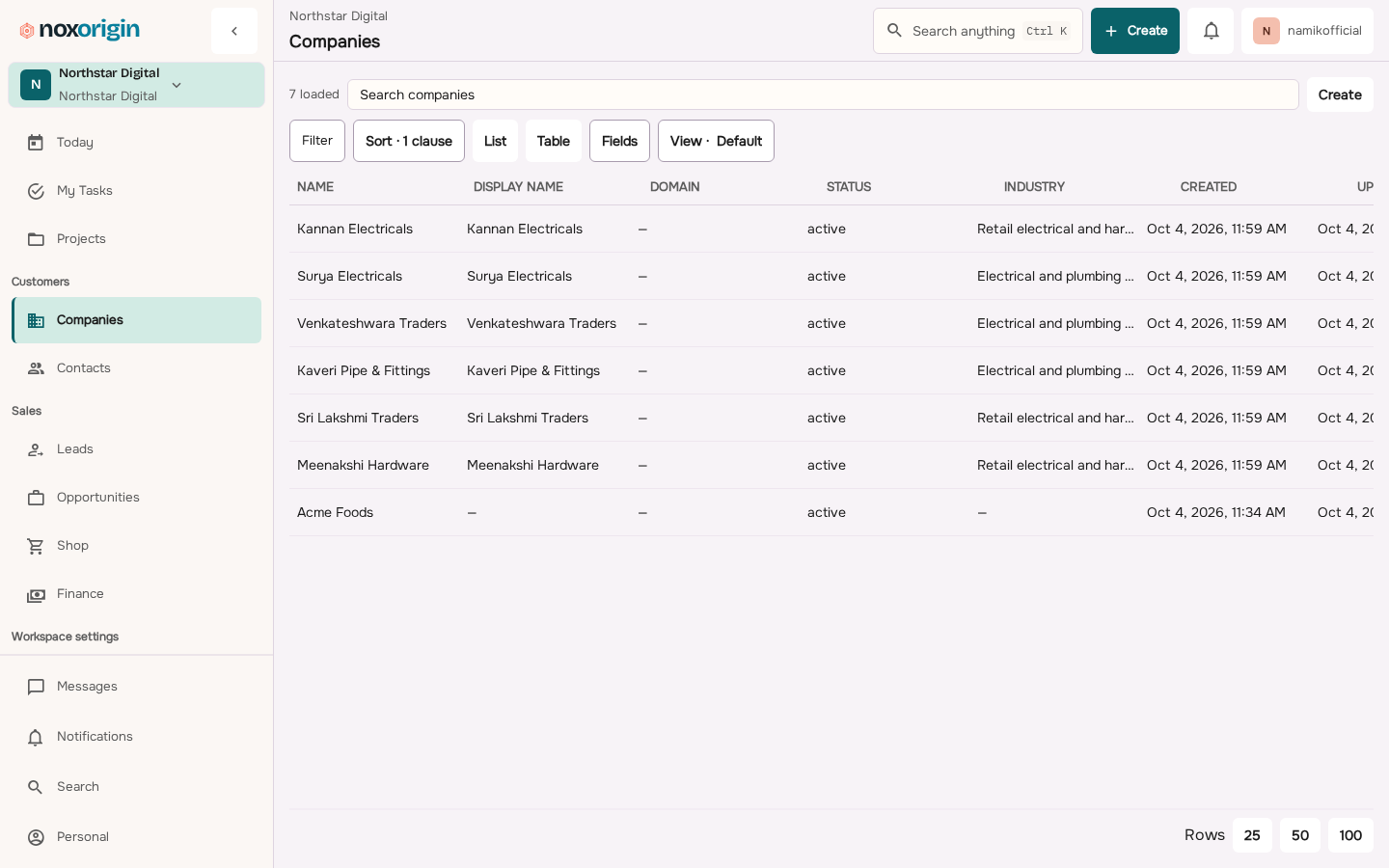
NoxOrigin keeps the agency relationship on one record — contacts, ownership, stages, conversation history, custom fields, projects, quotes, invoices, and the four money states — so nobody has to re-key a client into three different tools.
What it actually replaces
For most agencies the trigger is not a missing feature. It is that the same client exists in four places and only one of them is current.
The shared-lead spreadsheet
One row per company with notes in a free-text column, no ownership rules, and a version that changes every Monday. Contacts, stages, and next actions belong in records with a history.
A channel full of context
Chats answer "what did we say" for about a month. Past that, the decision is whatever the most recent person remembers, and clients notice the inconsistency.
A separate contacts tool
A contact list that is not attached to the company, the opportunity, or the invoice produces duplicate contacts, stale numbers, and no way to see who the client actually is.
The monthly account review deck
Exporting data to build a status report once a month is a sign the client-level view does not exist in the operating system where the work happens.
The client record, in the order it gets used
Six steps an account manager, a delivery lead, and the founder can all describe the same way.
Client record created once
A prospect becomes a company record with its own contacts, owner, source, and stage, so the relationship outlives the enquiry that started it.
Opportunity holds the deal
What is being sold, its expected value, its stage, and its next action live on the record rather than in a proposal attachment that nobody updates.
Conversations stay with the client
Shared customer conversations keep internal comments, mentions, templates, and saved replies attached to the record, so a new account manager can read the history instead of asking for a recap.
Delivery attaches to the same client
Projects, task lists, assignments, and recurring follow-ups open from the client or the won opportunity, carrying the scope with them.
Money is visible on the client
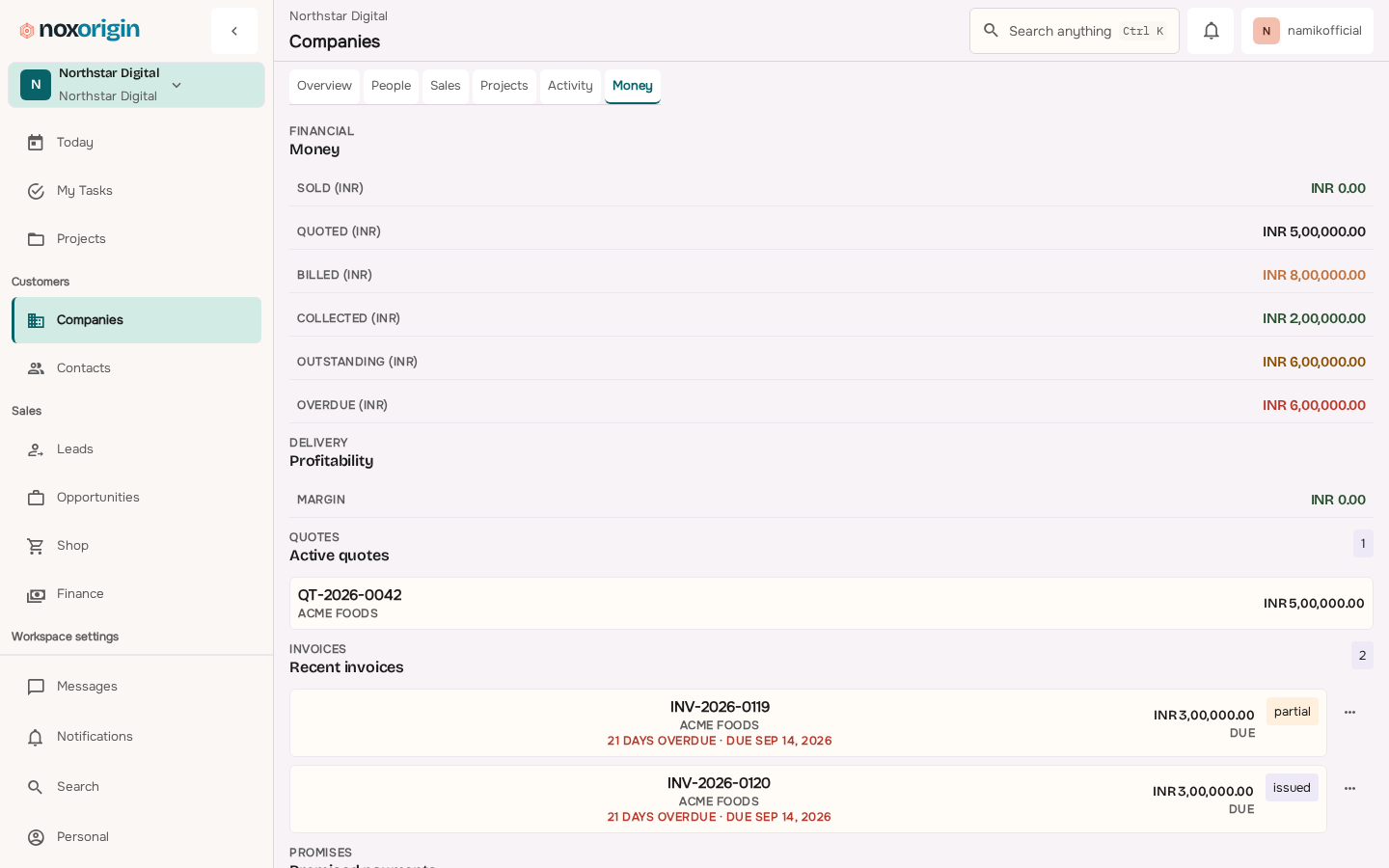
Sold, quoted, billed, collected, and outstanding value read off the client record, so an account review is a conversation about numbers that are already there.
Renewal and retention get owners
Recurring follow-ups, payment promises, and overdue items surface in Today with a named person attached rather than as a general worry.
Client money, on the same screen as the relationship
An account review stops being a data request when quoted, billed, collected, and outstanding are already attached to the client.
Where client management is the wrong purchase
Four cases where a different tool serves the business better than a connected client record.
A marketing automation or email-sending platform
NoxOrigin stores customer conversations and records follow-up. Bulk campaign sending, deliverability tooling, and lead scoring are outside the current platform areas.
A support desk
Ticket queues, SLA handling, and agent-facing knowledge bases are a different product category. There is no built-in ticketing desk inside NoxOrigin.
A contact database you never sell to
The record exists to run client work. If the requirement is enrichment, data appending, or list buying, this is the wrong tool.
A directory of contacts with no delivery behind it
Client records earn their keep when projects and invoices attach to them. For a pure rolodex with no client work, this is more structure than you need.
Cost and plan limits
Starter is ₹800/month with 3 users, 10 active projects, and 1,000 contacts. Growth and Agency, the 30-day Growth trial, and the add-ons for extra users and workspaces are listed in full on the pricing page.
Client management software questions
Is client management software just a CRM with a different name?
The client record is the CRM part, but in an agency the useful part is what else hangs off it. Quotes, projects, invoices, payments, and the four money states attach to the same client. A plain CRM stops at the relationship; here the relationship is also the billing history and the delivery history.
What does the client record hold?
Company details, contacts, ownership, pipeline stages, next actions, activity history, custom fields for the things your agency actually tracks, and saved views for recurring questions. Attachments to the same client include shared customer conversations, projects, quotes, invoices, and payments.
Can we store our own fields, such as sector, contract type, or account tier?
Yes. Custom fields and saved views are included from the Starter plan onwards, so you can record the attributes your own account review depends on without asking for a development change.
Can different account managers see only their own clients?
Roles, teams, and workspace-scoped permissions are part of the platform layer, so a role can be limited to the records the person is responsible for. Views can be scoped too, so each account manager opens the day on their own portfolio.
How much does it cost?
Starter is ₹800 per month for 3 users, 1 workspace, 10 active projects, and 1,000 contacts. Growth is ₹1,600 per month with a 30-day trial, 10 users, 50 active projects, and 10,000 contacts. Agency is ₹5,000 per month with 25 users, 3 workspaces, and 50,000 contacts.
Give every client one record instead of four partial ones.
We will map your current client record across tools and show what connects, what duplicates, and what has no owner.