Sales to project hand-off software that carries the commercial context into delivery.
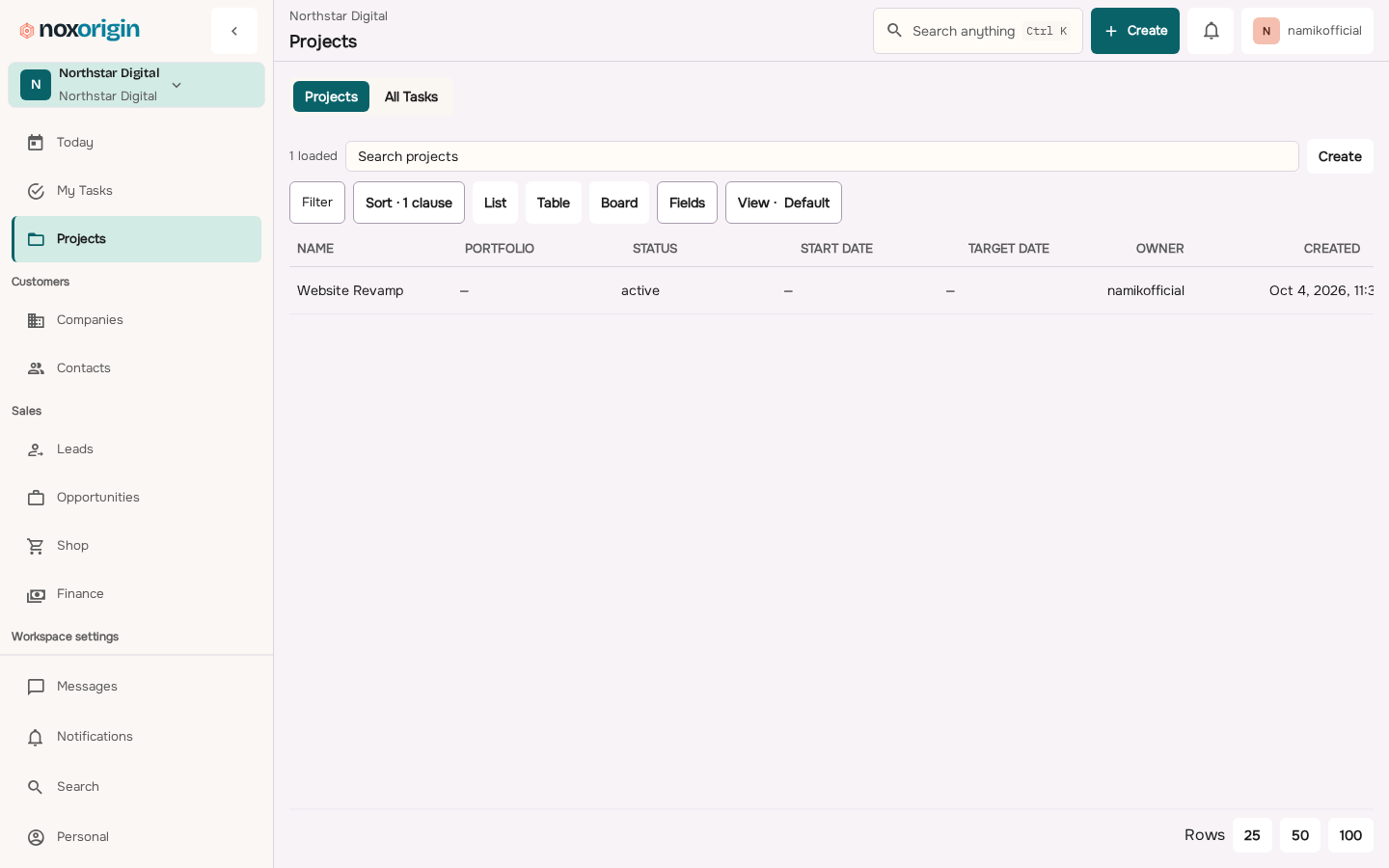
NoxOrigin turns a won opportunity into a project that already knows its client, its contacts, and its scope — with task lists, single-owner assignments, due dates, and recurring follow-ups feeding the same record that later produces the invoice.
The four symptoms of a broken hand-off
If any of these are normal on your team, the hand-off — not the delivery team — is the thing to fix first.
The brief arrives as a forwarded email
Delivery starts from whatever the account manager remembered to attach, which is rarely the full set of promises made during the sale.
The quote gets typed twice
The proposal goes out as a PDF, then the same numbers are entered again into a billing system that has no relationship to the opportunity.
Mid-project handover is a rebuild
When the person running delivery leaves, the remaining team has open work with no assignment history, so the first two weeks go on reconstruction instead of delivery.
Scope creep is never re-estimated
Extra work is agreed verbally, delivered anyway, and never re-quoted, so the project stops being the project that was priced.
The hand-off, step by step
This is the sequence a service team can adopt without changing how it sells, and the part a sales manager and a delivery lead can both be held to.
The deal is won on the record
The opportunity carries the client, the contacts, the scope, the value, and the next action, so the information delivery needs already exists before anyone is told the work is won.
The project opens from that record
Status, dates, and members are set on the project at creation. The scope is inherited rather than retold, so the kick-off call is about the work instead of about reconstructing the deal.
Scope becomes a task list with a sequence
Task lists carry priorities and an order. Board or list is a preference of how people think; the underlying records are identical either way, so nobody is locked into a view that does not suit them.
Each task gets one owner and a date
Assignments and due dates turn a commitment into something the rest of the business can see. Open-ended tasks with no date are where slippage hides, so this is worth pushing on at onboarding.
Repeating commitments become records
Client check-ins, renewals, and post-delivery calls are modelled as recurring follow-ups, dated and assigned, instead of as calendar notes that disappear when the person who set them is on leave.
Status is read back from the tasks
"Where are we on this project" is answered from what is actually done rather than from the most optimistic person in the room, and finished work reaches billing without a second person re-deriving it.
The work arrives in a queue, not in a channel
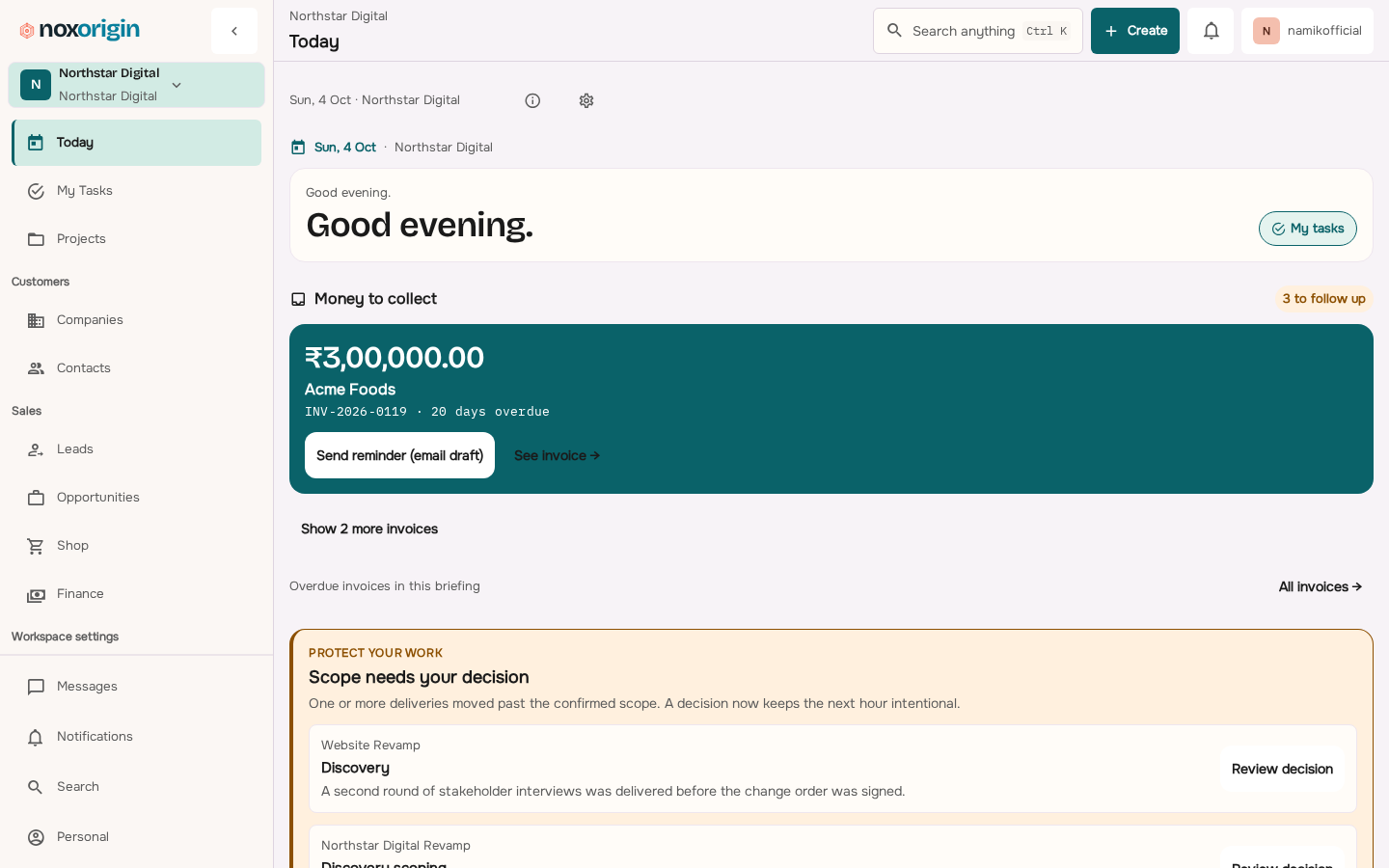
Today assembles attention items, assigned work, and overdue or due-soon work from records that already exist, so the new-hire problem becomes a matter of reading a list rather than of remembering the business.
When this is not the right fix
Some hand-off problems are process problems, and no tool fixes them on its own.
A team that only needs a kanban board
A board with cards and no commercial record is cheaper to run in a simple task tool. The hand-off is only valuable when the client, scope, and money are attached.
Software and engineering backlog planning
There is no sprint, backlog, or release-planning model here. Delivery is modelled as client projects, task lists, and assignments.
Resource capacity and timesheets
Assignment visibility is not time capture. If the requirement is billable hours, utilisation, or capacity planning, that is a different category of product.
A change to a deal already in flight
The handoff is designed for work that has been won. Reworking a live proposal mid-negotiation is a sales process problem, and better handled inside the CRM stage definitions first.
Plan limits that matter for delivery
Growth is ₹1,600/month or ₹15,000/year with a 30-day trial, 10 users, 50 active projects, and multiple sales processes. Agency raises this to 25 users and 250 active projects across 3 workspaces.
Hand-off software questions
What actually breaks in a sales-to-project hand-off?
The commercial context, not the work. The scope, the promises made in the proposal, the client contacts, the agreed dates, and the price all live with the person who sold it. Delivery restarts from a brief, a kick-off call, and a task list rebuilt from memory — and the quote is re-keyed into a billing system that has never seen the opportunity.
Does NoxOrigin create the project from the won deal?
Yes. A won opportunity, or a standing client with recurring work, becomes a project with its own status, dates, and members, carrying the client, the contacts, and the agreed scope with it. A project can also be created directly from an existing customer record for work that was not sold as a new opportunity.
How do I stop the delivery team from being ambushed by unassigned work?
Every task carries one assignee and, where it matters, a due date, and those assignments surface in the Today queue as assigned, overdue, and due-soon work. Shared ownership feels fair and hides slippage, because a task assigned to a team is a task nobody is personally behind.
Can the hand-off be partly automated?
Not in NoxOrigin, and it would be dishonest to imply otherwise here. There is no rule engine: no state change causes work to appear, nothing is scheduled, and no automated rule reviews itself afterwards. The hand-off is a person reading the Today queue, creating the project and the first task with dates on them, and the audit record shows who moved what. If the hand-off is large enough that you want the mechanical step removed rather than staffed, that is a rule engine requirement — and you should evaluate a product whose engine has shipped instead of buying this one for it.
What does it cost?
Starter is ₹800 per month with 3 users, 10 active projects, and 1,000 contacts. Growth is ₹1,600 per month with a 30-day trial, 10 users, 50 active projects, 10,000 contacts, and Razorpay payment links. Agency is ₹5,000 per month with 25 users, 3 workspaces, and 250 active projects.
Make the hand-off a record instead of a briefing call.
We will trace one recent project from won deal to invoice and show exactly where the context was lost.