Complaint and warranty software that asks the only question that matters: has this work been invoiced yet?
A complaint is a thing that went wrong and needs a person. A warranty claim is a promise made by somebody else, and it may cost you nothing or everything. But the decision that actually changes your books is not complaint versus claim — it is whether the faulted work sits on an invoice that already exists. If it does, it is a credit. If it does not, it is a change to the scope, and the only mechanism for that is a new quote.
Three different things arrive wearing the same complaint
The customer’s message is the same in all three cases. What differs is what it costs, who decides, and which document — if any — can carry the outcome.
The complaint: something went wrong and a person must fix it
Nobody is claiming money back, and nothing in the ledger should change. It is a ticket with a name against it and a clock running. The cost is the technician’s time and the goodwill, and the record that matters is who dealt with it and what was said — not a financial adjustment.
The warranty claim: somebody else’s promise, at an unknown price
A manufacturer or supplier agrees to cover a part. Whether that is free depends on their answer, and their answer arrives after you have already sent a technician. If they honour it, nothing in NoxOrigin changes and there is no figure to record. If they decline, it becomes real money — and which kind of real money depends entirely on the next section.
The fault on work you already invoiced: it is a credit
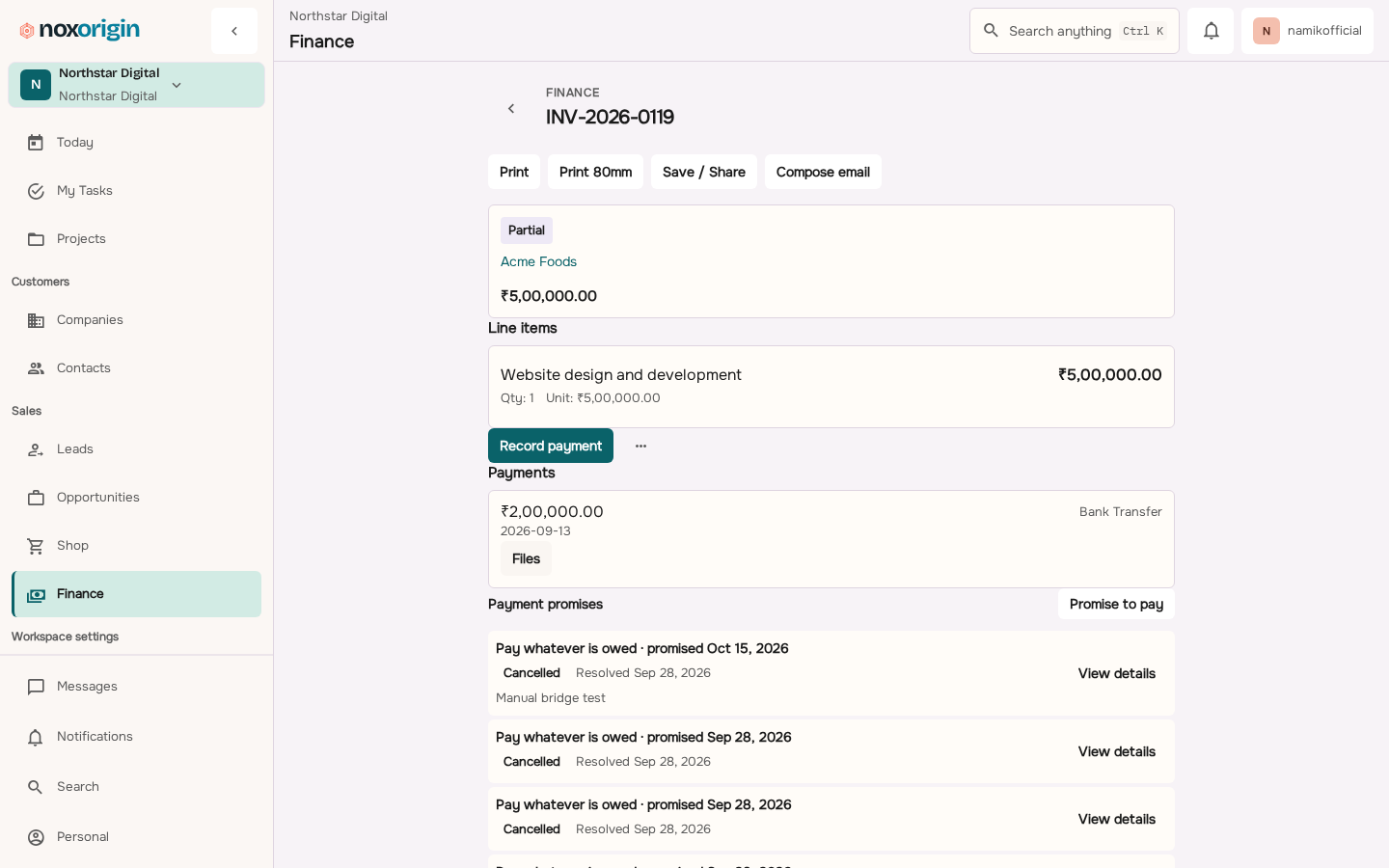
An invoice exists, so a credit note has something to attach to. The credit reduces what the customer owes and is not money received — a credit and a payment are different records pointing in opposite directions, and reversing one does not reverse the other. Recording the concession as a payment instead of a credit produces the same net position and a false document.
The fault on work you have not invoiced yet: it is a scope change
There is no invoice, so there is nothing to credit. The faulted work is not invoiced either — it is removed from what you are going to deliver, and a new quote goes out on the same project for the reduced remainder. This is the whole spine of the page: the same fault, the same customer, the same goodwill, and two completely different documents depending on a date.
The complaint that is neither
Sometimes a fault costs money, sometimes it costs goodwill, and sometimes the customer simply wants somebody to say it will not happen again. Only the first of those produces a document, and deciding in advance which kind you are dealing with is cheaper than working it out while the customer is on the phone.
A routine that ends in a document, or in nothing at all
Six steps. Step three is the fork, and steps four and five are the two halves people collapse into one because they look like the same conversation.
Separate the three things on the day they arrive
A complaint that needs a person, a warranty claim that is somebody else's promise, and a fault on work that is already invoiced are three different records with three different owners. Filing all three as the same kind of complaint is how a credit note gets raised against an invoice that does not exist yet.
Give the complaint a person and a clock, not a ledger entry
The ticket carries the human being and the ageing. The ledger stays clean, which is the whole reason the customer statement can be trusted later. Nothing you type into a complaint should change what the customer owes.
Find out whether the faulted work is on an invoice that already exists
This one question decides everything downstream. Invoiced work can be credited against a document you can point at. Un-invoiced work cannot, and pretending otherwise produces a credit note against nothing and a scope you have already billed for.
If it is invoiced: raise the credit note, and decide who pays separately
The credit note is your concession. The manufacturer reclaim, the supplier replacement, and the goodwill visit are separate decisions with separate money, and none of them is implied by the credit. Deciding them in one step is how a concession turns into an assumption that the supplier will pay.
If it is not invoiced: quote the reduced scope on the same project
One new quote for what you will actually deliver, accepted on the record, then invoice from it. The old quote is not edited and does not quietly lose a line — it stays as the thing that was originally agreed, which is what makes the reduction defensible when the customer asks.
Write the outcome down on the customer
What was the fault, what document settled it, and who was told. The second complaint about the same failure is the expensive one, and the cheapest defence is a written record of the first — including the cases where the answer was that the manufacturer covers it and it cost nothing.
One job, one fault, two different documents
Every figure below is constructed for this page. It is arithmetic you can check by hand, not a NoxOrigin result and not a number from a customer account — replace all of it with your own before drawing any conclusion from it.
The job, before the complaint
Quoted at ₹1,80,000. One progress invoice raised for ₹1,20,000. Payments allocated against it total ₹1,20,000, so outstanding is ₹1,20,000 − ₹1,20,000 = ₹0. Still unbilled: ₹1,80,000 − ₹1,20,000 = ₹60,000. Everything below depends on which half of that ₹1,80,000 the fault landed in.
Case one — the fault is inside the invoiced ₹1,20,000
Faulted work worth ₹45,000. A credit note for ₹45,000 reduces billed to ₹1,20,000 − ₹45,000 = ₹75,000. Allocations are untouched at ₹1,20,000, so the derived position is ₹75,000 − ₹1,20,000 = −₹45,000: the customer is ₹45,000 in credit. Note the direction. The credit note has reduced a claim; it has not received a rupee, and cash received is still ₹1,20,000.
What happens if the concession is typed in as a payment instead
Recording the same ₹45,000 as a payment makes total received read ₹1,20,000 + ₹45,000 = ₹1,65,000 against an invoice of ₹1,20,000. The net position looks identical and the documents are opposites — a customer statement built from it would claim the customer paid more than the invoice, and the original invoice would still assert the full ₹1,20,000. A credit and a payment are different records; that is the whole reason they fire in opposite directions.
Case two — the fault is inside the unbilled ₹60,000
The same ₹45,000 fault, now inside work nobody has invoiced. There is no invoice to credit, so the faulted work is simply not part of what gets billed. A new quote goes out on the same project for the reduced remainder: ₹60,000 − ₹45,000 = ₹15,000, accepted, and invoiced as ₹15,000. Total billed for the job becomes ₹1,20,000 + ₹15,000 = ₹1,35,000 against an original quote of ₹1,80,000, a reduction of ₹1,80,000 − ₹1,35,000 = ₹45,000 — the same reduction as case one.
The same money, two different statements
Both cases reduce the job by ₹45,000 and leave ₹1,35,000 billed. One is an invoice for ₹1,20,000 plus a credit note for ₹45,000, with a negative balance on the customer. The other is two invoices totalling ₹1,35,000 with no credit note at all. The customer reads different documents, the ageing report reads different rows, and the tax treatment of the two is not necessarily the same — which is a question for your chartered accountant, not one NoxOrigin decides.
The warranty claim that costs nothing
A ₹28,000 compressor is replaced under a manufacturer warranty at no cost to anyone. Billed stays ₹1,20,000, allocated stays ₹1,20,000, outstanding stays ₹0. Nothing in the ledger moves, because nothing moved. The claim is a promise with a response date, and if the manufacturer declines it, the same ₹28,000 arrives later as a credit note if that work was invoiced or as a new quote if it was not. Do not plan the month on the assumption that the claim is free.
The complaint that never becomes money
A customer complains that the technician was rude. Before: billed ₹1,20,000, allocated ₹1,20,000, outstanding ₹0. After: ₹0, because no credit note and no new quote was raised. Nothing changed in NoxOrigin, and that is the correct behaviour — a complaint is a person being asked to fix something, and only two documents convert it into money.
Where this is the wrong tool
A complaint tool is judged by what it refuses to decide. Almost everything below can be automated into looking helpful while quietly making a commitment your business has not authorised.
A complaint is a ticket, and Nox-Tickets is a scoped custom deployment
There is no ticketing module inside a NoxOrigin platform plan, and no plan unlocks one. Nox-Tickets is available as a scoped dedicated or white-label deployment for QR validation, scanner devices, gates and event operations — quoted and priced as its own deployment, never at the platform price, and not something you can add on a Tuesday. For a complaint queue you need people, a process and a queue you already have; what this page covers is what happens to the money afterwards.
There is no change-request, milestone, or deliverable record
A scope change is a new quote on the same project. There is no change-request record, no milestone record, no deliverable list, no contract editor and no e-signature, so a reduction in scope is priced and accepted as a quote rather than tracked as an amendment. A document explaining the change, with the approval on it, is still worth writing — it is simply not something the system will hold for you.
It is not a warranty administration system
No manufacturer agreement records, no supplier claim reference numbers to chase, no parts-return workflow, no exchange tracking, and no cost-per-claim history. The claim is somebody else’s document; all you get here is the customer, the invoices, and whatever you wrote down.
Nothing merges automatically and nothing enforces entitlement
If the same customer complains under two records, detection flags the pair as candidates and a person reviews; there is no automatic merging, so a split record quietly splits the complaint history too. And there is no membership or access-control product deciding whether a customer is still covered — the warranty period is a date you compare by hand.
Paid is a projection, and this is not a tax tool
An invoice and a payment are different records; paid is derived from allocations rather than stored, which is what makes a credit note mean something precise. But NoxOrigin does not file GST returns or any other statutory return, and it does not decide how a credit note or a reduced quote should be treated. That question belongs to your chartered accountant.
Where the outcome has to live
Every complaint, claim and credit belongs to a customer, and the next complaint about the same failure is only cheap if the first one left a written trace on that record.
Run it on the plan that matches your customer count
Growth is ₹1,600/month or ₹15,000/year, includes a 30-day trial, 10 users, 50 active projects, and 10,000 contacts. The customer, the quote, the invoice and the credit are part of the workspace rather than an add-on. These are NoxOrigin platform plans — NoxCRM, Nox-Billings and Nox-Tickets remain available as scoped custom deployments, priced separately, and Nox-Tickets in particular is not included in any of them.
Customer complaint and warranty questions
What is the difference between a complaint and a warranty claim?
A complaint is a thing that went wrong and needs a person to look at it. A warranty claim is a promise somebody else made — typically a manufacturer — that may or may not cost you anything, and you do not find out which until they answer. A complaint with no money attached is the common case and the easiest to get right: it is a ticket, someone deals with it, and no figure in the ledger changes. A claim is a complaint with somebody else's decision attached to it, and it can land on either side of your invoicing.
Is a complaint a money record?
No. A complaint does not move a balance by being raised. It becomes money only when a person decides it should, and that decision produces one of exactly two documents: a credit note against an invoice that already exists, or a new quote on the same project. Until then the customer owes what they owed, and the only honest statement about the complaint is what was written down about it. Treating the ticket itself as a financial adjustment is how a customer statement ends up disagreeing with the ledger.
The fault is on work I have already invoiced. What now?
A credit note, because an invoice exists and an invoice is the only thing a credit can attach to. The credit reduces what the customer owes. It is not money received: a credit note and a payment are different records moving in opposite directions, and reversing one does not reverse the other. If the customer keeps the money and absorbs the loss, the credit is the whole adjustment; if the manufacturer pays you, that payment is a separate record arriving later.
The fault is on work I have not invoiced yet. What now?
A new quote on the same project, for the reduced scope, and an invoice raised from the quote the customer accepts. There is no invoice to credit, so a credit note has nothing to attach to, and the faulted work simply is not part of what you invoice. There is no change-request record, no milestone record, no deliverable record and no contract editor here, so the mechanism is the one the money side always uses: quote, accept, invoice.
Does NoxOrigin include complaint or ticket management?
No, and this is worth being blunt about. A complaint is a ticket, and Nox-Tickets is a scoped custom deployment — a dedicated or white-label build for QR validation, scanner devices, gates and event operations, priced separately from the platform and never bundled into a platform plan. You do not get ticketing by adding a module, and no platform plan unlocks it. For complaints about jobs, the queue is your people and your process; what NoxOrigin does is hold the customer, the quote, the invoice and the credit that the decision produces.
Can the software tell me whether this customer is still under warranty?
No. There is no membership or access-control product, no entitlement engine, and nothing that grants or withholds a customer's rights. A warranty period is a date you read off the invoice and compare against today's date by hand, and the comparison is yours to make and to write down. NoxOrigin stores the dates honestly and does not enforce the rule, because a period that is decided by a person's reading is a period that can be argued about — which is usually the point.
Find out whether the fault is already on an invoice.
Bring one recent complaint. We will walk the two paths it can take — a credit note, or a new quote on the same project — and show you which one your records actually support.