Customer payment tracking that can name who owes what, and since when.
NoxOrigin keeps the invoice and the payment as two different records, because they are two different facts. Amount, date, and method get recorded against the invoice; partial payments are tracked rather than rounded away; promises carry a date; and receivables read by client and by age. For a small business in India, that is the difference between knowing money is out there and knowing which conversation to have on Monday.
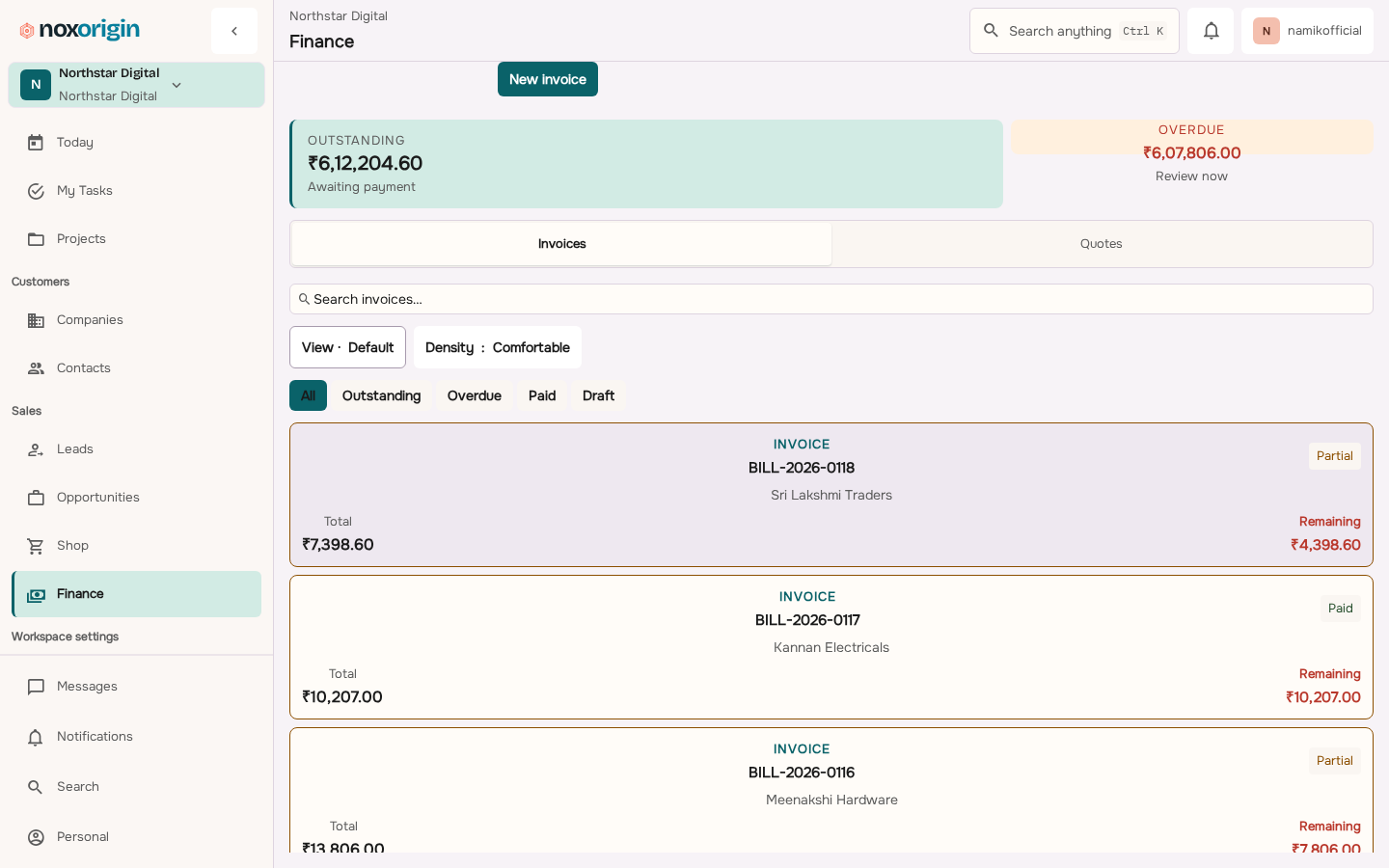
One place where what was billed and what was paid can be read together
Quotes, invoices, outstanding value and payment state beside the work that caused them.
Why money owed is hard to manage without a record
Four failures that all end the same way: a balance argued about instead of collected.
Outstanding is a total, not a list
The business knows a large amount is unpaid and has no way to order it, so the easiest invoices to chase are chased and the hardest are forgotten.
Payments arrive and go missing
A bank transfer arrives without a reference, gets posted to nobody, and is discovered at month end as a difference that everyone is confident is not their fault.
The same client has three spreadsheets
A billing sheet, a collection sheet, and a delivery sheet disagree, and the argument about a balance is settled by whoever kept the more complete file.
Cheerful clients look profitable
Revenue is read without the cost of serving that client, so the relationship that consumes the most time and attention is the one that looks best.
From invoice to collected, in six steps
The sequence a small business can adopt without a collections department.
Bill against the work that caused it
An invoice raised from the delivery or the quote, with tax treatment applied once at the point of billing, so the amount being collected is the amount that was agreed.
Record the payment as its own fact
Amount, date, and method recorded against the invoice — including a partial payment — so the balance is derived rather than estimated.
Read the outstanding list by client and age
Receivables sorted by relationship and by how long, which turns ‘we have money out there’ into a list somebody can work through in a specific order.
Name an owner for collection
A promise, a date, and a person. A shared outstanding list without an owner becomes a shared outstanding list nobody works, and that is the real cause of slow collection.
Send a payment link for the clients who want one
Razorpay payment links on Growth and Agency let a customer pay against a specific invoice from wherever they are, without a bank-transfer screenshot to interpret.
Judge the relationship, not just the ledger
Client money and project economics read the same records, so a client who is profitable and a client who is expensive to serve can be compared rather than guessed.
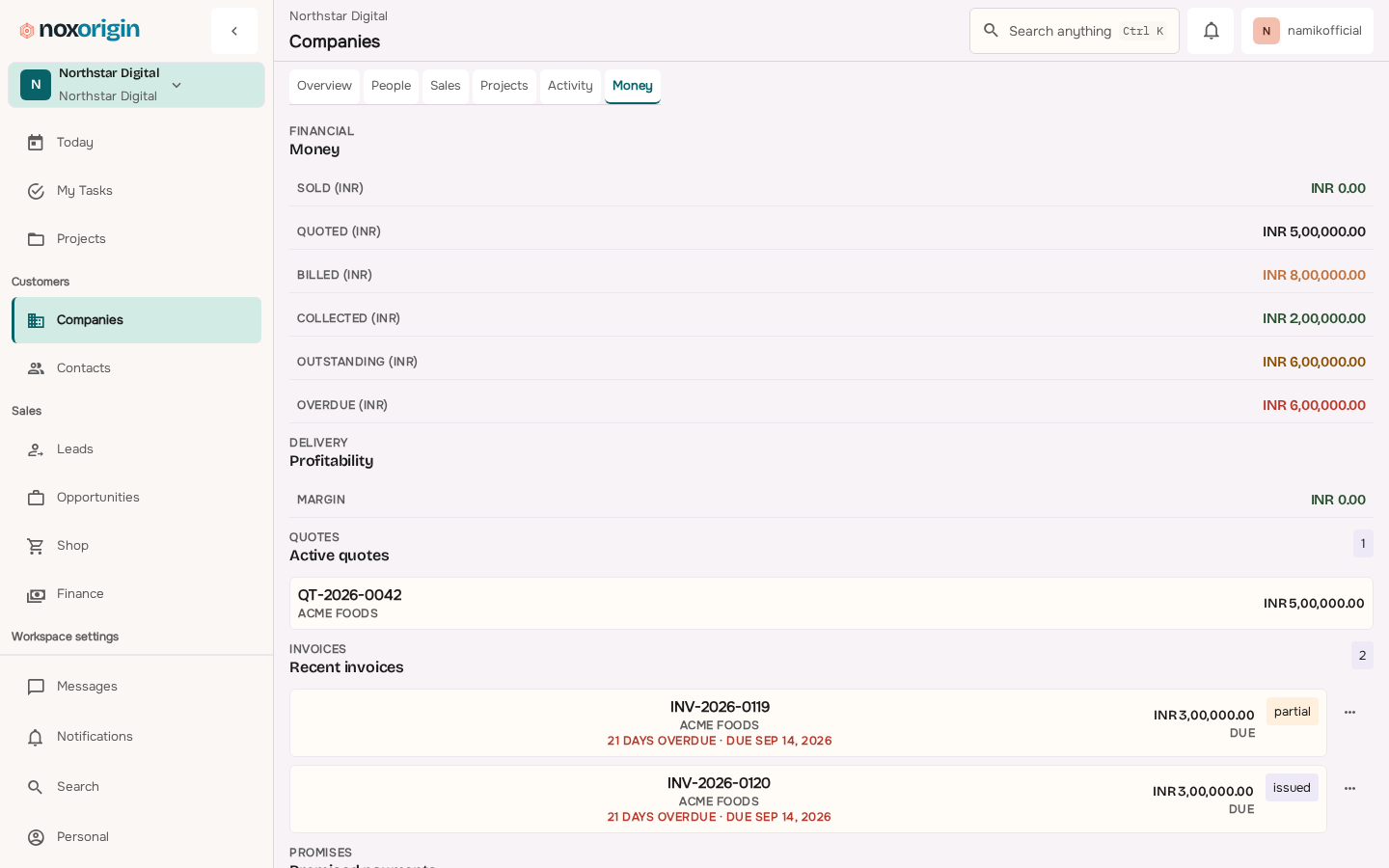
Read it per relationship, not just in total
Sold, quoted, billed, collected and outstanding — read off the customer record itself.
Where payment tracking software is the wrong buy
Described plainly, because a collections problem dressed up as a software problem is the expensive kind.
A collections agency or dunning service
No scheduled dunning sequences, no recovery-fee model, no legal escalation, no credit bureau data. A system of record that holds promises is not a system that enforces them.
A statutory receivables and accounting ledger
No ledger, no trial balance, no ageing computed under a specific accounting standard, no period close. The ageing here is an operational read of your invoices, not a filing.
A payment gateway or settlement reconciliation
Recording a payment is a deliberate act against a known invoice. Bank-statement matching, gateway settlement files, and chargeback handling belong to your gateway and your accounting package.
Loan, EMI, or BNPL product management
No lending products, no repayment schedules, no credit decisions, no collections regulation. This tracks money owed to you for work you delivered.
Start on Growth if you invoice regularly
Growth is ₹1,600/month or ₹15,000/year with a 30-day trial and 10 users, and it is the plan that includes Razorpay payment links against an invoice — which matters more in India than it does almost anywhere else, because it turns a bank transfer into a payment somebody recorded.
Payment tracking questions
Why is the payment a separate record from the invoice?
Because the amount received, the date it arrived, and the method it came by are facts the invoice does not contain. An invoice is a request; a payment is an event that can be partial, late, split, or received for an invoice that was raised months ago. Keeping them as one record is how an outstanding balance quietly becomes wrong and stays wrong.
What can I actually see about what I am owed?
Receivables read by client and by age, so the question changes from ‘how much is outstanding’ — which is a total nobody can act on — to ‘who owes what, and since when’. Client money reads the same records per relationship, which is what makes a profitability conversation with a difficult client possible instead of theoretical.
Can a client pay in instalments?
Yes. Partial payments are recorded against the invoice and the balance is tracked rather than being rounded away, and a payment promise can be recorded with a date so the follow-up has something to point at. On the Growth and Agency plans, Razorpay payment links can be sent against an invoice, which suits Indian customers who prefer to pay on their own schedule.
Does it chase customers for me?
It gives collection an owner and a list, which is the part that usually fails. It is not a collections agency, it does not send dunning on a schedule, it does not charge a recovery fee, and it does not escalate to legal. If the problem is a client who does not answer anyone, the answer is a different kind of business process — we will not pretend a screen fixes it.
Who can see the money?
Recording a payment is its own permission, separate from raising an invoice, and both are separate from reading commercial reporting. An admin who maintains customers and catalogs does not need to hold the permission that records cash, and the audit log records sensitive actions so the question of who recorded what has an answer.
What does it cost?
Starter is ₹800 per month and Growth is ₹1,600 per month with a 30-day trial — Growth is the plan that includes payment links, so it is the usual starting point for a business that invoices regularly. Agency is ₹5,000 per month for groups running several workspaces. Current limits and inclusions are on the pricing page.
Getting to the money, and chasing it
Ask who owes what. Then ask since when.
Bring the client who worries you most. We will show you how NoxOrigin turns that anxiety into a named invoice, a recorded promise, and a dated follow-up.