Quotation to order software that makes the revision a record instead of a conversation.
A quotation is a list of items and quantities, and that list has to be precise at exactly the moment it is still negotiable. When the list lives in a spreadsheet, revising it means redoing it — so the revision happens on a call, and the verbal version is what gets invoiced. NoxOrigin holds the quote, the revision, and the order as separate records on the same project, deliberately not as one number that was quietly edited.
Where the quote stops matching the work
A quotation is cheap to be precise about and expensive to be vague about. These are the three places the list gets separated from the work, in the order it usually happens.
The revision happens verbally
Once a quote has gone out as a spreadsheet or a PDF, changing one quantity means redoing the file, re-exporting it, and sending it again. So the change is agreed on a call instead — and from that moment the document on file and the work being done are describing different things.
The order is retyped
When the accepted quote becomes an order, the items, quantities, and rates are typed into an invoice or a job card for the third time. Each retyping is an opportunity for a quantity to arrive as a different number, and nothing flags it because all three copies are internally consistent.
Nobody compares agreed against billed
If the agreed version is a file and the billed version is an invoice, finding unbilled scope means reading both documents side by side. When they are separate documents rather than one record, the gap between them is not a number anybody looks at — it is a feeling that a job did not go to plan.
The tax treatment is settled last
Item classification, rate, and place of supply get decided while the invoice is being raised, which is the most expensive moment to discover that the quote should have said something else. That is a question for your chartered accountant; the record only has to carry what they tell you.
A quote lifecycle somebody else could follow
Six steps, each one a record rather than a status somebody remembers updating. The revision step is the one that decides whether the rest is worth anything.
Price the work as line items
Items, quantities, rates, and tax treatment sit on the client and project the work belongs to, because a quotation is a list and the list has to be the record.
Issue the quote as a numbered version
A number, a date, a validity period, and a total — held on the project rather than in an inbox, so the version that was sent is still readable later.
Build the order from the quote
The accepted quote is what the order and the delivery are built from, so the quantities delivery is measured against are the quantities that were priced.
Raise a change as a new quote on the same project
An extra page, a different quantity, a line that was missed: each becomes its own quote with its own total against the same project. Nothing already agreed is overwritten.
Invoice from what was accepted
The invoice carries the line items and tax treatment forward and is a document in its own right — not the quote with the header changed.
Read quoted against billed on the project
Every quote on the project sums to what was agreed, so the difference between agreed value and invoiced value is a number on the project rather than a suspicion at month end.
A revision, priced twice
Every figure below is constructed for this page. It is arithmetic you can check by hand, not a NoxOrigin result and not a number from a customer account — replace all of it with your own before reading anything into it.
Q-1, the quote as accepted
Landing page build: 1 × ₹45,000 = ₹45,000. Content pages: 6 × ₹6,000 = ₹36,000. Taxable value ₹45,000 + ₹36,000 = ₹81,000. Tax at 18% of ₹81,000 = ₹14,580. Quote total ₹81,000 + ₹14,580 = ₹95,580.
R-1, the change, as a new quote on the same project
Content pages become 10 × ₹6,000 = ₹60,000. One added line, analytics setup: 1 × ₹15,000 = ₹15,000. Taxable value ₹45,000 + ₹60,000 + ₹15,000 = ₹1,20,000. Tax at 18% of ₹1,20,000 = ₹21,600. Quote total ₹1,20,000 + ₹21,600 = ₹1,41,600.
What the change cost
Taxable change ₹60,000 + ₹15,000 − ₹36,000 = ₹39,000. Tax on that change ₹39,000 × 18% = ₹7,020. Total change ₹39,000 + ₹7,020 = ₹46,020. The same figure from the other direction: ₹1,41,600 − ₹95,580 = ₹46,020.
What the verbal version looks like later
If the invoiced work follows the call and the recorded quote stays at Q-1, invoiced ₹1,41,600 against quoted ₹95,580 leaves ₹46,020 unexplained — which reads as unbilled scope or a billing dispute rather than an agreed revision. Raised as two quotes and invoiced as two invoices, ₹95,580 + ₹46,020 = ₹1,41,600 and the gap is zero, because the change was priced before anybody delivered it.
About the 18%
The rate is a number chosen so the arithmetic above can be checked by hand. What rate applies to your supply, and what belongs on a given invoice, is a question for your chartered accountant. NoxOrigin carries the treatment you enter and files nothing.
Where this is the wrong tool
The honest limits of a quotation lifecycle. Some of these are things a contract tool does better, and one of them is a gap in this product you should plan around.
It is not a contract or signature tool
There is no contract editor, no e-signature, and no acceptance workflow. A quote becomes an order because somebody accepted it, and if your counterparty needs a signed document with a legal effect, that belongs in the document and signature tooling built for it.
It does not record time, so it cannot price it either
There is no timesheet record and no payroll module. A time-and-materials quote is priced by the hours and rates you enter, and those hours have to come from somewhere else — NoxOrigin will not invent a cost side it never measured. Expense tracking is in Nox-Billings as a scoped custom deployment, and purchasing is in Commerce.
It does not cost your work for you
A margin on a quote is only as good as the costs entered into it. NoxOrigin does not hold your supplier costs, your day rates, or your historical cost per item type, and it will not roll a margin up from a catalogue you have not loaded.
It does not price the job or collect the money
A quote records what you intend to charge; it says nothing about whether the work will take the time you assumed, and it does not collect anything. Recorded payments and receivables ageing belong to the invoice side of the chain, not to the quote.
The project the order actually runs on
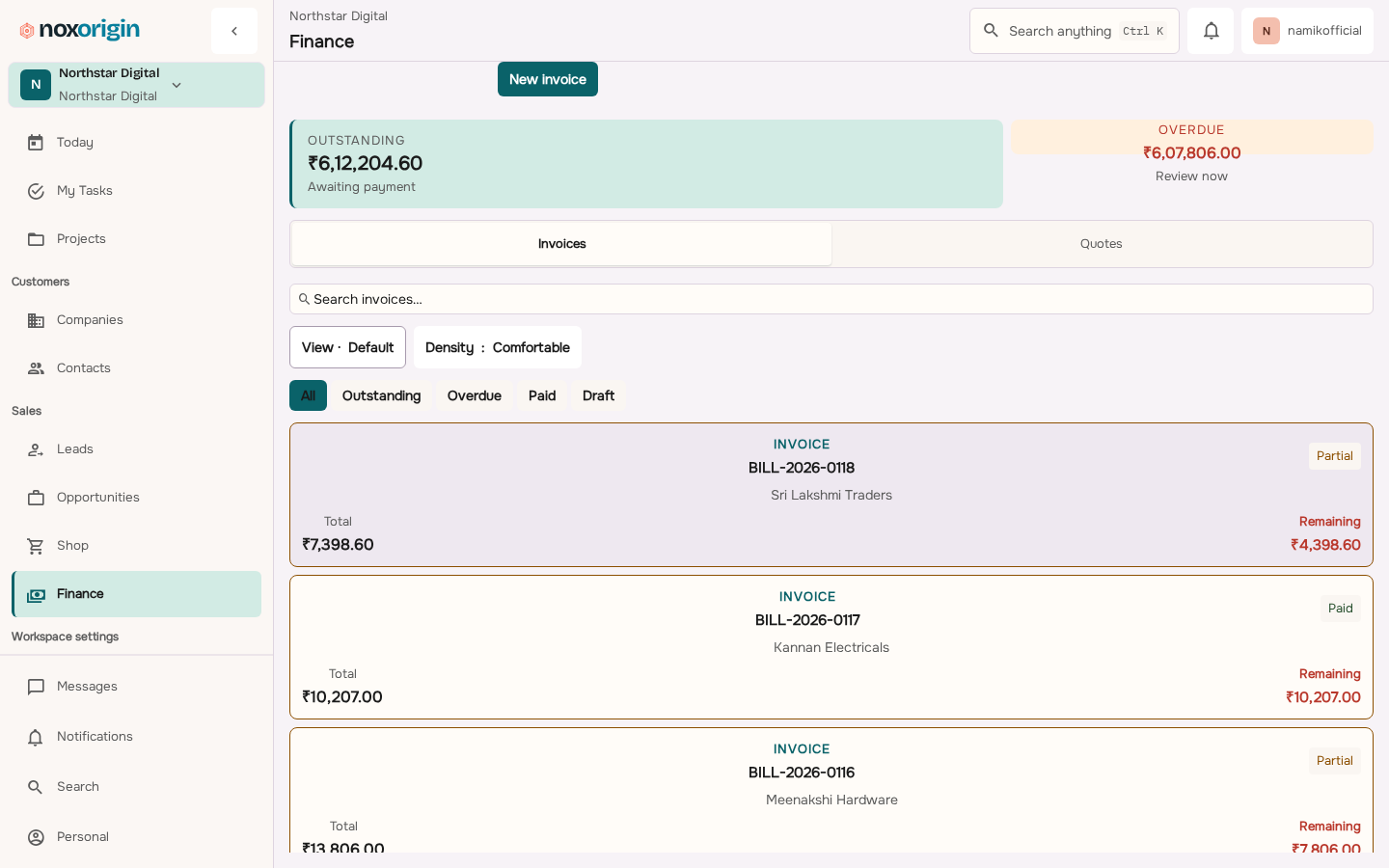
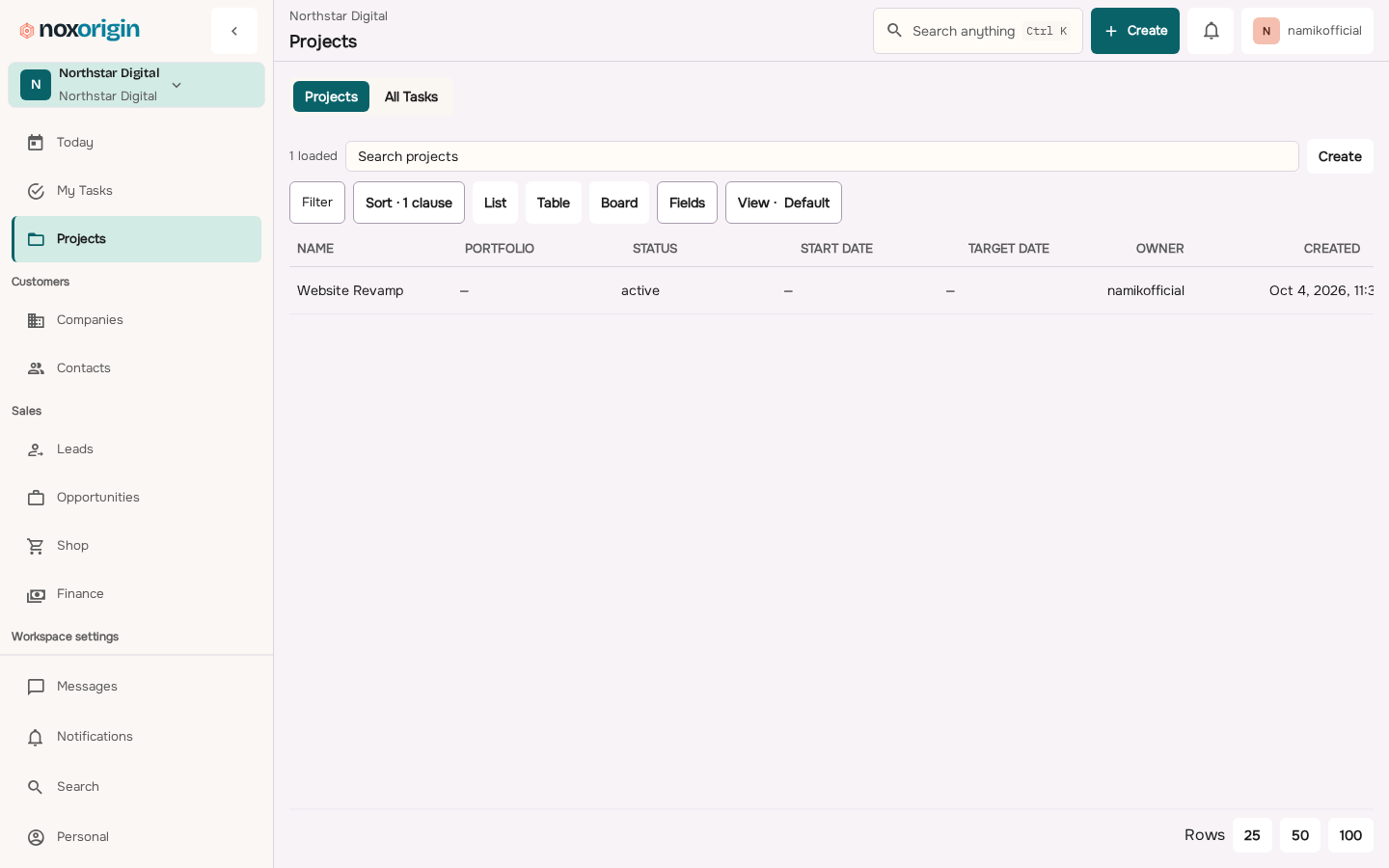
Quotes, the work they priced, and the invoices that work produced sit against the same project — so a change raised as a new quote is visible beside the delivery it affects, instead of in a mailbox from last month.
Run it on the plan that matches how much you quote
Growth is ₹1,600/month or ₹15,000/year, includes a 30-day trial, 10 users, 50 active projects, and 10,000 contacts. Quoting, revisions, and the quoted-against-billed comparison are part of the Finance area and reporting that come with the workspace, not an add-on. These are NoxOrigin platform plans — NoxCRM, Nox-Billings, and Nox-Tickets remain available as scoped custom deployments, priced separately.
Quotation to order questions
What is quotation to order software?
It is the practice of carrying a priced list of items and quantities from the first proposal, through every revision, to the order and the invoice behind it — without the list being retyped at each step. A quotation is a list of items and quantities, and NoxOrigin keeps that list as a record with a number, a date, and a total attached to the project it belongs to.
How is a change of scope handled after the quote is accepted?
A change is a new quote raised against the same project. There is no change-request record, no contract editor, no e-signature, and no separate milestone or deliverable record. The original quote stays exactly as it was agreed and the new quote carries the change with its own total, which is what makes the difference between them a figure rather than a recollection.
Can the accepted quote simply be edited instead?
Not without losing the only comparison that matters. Editing the accepted quote removes the record of what was agreed first, so afterwards you cannot say what the change cost or what was in scope on the day the client said yes. Revising by raising a new quote keeps quoted value accumulating on the project, so quoted-against-billed can still be read.
Are the quote, the invoice, and the payment the same record?
No, and they are deliberately not. A quote is a priced proposal. An invoice is a statutory document raised from the quote, carrying the line items and tax treatment forward. A payment is a third record: money received and recorded as an allocation against an invoice, with paid a projection of those allocations rather than a field that anybody sets. Collapsing the three is how a revision ends up billed without ever having been priced.
Does it tell me whether a quote is worth winning?
No. It gives you the priced list, the revisions, and the quoted-against-billed comparison. Whether to discount, whether the client will pay, and what the rate should be are commercial judgements. It also does not cost your work for you: there is no timesheet record, so a time-and-materials quote is priced by the hours and rates you enter rather than captured automatically.
Does this replace my accounting package or my chartered accountant?
No. Statutory accounting, ledgers, and filing stay with the tools built for them, and NoxOrigin does not file GST returns or any other statutory return. Where a tax rule affects what you should be charging, that question belongs to your chartered accountant. What NoxOrigin produces is the quote, the revision, the invoice, and the record of what has been allocated against it.
Make the revision a quote, not a call that changes the invoice later.
Bring the quote that went out and the invoice that eventually went in. We will show you where the two versions diverged, and what a change raised as a new quote would have looked like.