Service contract software that treats the renewal date as the only date, and the renewal as a quote.
A service contract is recurring money with no invoice per visit, so nothing in the ordinary course of business produces a reminder. The work goes out, the customer is happy, and the date on which the agreement quietly stops existing sits in one person’s memory — usually the only person who knows it. A renewal is not an automatic charge. It is a new quote on the same customer, sent on a date somebody remembered.
Why a service contract is a different shape of money
Nothing on this list is a feature request. Each item is a consequence of the same decision — no invoice per visit — and each one has to be handled somewhere other than the invoice register.
There is no invoice per visit, so nothing nags
A retail job produces a document every time work is done and the document is the reminder. A contract visit produces a document twelve times a year, at best, and often fewer. The interval between the last invoice and the end date is the whole risk, and it is invisible in every report you already run.
The renewal date is the only date that carries the money
A late invoice is a collections problem with a known owner. A missed renewal date is a year of unpriced work followed by a negotiation conducted from a weak position, because by the time it is noticed the customer has already had three months of service.
A renewal is a new quote, not an automatic charge
Nothing in NoxOrigin fires on a date. Last year’s quote is a document that was accepted then; a renewal has to be priced, sent, and accepted again. That is deliberate — pricing that moves on its own is pricing nobody agreed to.
A service history is not a timesheet
The customer asks what they used, and the honest answer requires a record of visits. There is no service-history record and no timesheet record in NoxOrigin, and no payroll module to receive the hours if you typed them in. The only visits the system can evidence are the invoiced ones.
The price you agreed last year is not a stored rate
₹10,000 per visit is something you divide out of a ₹1,20,000 quote, not a recurring price sitting in a field waiting to be applied. Next year’s number is an argument you have again, and the arithmetic below shows what happens when you do not have it.
A renewal routine that ends in a document
Six steps, and the two that get skipped are the two that cost the year: the month-before reconciliation, and the seam.
Write the contract as a quote, with the end date on a line
A quote with dated line items and a stated validity is the only version of the agreement that can be pointed at later. The per-visit figure is division on the quote, not a stored recurring rate — nothing in NoxOrigin remembers a rate to apply again next year.
Put the end date where it is not somebody's memory
A calendar entry, a task list, an alarm, a note in the customer record — whatever your team actually reads. The software is where the money lands after the conversation, not the thing that starts the conversation.
Work the month before: delivered against invoiced
Twelve visits promised, eleven invoiced. The gap is a real visit worth real money, and until it is invoiced it is not a receivable, so no ageing report will hold you to it. This is the reconciliation that makes the renewal conversation honest.
At the end date, raise a new quote on the same customer
Not an edit of last year's quote, and not a charge. A new quote keeps both years readable: what was agreed, at what rate, for how long. A quote rewritten in place destroys the only record of what the customer was ever asked to approve.
Get it accepted, then invoice from the accepted quote
Two people, two steps. Nobody accepting the quote means no invoice, which is a real answer when the customer is not renewing — and it is an answer you get for free, because the system will not do it for you.
Reconcile the seam, in writing
The delivered-but-uninvoiced visit, the credit agreed in the negotiation, the balance still unpaid. A renewal signed in the good months and forgotten in the bad ones is how a twelve-month contract quietly becomes an open-ended one at somebody else's rate.
One contract, twelve visits, and the seam nobody reconciled
Every figure below is constructed for this page. It is arithmetic you can check by hand, not a NoxOrigin result and not a number from a customer account — replace all of it with your own before drawing any conclusion from it.
The contract, as quoted
Twelve monthly visits at ₹1,20,000 for the year. The per-visit figure is division, not a stored rate: ₹1,20,000 ÷ 12 = ₹10,000. NoxOrigin does not retain ₹10,000 as a recurring price, which is why next year has to be quoted again rather than generated.
What year one actually produced
Twelve visits delivered, eleven invoiced: 11 × ₹10,000 = ₹1,10,000. Payments received ₹1,00,000, allocated as 10 × ₹10,000 = ₹1,00,000 against invoices one to ten. Outstanding ₹1,10,000 − ₹1,00,000 = ₹10,000, and all of it sits on invoice eleven: ₹10,000 − ₹0 = ₹10,000. One visit is missing an invoice entirely — 12 − 11 = 1 visit, ₹10,000 — and no ageing report can show it, because a receivable is an invoice and there is not one.
Why marking invoice eleven paid does not clear it
Paid is a projection of allocations, never a stored field. If invoice eleven is marked paid and no payment is allocated against it, the derived outstanding stays ₹10,000 while the screen says settled. The derived balance is the one that is true; the label is a convenience. This is the same rule the invoicing side of the business runs on, described at length in why an invoice and a payment are not the same record.
The renewal, as a new quote
Year two quoted at ₹11,000 per visit: 12 × ₹11,000 = ₹1,32,000. That is ₹1,000 more per visit, 12 × ₹1,000 = ₹12,000, and ₹12,000 ÷ ₹1,20,000 = 10% more than year one. The ₹11,000 and the 10% are inputs chosen for this example. NoxOrigin does not propose them, escalate them, or apply them to anything.
What the missed date costs
The contract ends 31 March and nobody acts. April, May and June are each delivered and invoiced at the old rate: 3 × ₹10,000 = ₹30,000 of work under an agreement that had already ended. On 1 July a twelve-month quote for year two goes out at ₹1,32,000. Total exposure for those fifteen months is ₹30,000 + ₹1,32,000 = ₹1,62,000, and the ageing report shows ₹30,000 — the ₹1,32,000 is a quote, and a quote is not a receivable. Check it against the visits: 3 + 12 = 15, and 3 × ₹10,000 + 12 × ₹11,000 = ₹30,000 + ₹1,32,000 = ₹1,62,000. The figures agree, which is the only reason this is a story rather than a mystery. The only reason you can tell it at all is the end date.
The visit nobody can account for
The customer says they used seven of twelve. NoxOrigin holds no service-history record, so 12 − 7 = 5 visits cannot be confirmed from the system, and if those five were never invoiced there is no row for them to appear in. The other half of the same conversation is worse: there is no timesheet record and no payroll module, so the two hours each technician spent on a visit is not captured either. What was used, and what it cost to deliver, both have to come from your own records, in writing, before the quote goes out. A renewal negotiated without those two numbers is a renewal negotiated blind.
Where this is the wrong tool
A renewal tool is judged by what it will not do for you. Every item below can be done badly by software and badly by a person in a hurry, and the honest answer is that you need a process as much as you need a record.
There is no recurring-billing engine and no dunning
Nothing charges on the end date. No card on file, no auto-debit, no retry ladder, no reminder sequence, no scheduled invoice generation, and no automated escalation. If you are selling a subscription product where the amount and the date are both known in advance and nobody should have to be involved, that is a different product and this is not it.
A service history is not a timesheet
No timesheet record, no payroll module, no clock-in, and no timesheet-to-invoice conversion. Labour hours on a contract visit cannot be captured here, and neither can wage cost, because there is nowhere for either to land. This matters most at renewal, which is exactly when someone asks whether the retainer is funding the work.
There is no contract editor and no e-signature
No amendment record, no clause library, no version history on an agreement, and no signature capture. Contract terms live in the lines of the quote and in whatever document you send the customer. An accepted quote is evidence of what was agreed, not a contract management system.
It is not a membership or access-control product
There is no entitlement engine deciding which customers are currently under a plan, what a given customer is allowed to book, or when a service lapses. Roles and permissions govern your own users, not your customers’ entitlements, and the warranty or contract period is a date you compare by hand.
It is not a tax or statutory tool
NoxOrigin does not file GST returns or any other statutory return, and it does not decide how a renewal should be treated. Whether a renewal is a fresh supply, an advance against future work, or a continuation of one engagement is a question for your chartered accountant, and the answer does not change because a quote was sent on time.
Why a missed renewal date is invisible in the money
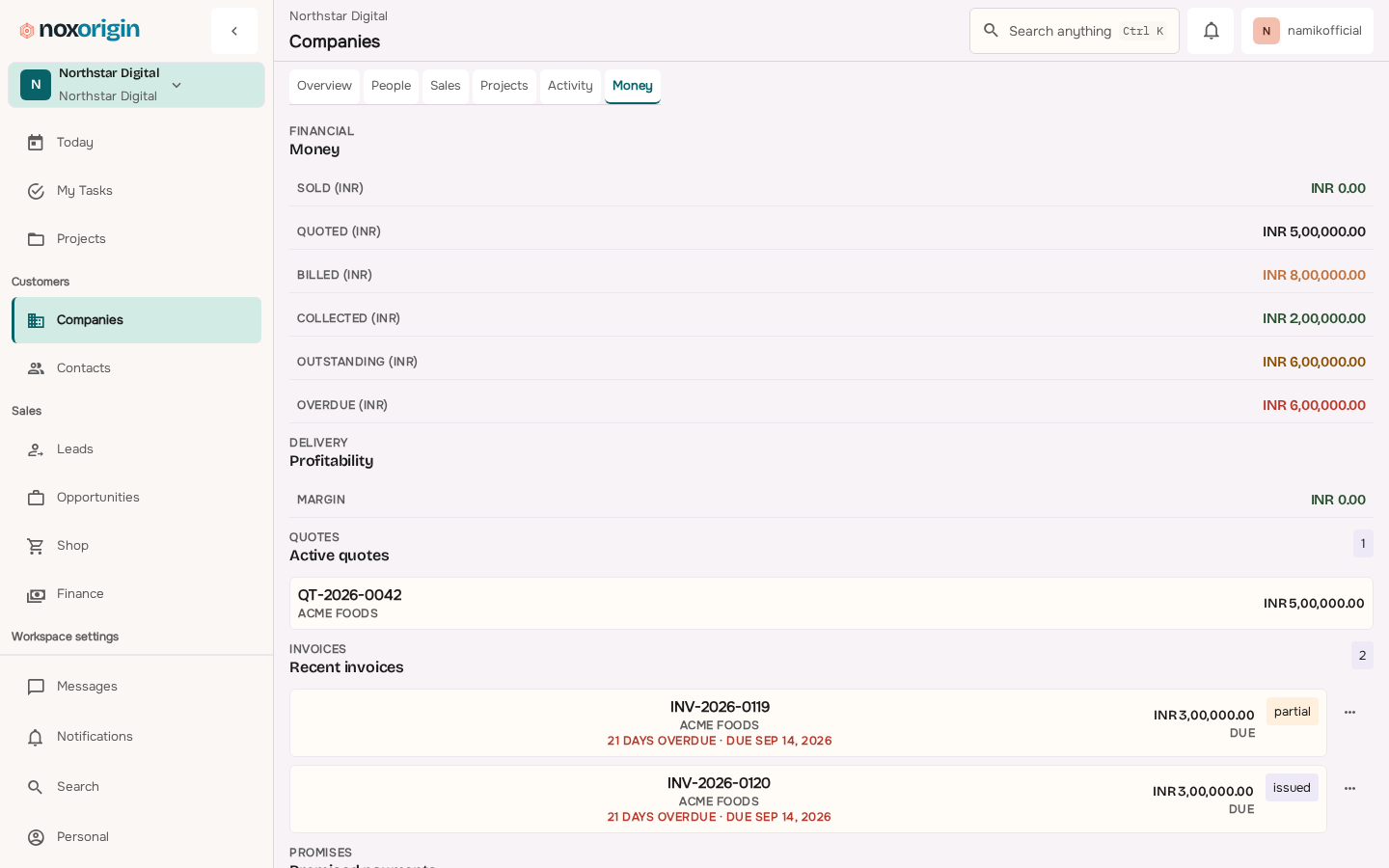
Quoted, billed, collected and outstanding sit on the customer record. Work that was delivered and never invoiced, and a year that was agreed and never quoted, are both absent from that picture — and both are exactly what a renewal is made of.
Run it on the plan that matches your customer count
Growth is ₹1,600/month or ₹15,000/year, includes a 30-day trial, 10 users, 50 active projects, and 10,000 contacts. The contract, the renewal quote, and the invoices that follow are part of the workspace rather than an add-on. These are NoxOrigin platform plans — NoxCRM, Nox-Billings and Nox-Tickets remain available as scoped custom deployments, priced separately.
Service contract and renewal questions
What is service contract and renewal software?
It is the practice of making the date a contract ends visible to somebody other than the person who was told about it, and of turning the renewal into a document the customer accepts on the record. The work is two dates and two conversations: what was delivered, what was invoiced, and what the next year is priced at. A contract that renews by itself is not a contract — it is a habit, and the habit usually ends when the person holding it leaves.
Does a renewal charge the customer automatically?
No. A renewal is a new quote on the same customer. There is no recurring-billing engine that fires on the end date, no card on file, no auto-debit, no retry ladder and no dunning sequence. Accepting the quote and raising the invoice are two separate steps taken by two people, and if nobody accepts the quote, no invoice exists and no money is owed. That is a feature for a business that prices a visit rather than a subscription, and it is the reason a renewal that nobody chased stays unchased.
Can NoxOrigin tell me which visits happened under the contract?
No. There is no service-history record. What NoxOrigin holds against a customer is the quotes, invoices and payments you raised, so the only visits it can evidence are the visits that were invoiced. If a visit was delivered and never invoiced, there is no row for it anywhere, no report can show it, and a customer who says they used seven of twelve cannot be confirmed or denied from the system. Answer that from your own records, in writing, before the renewal quote goes out.
Where do the labour hours on a contract visit go?
Nowhere, and that is a limitation rather than an oversight to be worked around. There is no timesheet record and no payroll module, so two technicians spending two hours on a monthly visit is not captured, and there is no timesheet-to-invoice conversion to convert it with. A service history is not a timesheet: one is a promise about frequency, the other is a record of effort, and NoxOrigin only keeps the first kind of thing as documents. If you bill hours, you need a timesheet somewhere, and it is not here.
What happens when the renewal date passes and nobody does anything?
Nothing happens in the system, which is the problem. The visits continue, somebody invoices them at the old rate, and an ageing report does not object — because the value of the next year is still a quote, and a quote is not a receivable. The work is on the ground and invisible in the money until somebody decides what it is. The only defence is a date that lives somewhere other than memory, and the software is where the consequences land afterwards, not a diary that nags you on the day.
Is a contract renewal part of a plan I can buy?
The renewal is a workflow over records that are part of the NoxOrigin platform workspace, so the plan you pick is the plan that covers your customer and project count. NoxCRM, Nox-Billings and Nox-Tickets are separate scoped custom deployments, priced separately, and none of them carries the platform price. And NoxOrigin does not file GST returns or any other statutory return: whether a renewal is a new supply, an advance, or a continuation of the same engagement is a question for your chartered accountant.
Put the date somewhere other than your head.
Bring one live contract. We will show you what the record can evidence, what it cannot, and exactly where the renewal has to be a quote rather than a charge.