Housekeeping and facility services software with no scheduling, no dispatch, no technician roster, no route planning, no attendance, no timesheets and no payroll — a billing record, not a field-service system
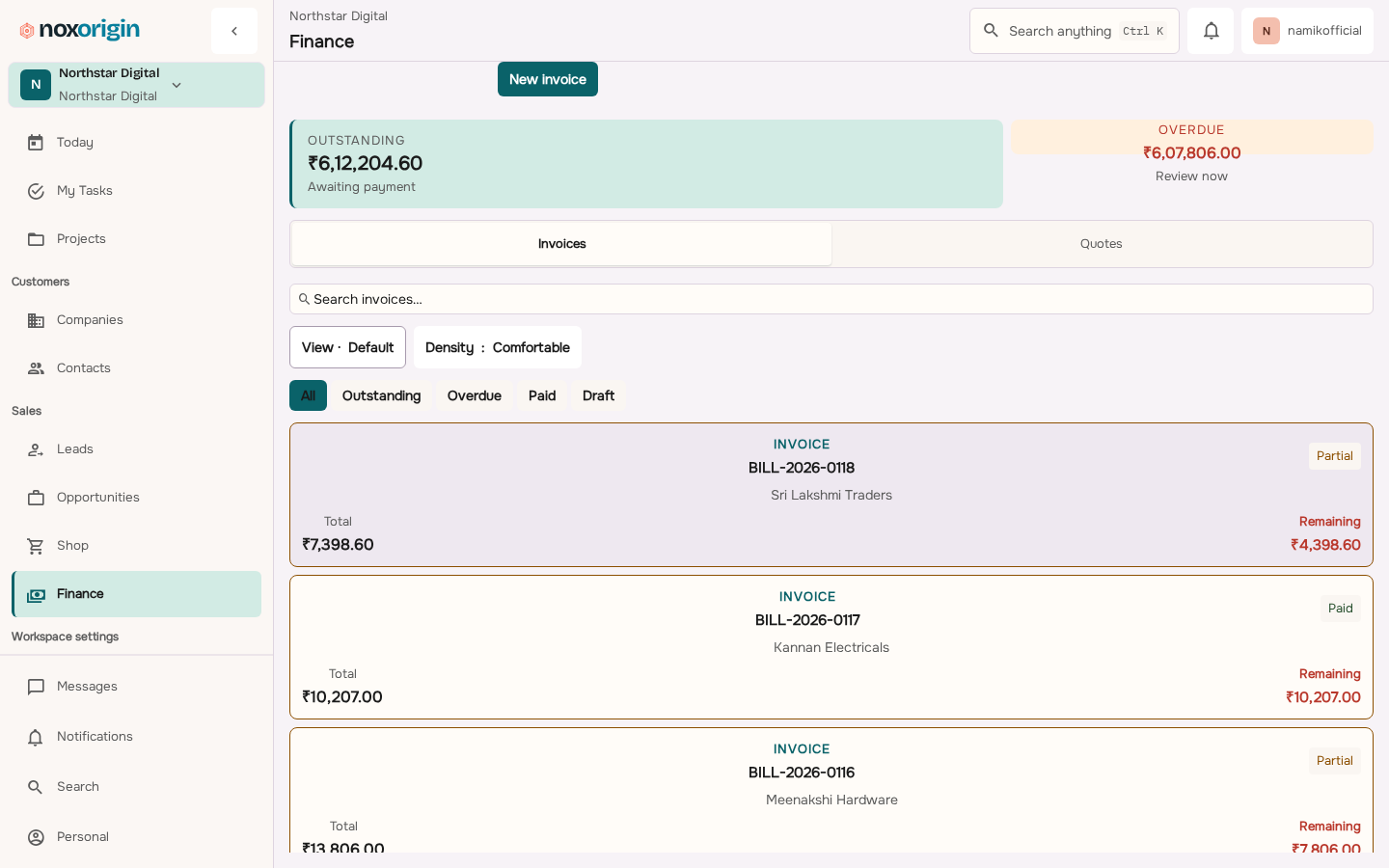
Facility services software is a schedule and a roster, and the schedule is the product. NoxOrigin is not a field-service management system. There is no service scheduling or dispatch engine, no technician or attendant roster, no route planning, no attendance or timesheet record, no payroll and no recurring job generator. It does not know that a cleaning visit is due on Thursday. What it does is contract a client, invoice the visit or the month, allocate the payment, and keep the record of what was billed against what was agreed — which is the part that decides whether you know who has paid and whether the invoice can be defended.
Three things a field-service system does, and the records you get instead
Schedule the work, dispatch the crew to it, and record that the crew turned up. None of the three is in NoxOrigin in any form. The replacement is smaller and is about documents rather than about people moving through buildings, which is why it is worth stating plainly rather than implying breadth.
No scheduling and no dispatch engine
There is no service scheduling engine, no recurring job generator, no job calendar, no slot, no availability, no reschedule, no cancellation, no auto-skip, no dispatch board, no work order, no job status and no mobile field app. Nothing here looks at a date and creates a job, because a billing document has no way to know that work is due. The schedule is the product in this category, and it is maintained by you.
No technician or attendant roster, and no route planning
There is no person record for a worker, no shift, no rota, no skill profile, no certification or expiry tracking, no assignment of a person to a job, no map, no route optimisation, no stop sequencing and no travel time. Who is sent where is not modelled at all. A field-service management system owns the crew and the route; this owns the client and the invoice.
No attendance, no timesheet, no payroll
There is no check-in, no check-out, no attendance record, no hours, no job duration, no labour cost, no leave, no overtime, no payslip, no employee statutory deduction and no payroll bank file. Payroll needs attendance and this does not hold attendance, so the dependency does not begin. Expenses are a Nox-Billings capability; purchasing and stock movement are in Commerce.
What there is instead: the client contracted, the visit or the month invoiced, the payment allocated, the agreement kept readable
The client as a counterparty, the agreement as priced lines on a quotation or a service contract, the visit or the month raised as an invoice against that client, the payment recorded as its own record and allocated by a person, and the billed-versus-agreed comparison left visible rather than collapsed into a total. Four records. They answer what a facility services business needs at month end: who has paid, who has not, and what was actually billed against what was signed.
A facilities contract routine where the schedule stays yours and the invoice is a document
Six steps. Step three is manual by design, and step six is the one that decides whether you can answer the only two questions that matter at month end: who has paid, and what was actually billed against what was agreed.
Record the client, and decide who is paying
In NoxOrigin the contract is a billed thing attached to a counterparty. Who that is, and whether the payer is the building owner, the tenant or a facilities manager, is a decision made once and written down, and it is what makes every later invoice raisable without a phone call. On a facilities contract this is the decision that goes wrong most often, because the same building can be invoiced to three different parties over its life.
Write the scope as priced lines, so visits are a number and not a description
A housekeeping scope is visits multiplied by a rate: four visits a month at 2,200 each, expressed as lines with quantities and rates. There is no rate-card engine and no schedule to read a price from, so the rate is a figure somebody chose, and the value of the record is that the chosen figure is still visible later. If the rate or the number of visits changes, the change is a new quote on the same client and the first is never overwritten.
Raise the invoice for the visits or the month, by hand, with the tax treatment stated
Because there is no recurring job generator, the invoice exists only once a person has raised it, which makes the total the one place a mistake is visible. A line entered at the wrong rate or with the wrong visit count is obvious in the total and invisible for a month. NoxOrigin does not determine place of supply, does not apply reverse charge, does not generate an e-invoice and files nothing.
Record a missed visit as a reason, and re-price the reduced scope as a new quote
There is no SLA clock, no breach state, no penalty rule, no automatic credit note and no exception queue. A missed visit is a reason a person writes, and the remedy is priced by a person as another quotation for the reduced number of visits. Encoding the credit as a rule would make money move without anybody deciding to move it, which is exactly the kind of thing that ends in a dispute nobody documented.
Record the payment as its own record, including a short or late payment
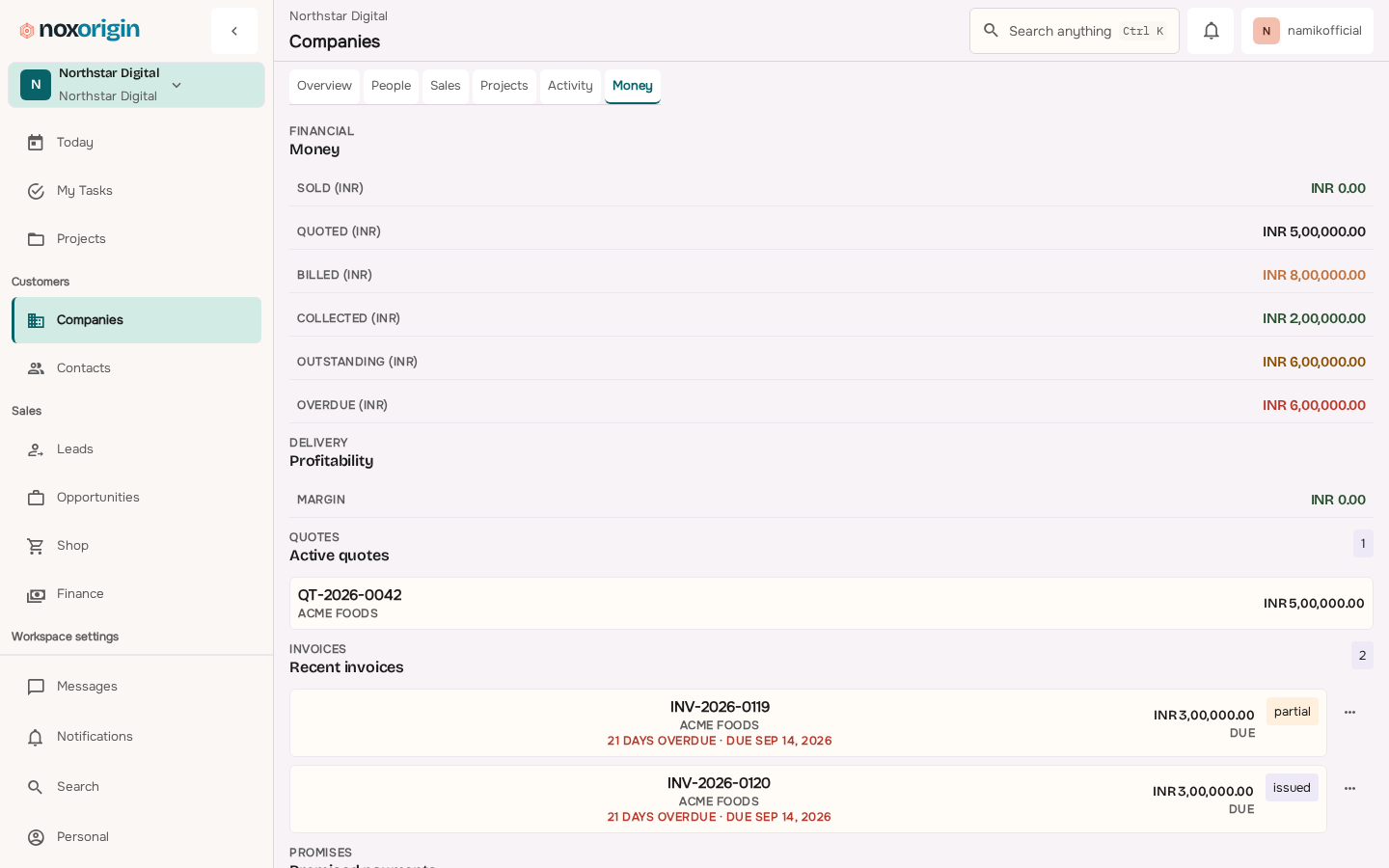
An invoice and a payment are different records, so paid is a projection of allocations rather than a stored flag. This matters more for facilities work than the size of the invoices suggests, because a large client paying a month late is ordinary: 25,000 against a 31,152 quarterly invoice leaves a real outstanding figure, and the gap between money received and money allocated is exactly where that figure goes wrong. A short payment is recorded honestly as a short payment.
Read outstanding by client and by age, and compare billed against agreed
The reason a facility services business needs this record is the client who says the invoice is wrong and the client who has not paid. Outstanding per client, aged, with a recorded payment promise on the older items, alongside what the contract said against what was invoiced, is the working list. There is no dunning and no automated chase; the queue is decided by a written rule and worked by a person.
A four-visit monthly contract, a missed visit, a part payment, and the arithmetic shown
Every figure in this section is constructed for this page so the arithmetic can be checked by hand. It is not a NoxOrigin result, not a customer’s record and not a benchmark. The 18% appears only so the totals can be verified; it is not a tax position. NoxOrigin does not file GST returns, does not generate an e-invoice or an e-way bill, and records no TDS or TCS. This page publishes no cost per visit, no attendance rate, no service-level achievement and no benchmark for any of them.
A monthly contract of four visits at 2,200 each
Four visits at 2,200 is 4 × 2,200 = 8,800 of taxable value. GST at 8,800 × 0.18 = 1,584, and the invoice total is 8,800 + 1,584 = 10,384. Billed quarterly, three of those is 3 × 10,384 = 31,152, and 31,152 ÷ 1.18 = 26,400 of taxable value, which is 3 × 8,800. The count of four is a number a person entered; nothing derived it from a schedule.
One visit in a month is missed
Nothing in NoxOrigin notices and nothing changes automatically. There is no recurring job generator, no SLA clock, no breach state, no penalty rule and no automatic credit note. What happens is that a person records the reason, and the reduced scope is priced as a new quote: three visits at 2,200 is 3 × 2,200 = 6,600, GST at 6,600 × 0.18 = 1,188, and a total of 6,600 + 1,188 = 7,788. The difference from the full month is 10,384 − 7,788 = 2,596, which is one visit of 2,200 plus 2,200 × 0.18 = 396 of tax. The original quote is untouched.
What the crew cost would need, and why it is not here
Attributing a cost per visit needs hours on site, and there is no field to put them in. Four attendants across 26 days at 8 hours is 4 × 26 × 8 = 832 hours, and every one of those hours has to come from somewhere outside NoxOrigin, because there is no attendance record, no timesheet, no job duration and no labour cost. So 10,384 divided by 4 is 2,596 of revenue per visit and no cost at all, which is a figure that looks like margin and is not. Expenses are Nox-Billings; payroll is neither.
A quarterly invoice of 31,152, and 25,000 arrives
Recorded as a payment, it reduces nothing until a person allocates it. Allocated against that invoice, 31,152 − 25,000 = 6,152 remains outstanding, and the 6,152 is a number the aged report reads from allocations rather than from a stored paid flag. A second client paying nothing for the same quarter sits beside it in the same list, because large clients paying late is the ordinary case in this trade rather than the exception.
What billed-versus-agreed actually means here
Two documents describe the same obligation and they are kept apart on purpose. The quotation said four visits a month; the invoices say what was billed. In a good month they agree, and in the month something went wrong they do not, and that gap is the argument a client has when they say the invoice is wrong. Making the reduction an automatic credit would have destroyed the record of the disagreement, which is usually the thing you need when a client disputes a month three weeks later.
The figures this page will not give you
There is no cost per visit, no attendance percentage, no service-level achievement rate, no utilisation figure, no response time and no benchmark for any of them here. Each is a ratio whose denominator — per visit, per attendant, per contracted visit — is picked after the result is known, and a company running four large sites and one running two hundred small ones will report entirely different numbers from the same year. None are printed, and yours is the one worth computing.
What was asked for, and the honest answer
If the first five rows apply to you, stop here and buy a field-service management system. The rest is what NoxOrigin does with a facilities contract somebody has invoiced and the money that arrived against it.
| What a buyer asks for | In NoxOrigin |
|---|---|
| Schedule cleaning or maintenance visits | No. No service scheduling engine, no recurring job generator, no job calendar, no slot and no availability. A visit is invoiced because a person entered a line for it. |
| Dispatch technicians or attendants to jobs | No. No dispatch board, no work order, no job assignment, no shift, no rota, no skill profile and no mobile field app. NoxOrigin does not model who does the work. |
| Plan routes across multiple buildings | No. No map, no route optimisation, no stop sequencing, no travel time and no service-area logic. Which attendant goes where is a dispatch product's decision. |
| Record attendance, check-in and hours worked | No. No check-in, no check-out, no attendance record, no timesheet, no job duration and no labour cost. Payroll is a separate product that consumes attendance this one does not hold. |
| Run payroll for the cleaning crew | No. No payroll, no salary, no payslip, no leave, no overtime, no employee statutory deduction and no payroll bank file. It is not close, and it is not on any plan. |
| Contract a client with a priced scope of visits | Yes. A quotation or service contract with lines, quantities, rates and a stated tax treatment against the client, with the original never overwritten when the scope is revised. |
| Invoice the visits or the month with a checkable total | Yes. The invoice carries the lines and the tax treatment a person stated, and the total is the arithmetic of the two, so a wrong visit count or rate is visible in the total rather than a month later. |
| Re-price a reduced scope after a missed visit | As a new quote on the same client. There is no SLA clock, no breach state, no penalty rule and no automatic credit note, so the reduced scope is another priced document beside the original. |
| Record a part payment from a large client | Yes. The payment is its own record and a person allocates it, so 25,000 against a 31,152 invoice leaves 6,152 outstanding rather than looking settled by an assumed rule. |
| See what is outstanding, by client and by age | Yes. Outstanding value per client, aged, with a recorded payment promise on the older items, read from allocations rather than from a stored paid flag. |
Where this is the wrong tool
The page title contains the word facility services, and the assumption worth removing first is that a visit can be scheduled from here. The rest of the list is the set of things a reader is most likely to believe are present because they usually are in this category.
If you need to know who is working where today, this is the wrong product
No dispatch board, no technician or attendant record, no shift, no rota, no job assignment and no mobile field app. A field-service management system owns the crew; NoxOrigin owns the client, the invoice and the money. Buying this page's product hoping for a dispatch screen is the most common way this category is misunderstood.
Nothing here schedules a visit
No service scheduling engine, no recurring job generator, no job calendar, no slot, no availability, no reschedule, no cancellation and no automatic skip. If nobody raises the line, nothing is invoiced, and the software will not notice that a month went by.
Nothing here plans a route or dispatches anyone
No map, no route optimisation, no stop sequencing, no travel time, no service-area logic and no proximity matching. Which attendant goes to which building is decided in a dispatch product or by a person with a spreadsheet.
Nothing here records attendance, hours or payroll
No check-in, no check-out, no timesheet, no job duration, no labour cost, no leave, no overtime, no payslip and no payroll bank file. Expenses are Nox-Billings; purchasing and stock movement are in Commerce. No cost per visit can be computed from NoxOrigin records, and this page will not invent one.
Nothing here tracks consumables against a job
No stock movement, no consumption per visit, no reorder point, no auto-PO and no demand forecasting. Consumables and purchasing belong to Commerce, and the connection between a job and the stock it consumed is not modelled here.
A scope change is a new quote, not an edit
There is no change-request record, no milestone record, no deliverable record, no contract editor and no e-signature, and the original quote is never overwritten. A reduced or revised scope is another priced document against the same client, which is also what makes the billed-versus-agreed comparison possible months later.
An invoice and a payment are different records, and paid is a projection
Money received reduces nothing until a person allocates it, so a part payment and a full payment look identical until somebody allocates them. There is no dunning, no auto-debit, no card-on-file and no credit bureau, so a late facilities client is an aged line and a written follow-up.
This is not a PMS, a channel manager or a rent ledger
No property record, no tenancy record, no rent ledger, no valuation engine, no reservation system, no channel manager and no booking engine. If the property or the guest is what you are managing, that is a property-management product, and NoxOrigin is not one.
Contract invoicing and collections on the plan that matches your invoice volume
Growth is ₹1,600/month or ₹15,000/year, includes a 30-day trial, 10 users, 50 active projects, and 10,000 contacts. Say this plainly rather than let it be assumed: these are NoxOrigin platform plans. NoxCRM, Nox-Billings and Nox-Tickets are scoped custom deployments, quoted and priced separately against your own configuration, and the platform plan price never applies to any of them. Scheduling, dispatch, rostering, route planning, attendance and payroll sit on no plan, because they are not in the product at all — so if the roster is what you need to manage, say so, and that is a different conversation from a plan question.
Housekeeping and facility services questions, answered before you buy
Is NoxOrigin a field-service management system?
No, and the difference is structural rather than a missing feature. A field-service management system knows who is going where, at what time, with which skills, and whether they turned up. NoxOrigin knows what a client was contracted at, what was invoiced for the visit or the month, and whether the money has been allocated. There is no dispatch board, no work order, no technician or attendant roster, no route planning, no skill or certification matching, no mobile field app and no job status workflow. If the problem you have is who is sent where today, a field-service system is the right category.
Does it schedule the visits?
No. There is no service scheduling engine, no recurring job generator, no calendar of visits, no slot, no availability, no reschedule, no cancellation and no automatic skip. Nothing in NoxOrigin looks at a date and decides a job exists on it. A visit is billed because a person entered a line for it, and if nobody enters the line, nothing is invoiced. That is the single most important boundary on this page: a schedule you do not maintain yourself will not be maintained by the software.
Does it keep a roster of technicians or attendants?
No. There is no technician record, no attendant record, no shift, no rota, no skill profile, no certification or expiry tracking and no assignment of a person to a job. Who does the work is not a thing NoxOrigin models, which is deliberate: an hourly crew paid on a timesheet and a field-service roster are two different products, and only the first half of the money relationship is here. The client relationship and the invoice are modelled; the crew is not.
Does it record attendance or hours worked?
No. There is no check-in, no check-out, no attendance record, no timesheet, no hours, no travel time, no job duration and no labour cost. Nobody can log that an attendant was on site from 09:00 to 17:00, because there is no field in NoxOrigin to log it into. This is worth being blunt about: you cannot compute a cost per visit from NoxOrigin records, and any margin figure you see for a cleaning contract has labour in it from somewhere else. Expenses are a Nox-Billings capability, and purchasing and stock movement are in Commerce.
Does it do payroll?
No, and it is not close. NoxOrigin has no payroll, no salary, no payslip, no attendance input for payroll, no leave, no overtime, no statutory deduction for employees and no bank file. Payroll consumes attendance, and this product does not hold attendance, so the dependency does not even begin. Staff pay is a payroll product's job. This page will not quote a cost-per-visit figure, because any such figure would require an input NoxOrigin does not have.
What if a visit was missed and the client wants credit for it?
A missed visit is a fact a person records and the remedy is priced by a person. There is no automatic credit note, no SLA clock, no service-level breach state, no penalty rule and no auto-generated adjustment. The commercial correction is a new quote against the same client for the reduced scope — three visits instead of four — and the original quote is never overwritten. There is no change-request record, no milestone record, no deliverable record, no contract editor and no e-signature anywhere in NoxOrigin, so a revised scope is another priced document.
Can it invoice a monthly housekeeping contract?
Yes, and this is the part it is actually for. A contract of four visits a month at 2,200 each is 4 × 2,200 = 8,800 of taxable value, GST at 8,800 × 0.18 = 1,584, and a total of 8,800 + 1,584 = 10,384, raised as a document against the client. Quarterly, three of those is 3 × 10,384 = 31,152, and 31,152 ÷ 1.18 = 26,400 of taxable value, which is 3 × 8,800. Every one of those figures was entered and calculated by a person; none was derived from a schedule.
How does a part payment get recorded?
As a payment, and it does not settle the invoice by itself. An invoice and a payment are different records, so paid is a projection of allocations rather than a stored flag. A quarterly invoice of 31,152 with 25,000 received and allocated against it leaves 31,152 − 25,000 = 6,152 outstanding. There is no dunning, no auto-debit, no card-on-file and no credit bureau, so the follow-up on a late facility client is a person writing, and a payment promise recorded against the older item.
Does it handle multiple sites for one client?
A client is a client, and every invoice is raised against a named counterparty. There is no site entity, no building record, no floor or zone, no per-site schedule and no consolidation of several locations into one consolidated invoice. If a client has four buildings, that is four arrangements and four sets of documents, and whether they are one invoice or four is a decision a person makes each time. Nothing in NoxOrigin is site-aware.
Does it file GST returns or generate e-invoices?
No. NoxOrigin does not file GST returns or any other statutory return, does not generate an e-invoice, does not issue an e-way bill, does not record TDS or TCS, does not handle reverse charge, does not determine place of supply, and holds no bank connection or stored bank credential of any kind. It produces the invoice records such filing would be summed from, so a person or a separate product can check the figures before anything is filed.
Is this included in the platform plan price?
The plan prices on this page are NoxOrigin platform plans. NoxCRM, Nox-Billings and Nox-Tickets are scoped custom deployments, quoted and priced separately against your own configuration, and the platform plan price never applies to any of them. Scheduling, dispatch, rostering, route planning, attendance and payroll are on no plan, because they are not in the product. If the schedule is what you need to manage, say so in the conversation rather than assuming a plan price reaches it.
Tell us whether you need the schedule or the money.
If you need the schedule, we will say so before you spend any more of your time here, because NoxOrigin has no service scheduling or dispatch engine, no technician or attendant roster, no route planning, no attendance or timesheet record, no payroll and no recurring job generator, and no plan on this site changes that. It does not know your cleaning visits are due on Thursday. What it does have is the part that decides whether a facilities business is solvent: a client contracted, a visit or a month invoiced as priced lines, a payment recorded as its own record, and an allocation made by a person — so money invoiced without payment and money paid without an invoice are both still visible at month end, and what was billed stays readable beside what was agreed.