Time and billing software that does not record time — no timesheet, no utilisation report, no payroll
Most people arrive on this page wanting to bill by the hour. NoxOrigin cannot do that, and the reason is structural rather than a missing feature on the roadmap. There is no timesheet record, no time tracking, no timesheet approval, no staff utilisation figure, no capacity planning and no payroll module here. The work is recorded against a project and a customer. A fixed-fee or value-based engagement is fully supported, and the invoice comes from the quote that was agreed. What is not here is capturing billable hours, and you should decide that now rather than in month three.
Four products this name covers, and the one thing you get instead
Everything sold under “time and billing” belongs to one of the four below. The first three are not in NoxOrigin in any form, and the last item is what you get in their place.
The hours-capture engine
There is no timesheet record, no time tracking, no start-stop timer, no daily entry sheet, no billable-hours total, no rounding rule, no minimum billable increment and no timesheet approval workflow. Nothing in NoxOrigin can tell you how long a task took, when it started, or who spent the afternoon on it. This is the defining absence on this page and it is stated in the first screen of it, not in a footnote.
The utilisation and capacity report
There is no billable percentage, no utilisation rate, no capacity plan, no bench report, no per-person or per-skill availability view and no forecast built from recorded effort. A utilisation figure divides hours worked by hours available; NoxOrigin holds neither number, and the cost side of the ratio lives outside this record too — expense tracking is Nox-Billings and purchasing is in Commerce.
The payroll run
There is no payroll module, no salary structure, no payslip, no attendance or leave ledger, no overtime calculation and no statutory deduction handling. This page publishes no billable-hours percentage, no average utilisation rate and no payroll benchmark, because each of those would be a number about a business that is not yours.
What there is instead: the agreed number, the work, the invoice and the payment
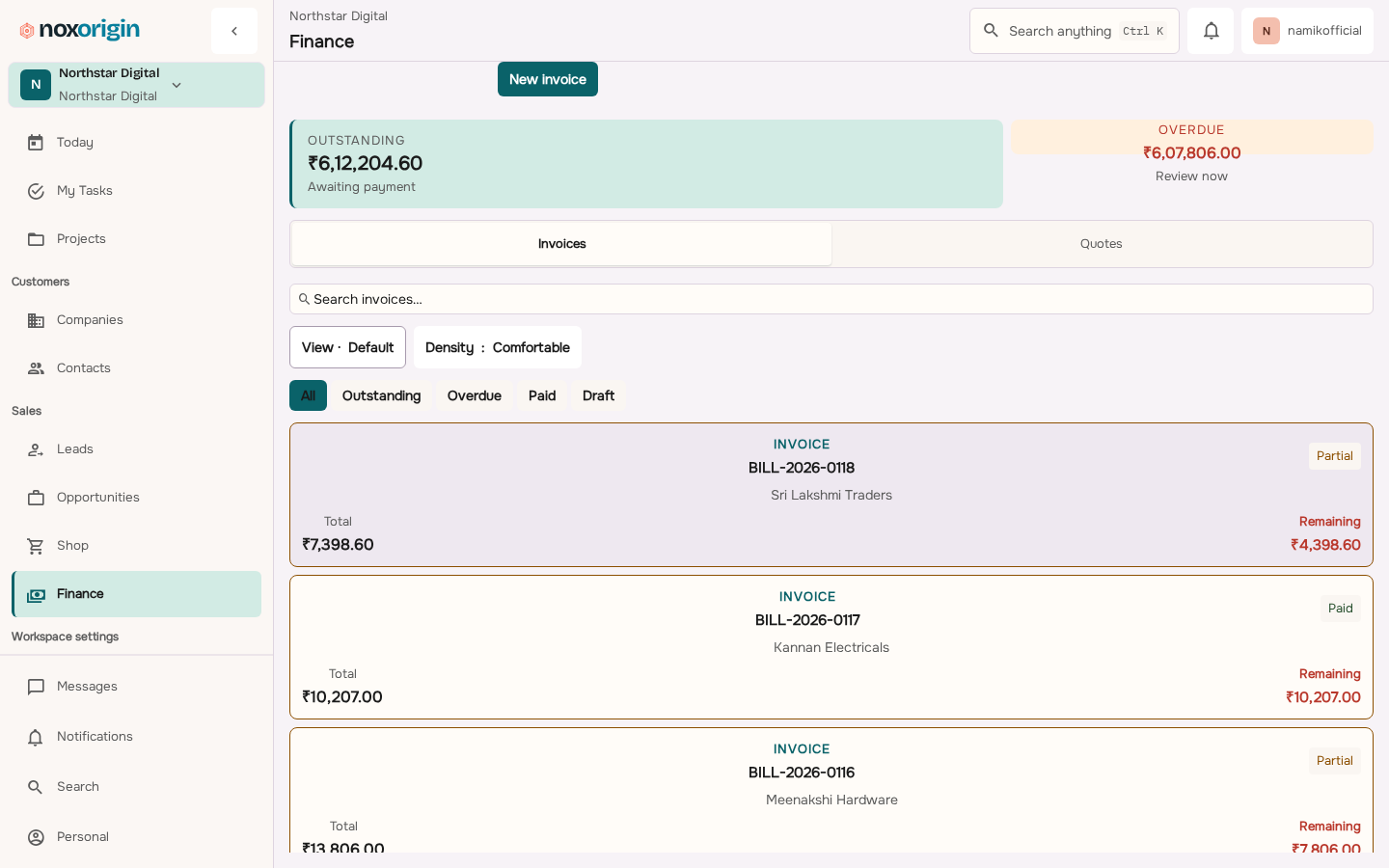
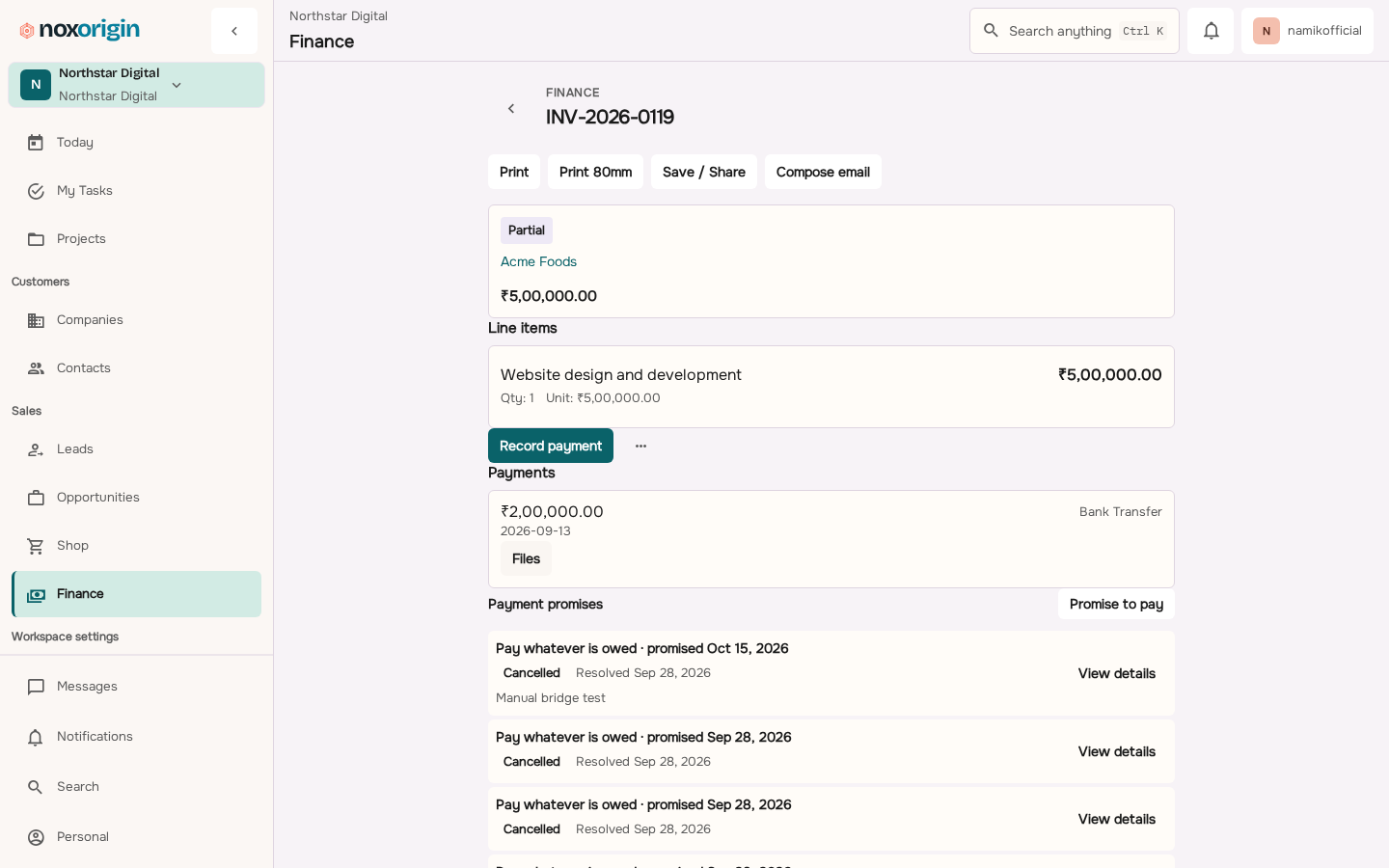
A quote with a number, a date and line items. A project that holds the tasks, assignments and due dates. An invoice raised against what was accepted. Payments recorded as separate records and allocated to invoices, with the outstanding balance following. For a fixed-fee, value-based or retainer engagement, that is the whole billing problem, and the missing timesheet is not a gap in it.
A billing routine for a price that was agreed, not one that was measured
Six steps. The third is where most teams expect a timesheet and there is not one, which is the whole difference between this product and the one you were probably picturing.
Decide the unit of the price, and write it down as one
Hourly, fixed-fee, value-based or retainer are four different products wearing the same name. NoxOrigin supports the last three properly. If the price is going to be a number that is reviewed at the end of the work, the ambiguity has to be settled before the quote, because nothing downstream will surface it.
Turn the agreed number into a quote with line items and a tax treatment
A number in an email is an assertion. A quote is a record with a number, a date and the arithmetic on it, and the arithmetic is checkable line by line rather than trusted. This is the point at which a fixed-fee engagement becomes something you can invoice against without going back to the original conversation.
Record the work against the project and the customer, not against a person’s week
Tasks, assignments and due dates describe what is being delivered and by whom. They do not measure how long it took, and they are not trying to. If a conversation turns into a hours-based charge mid-project, that is not a timesheet entry — it is a new quote on the same project.
Invoice against the accepted quote, and check the total before it leaves
An invoice is a different record from a quote, and a payment is a different record from an invoice; paid is a projection of allocations rather than a stored status. The last check before the invoice goes out is that its total is the accepted total, because the gap between them is the amount that gets argued about.
Record the payment, allocate it, and let the outstanding balance fall
Money received is a record; what reduces the balance is the allocation of that money to an invoice. A customer who pays one invoice and expects a second to be marked clear is a conversation, not a status. Doing this by hand is the single most common source of a wrong receivables figure.
Keep quoted against billed visible, and act on the difference
Unbilled quoted value is the number that shows a scope conversation happening somewhere other than the document. It has ordinary causes — work done and not invoiced, work invoiced and not paid, work never agreed — and the records can tell them apart even though no timesheet can tell you how long anything took.
One engagement, 180 hours nobody recorded, and a fee that was agreed anyway
Every figure in this section is constructed for this page so the arithmetic can be checked by hand. It is not a NoxOrigin result, not a customer’s record, and not a benchmark. The 18% GST appears only so the addition can be verified; it is not a tax position, and NoxOrigin does not file GST returns or any other statutory return. Nothing here is an average rate, a utilisation figure or a billable-hours percentage.
The estimate that was really an hours sheet
A team assumes 180 hours at a constructed rate of ₹2,500 an hour, which is 180 × 2,500 = ₹4,50,000. That figure looks like time and is really a decision. Sold as a fixed fee, it becomes ₹4,50,000 with a stated scope, and the 180 hours stop being a running total and become an assumption somebody chose. The distinction is the entire product.
The fee, invoiced in three instalments
Three instalments of 4,50,000 ÷ 3 = ₹1,50,000 each, which is 3 × 1,50,000 = ₹4,50,000. On the first instalment, GST at 18% is 1,50,000 × 0.18 = ₹27,000, so the invoice total is 1,50,000 + 27,000 = ₹1,77,000. Checked the other way: 4,50,000 × 1.18 = ₹5,31,000, and 3 × 1,77,000 = ₹5,31,000 — the same figure twice.
What would have happened with a timesheet
If this project had run to 260 hours, the overrun is 260 − 180 = 80 hours, and 80 × 2,500 = ₹2,00,000 of unbilled effort. NoxOrigin holds neither 260 nor 180 as a record: the work sits as tasks and the price sits as an accepted quote. A fixed fee absorbs that ₹2,00,000 by design, and the conversation it should trigger is a person pricing the next one differently.
The scope change nobody logged as one
Halfway through, the customer asks for an extra module. With no change-request record, no milestone record and no timesheet, the options are a second quote on the same project or an invoice the customer will dispute. The second quote carries its own lines and total, so both the original ₹4,50,000 scope and the revised one stay readable — which is the argument this record is actually here to support.
A retainer, where there is no invoice per visit
A constructed ₹75,000 a month for six months is 75,000 × 6 = ₹4,50,000 — the same project value, arrived at differently. GST at 18% is 4,50,000 × 0.18 = ₹81,000, and the billed total is 4,50,000 + 81,000 = ₹5,31,000. A retainer has no timesheet behind it either, so the month is billed as a period, not as effort, and a light month is absorbed or renegotiated by a person.
Two months deferred, settled as a credit note
If the work for two months is pushed into the next quarter, the credit is 75,000 × 2 = ₹1,50,000, the GST on the credit note is 1,50,000 × 0.18 = ₹27,000, and the credit total is 1,50,000 + 27,000 = ₹1,77,000. The invoice is a different record from the payment, and paid is a projection of allocations rather than a stored status — so the credit note and the allocation are two separate acts, in that order.
Quoted against billed, on the same project
Quoted value is ₹4,50,000. Invoiced to date is ₹2,25,000, which is the two instalments at 1,50,000 + 75,000. Unbilled quoted value is 4,50,000 − 2,25,000 = ₹2,25,000. That difference has ordinary causes, and the record is the only thing that can tell them apart. It cannot tell you how many hours produced the ₹2,25,000, because that number was never captured.
The figure this page will not give you
There is no average utilisation rate, no billable-hours percentage, no average project overrun, no revenue-per-consultant figure and no timesheet-derived productivity benchmark anywhere on this page. Each would be a ratio against a chosen period and a chosen denominator, and the denominator is chosen after the result is known. Two quite different billable percentages can describe the same consultancy in the same year, depending entirely on which people and which hours were counted, which is why we will not print one here and let you infer that yours would resemble it.
What was asked for, and the honest answer
If the first four rows apply to you, stop here and buy a timesheet product. The rest is what NoxOrigin does with a price that was agreed rather than one that was measured.
| What a buyer asks for | In NoxOrigin |
|---|---|
| Capture billable hours | No. No timesheet record, no time tracking, no timer and no hours total. Work is recorded as tasks, assignments and due dates. |
| Approve submitted timesheets | No. There is nothing to approve, because no timesheet is ever captured. |
| Report staff utilisation | No. No utilisation rate, no billable percentage and no bench or capacity view. A utilisation figure needs hours worked and hours available, and NoxOrigin holds neither. |
| Plan capacity against demand | No. There is no capacity plan and no forecast built from recorded effort. |
| Run payroll | No. No payroll module, salary record, payslip, leave ledger or overtime calculation. |
| Price and invoice a fixed-fee engagement | Yes. A quote with line items and a stated tax treatment, invoiced against the accepted quote, with the balance tracked. |
| Run a recurring retainer | Yes. A recurring figure per period, invoiced each cycle, with the renewal raised as a new quote on the same customer. |
| Handle a scope change mid-project | As a new quote on the same project. There is no change-request record, and the first quote is never overwritten. |
| Collect against an outstanding invoice | Yes, with the outstanding balance aged. An invoice and a payment stay separate records, and paid is a projection of allocations. |
| Record a refundable deposit | Yes, as a record against the customer or project. There is no deposit ledger and no rent or contract accounting of any kind. |
Where this is the wrong tool
Time and billing software is judged by what it refuses to imply. The list below is the set of things a reader is most likely to assume are present because the page title sounds like they are.
If the hour is your unit of charge, this is the wrong product
No timesheet, no time tracking, no billable-hours total, no timesheet approval, no utilisation report, no capacity plan and no payroll. Buy the product where the hour is the record. This page is worth exactly thirty seconds to you if that sentence applies, and we would rather you spend the rest of your evaluation on the right tool.
Nothing here measures the effort behind a price
A fixed-fee engagement absorbs overruns by design — that is what the fee is for. Without a timesheet, nobody can later show you that the work took twice what the quote assumed, which is precisely why a fixed fee has to be priced generously and reviewed by a person. If overruns are what you need to see, they have to be measured somewhere else.
An invoice and a payment are different records, and paid is a projection
Money received reduces nothing until a person allocates it to an invoice. Paid is derived from allocations rather than stored as a flag, which is why a large received-but-unallocated amount is worth chasing on the day it lands, and why outstanding figures from an unmanaged allocation queue cannot be trusted.
Merge is a setup decision, and nothing merges automatically
Duplicate detection flags candidate pairs and a person reviews them. The same client sitting on two customer records splits the quoted, billed and collected figures exactly as thoroughly as it splits the record, so the merge policy has to be agreed at setup rather than assumed to be running.
Shift close and day-end reconciliation are assisted-setup maturity
They are not switches you flip in an afternoon on a counter deployment. A counter that has not been reconciled through that conversation is producing new numbers rather than correct ones, and the /blog/whose-hour-is-it-shifts-and-the-business-day argument is the same boundary seen from the shift side.
This is not a tax product
NoxOrigin does not file GST returns or any other statutory return, and does not determine how a credit note, a write-off or a revision should be treated. That question belongs to your chartered accountant. The 18% used on this page is arithmetic, present so the examples can be checked by hand.
Run agreed prices, work and collections on the plan that matches your customer count
Growth is ₹1,600/month or ₹15,000/year, includes a 30-day trial, 10 users, 50 active projects, and 10,000 contacts. Say this plainly rather than let it be assumed: these are NoxOrigin platform plans. NoxCRM, Nox-Billings and Nox-Tickets are scoped custom deployments, quoted and priced separately against your own configuration, and the platform plan price never applies to any of them. If what you need is a timesheet, a utilisation report or a payroll run, say so in the conversation — that is a different product conversation, not a plan question.
Time and billing questions, answered before you buy
Can NoxOrigin capture billable hours?
No, and this is the first thing to establish rather than the last. There is no timesheet record, no time tracking, no start-stop timer, no daily timesheet entry, no timesheet approval step and no billable-hours total anywhere in NoxOrigin. The work is recorded against a project and a customer as tasks, assignments and due dates. The money is raised from an agreed quote. The interval between the two — how long the work actually took — is not recorded at all. If capturing hours is the reason you are reading this page, you should close it and look at a timesheet product, because no plan on this site will add the feature to you.
Then what is the point of time and billing software that does not track time?
That the billing half is a separate problem from the timing half, and it is solved badly. The money side is a quote that was agreed, invoices raised against it, payments recorded against those invoices, and the outstanding balance that follows — held as separate records so the thing that was agreed and the thing that was billed can be compared. A firm that prices fixed-fee or value-based work never needed a timesheet in the first place; it needed the agreed price, the progress, and the invoice to stay connected. A firm that prices by the hour is a different buyer, and this page exists largely to let you notice that before month three.
Can I report how utilised my staff are?
No. There is no utilisation report, no billable percentage, no capacity plan, no timesheet-derived productivity figure and no comparison of what people cost against what they billed. A utilisation figure is a ratio of two numbers, and NoxOrigin holds neither: it does not know the hours worked and it does not know the cost of the people who worked them. Expense tracking is a Nox-Billings feature and purchasing sits in Commerce, so the cost side of that ratio lives outside this record too. This page publishes no utilisation rate, no billable-hours percentage and no benchmark of either, because a number on a marketing page would be somebody else's business and not yours.
Does it run payroll, or tell me what a person earned?
No. There is no payroll module, no salary record, no payslip, no attendance-to-pay calculation, no overtime rule, no leave ledger and no statutory deduction handling. Nothing in NoxOrigin knows what a staff member cost the business. A timesheet product that also does payroll is a different category of purchase, and we would rather you knew that on this page than three conversations later.
Our work is charged by the hour. Can we still use it?
You can use it, but the hours have to be priced and agreed as a number rather than accumulated as they happen, which changes what the software is for. In practice that means a discovery phase quoted as a capped amount, a project quoted as a fixed fee, or a retainer as a monthly figure — and the hour count lives in the quote as an assumption that somebody chose, not as a running total that the system produced. That is workable and it is honest, provided the price you agreed does not depend on the record NoxOrigin does not have. The /industries/consulting-firms page covers the same boundary from the firm’s side.
Can it send a reminder when an invoice passes its due date?
It can keep the outstanding balance and, where your setup carries them, the payment promises people made, so a collection list is something you work rather than something you reconstruct. A payment is a different record from an invoice and paid is a projection of allocations rather than a stored flag, so a payment received without an allocation has not reduced anything yet. Chase escalation, dunning sequences and automatic late fees are not in scope here.
We are a consultancy billing hourly — is there a version of this that does track hours?
Not inside NoxOrigin, and we are not going to imply otherwise. The record that would answer it does not exist: no timesheet, no approval, no utilisation, no capacity. Our own writing on the boundary is at /blog/whose-hour-is-it-shifts-and-the-business-day for the shift and day-end half of the same argument, and /industries/consulting-firms for how a consulting firm should read this page. If the hour is the unit of your business, buy a product where the hour is the record.
Is this included in the platform plan price?
The plan prices on this page are NoxOrigin platform plans. NoxCRM, Nox-Billings and Nox-Tickets are scoped custom deployments, quoted and priced separately against your own configuration, and the platform plan price never applies to any of them. If your requirement is a timesheet, a utilisation report or a payroll run, say so in the conversation — that is a different product conversation, not a plan conversation.
Tell us whether the hour is your unit of charge.
If it is, we will say so before you spend any more of your time here, because NoxOrigin has no timesheet, no utilisation report and no payroll, and no plan on this site changes that. If your work is priced as a fixed fee, a value, or a monthly retainer — we will walk the arithmetic line by line, show you which record each number came from, and be explicit about the effort behind the fee that neither of us will be able to measure.