Quotation software for the moment the scope has to become precise — not a contract editor, an e-signature, or a change-request tracker
A quotation is a list of items and quantities, and a list is not a scope. It is the last moment the work is still negotiable and the first moment it has to be precise, and those two demands pull in opposite directions. When the list lives in a spreadsheet, revising it means redoing it — so the revision happens verbally, and the verbal version is what eventually gets invoiced. NoxOrigin holds the quote, the revision, and the work it became as separate numbered records, so the thing that was agreed and the thing that was delivered can be compared rather than remembered. Here is the honest boundary: there is no contract editor, no e-signature, no change-request record, and no milestone or deliverable record. A change of scope is a new quote raised against the same project, and the accepted quote is the agreement.
Four products a quotation is sold as, and the one thing it actually is
Everything under the quotation-and-estimate name belongs to one of the four below. None of them is in NoxOrigin, and the last item is what you get instead.
The contract editor
There is no clause library, no terms-and-conditions composer, no dunning terms, no liability or force-majeure text, no defined term reuse, no contract template assembly, and no merged document that joins your quote to your terms. A quotation here is priced scope on a numbered record. If your customer's procurement process requires a signed agreement with terms attached, this is the wrong product and no plan on this site will change that.
The e-signature
There is no signature capture, no typed or drawn signature, no OTP or email consent trail, no signing order, no countersignature and no signed PDF stored against the quote. What NoxOrigin can tell you is that a quote record exists, when it was raised and whether it was accepted. It cannot tell you that a named person with authority signed it, and the difference is the difference between an accepted quote and an enforceable agreement — which is why the accepted quote being the agreement is a convenience, not a legal mechanism.
The change-request tracker
There is no change-request record, no change-order document type, no reason field, no impact assessment, no schedule effect, and no approval attached to a change. A scope change is a new quote raised against the same project. That is a narrower thing than a change-request system and, in exchange, it is the arrangement where the original scope and the revised scope both remain readable afterwards, instead of a single document that was edited until the original wording no longer exists anywhere.
The milestone and deliverable planner
There is no milestone record, no deliverable record, no percentage complete against a quoted line, no delivery schedule generated from a quote, and no line-level billed-versus-delivered state. Delivery lives on the project — projects, tasks, assignments, due dates — and what it does not do is claim to be the scope. A quote cannot tell you a line was delivered, and a task list cannot tell you it was paid for.
The estimating engine
There is no cost model, no rate card, no quantity takeoff, no historical estimating, no margin calculation and no suggested price. The figure on a quote is arithmetic that a person did, and its only two advantages are that the inputs are visible and that a second quote can be raised against the first when the inputs turn out to be wrong.
What there is instead: the quote, the revision beside it, and the work it became
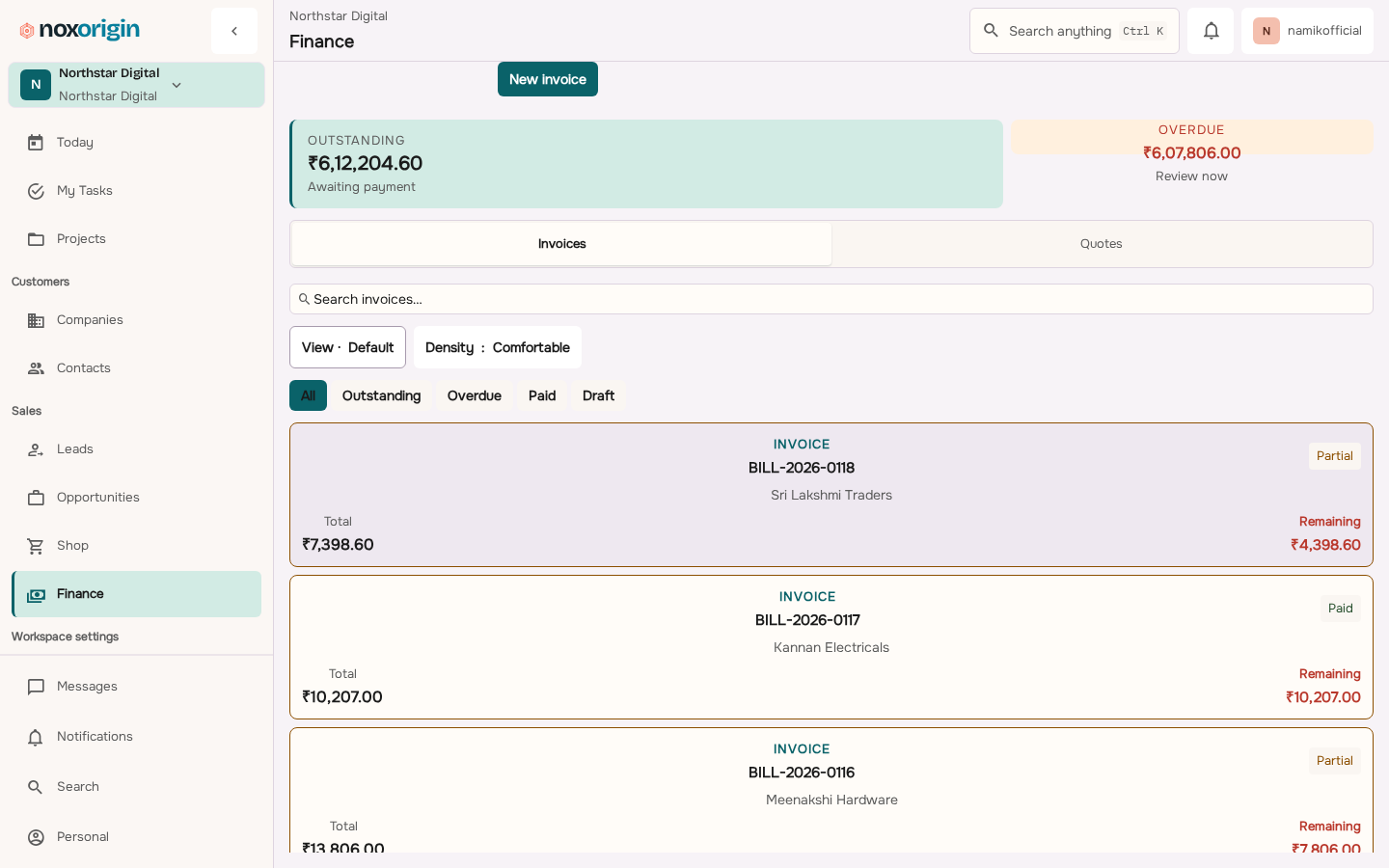
A quote with a number, a date and line items. A second quote on the same project when the scope changes, with the first left intact. The project those two attach to, the tasks that came out of them, the invoices raised from what was accepted, and the payments allocated against those invoices. Nothing here draws a conclusion about whether the work was worth doing — it only keeps the four records that were involved on the same record set, in order.
A quotation routine with a number on every step
Six steps, and the two that matter most are the fourth and the fifth. Those are the point at which a spreadsheet stops being a document and becomes the only copy of the scope, and the point at which acceptance has to be attached to a specific version.
Decide what is being priced, and write it as scope rather than as a list
A list of items and quantities is not a scope. Eight screens at a rate is a price; eight screens, the pages behind them, the content that has to be written, what happens when the customer changes their mind mid-build, and what is explicitly not included — that is a scope. The second version of the list is where the argument usually starts, and it starts because the first version never said what was outside it.
Price it, and put the arithmetic on the page
Unit rate times quantity, added up, with the tax treatment stated rather than implied. This page uses 18% GST in its worked examples purely so that the addition can be checked by hand, and the arithmetic is shown rather than asserted. It is a constructed example, not a NoxOrigin result, and NoxOrigin does not file GST returns or any other statutory return.
Send it as a numbered record, not as an attachment with no history
A quote with a number and a date on it is a record. A PDF emailed from a personal account is a document that will be found, once, by whoever remembers the thread. The difference matters most at the moment somebody asks what was actually quoted, in what state, on what date — and the answer in a spreadsheet is whichever cell is highlighted.
Let the revision be a second quote on the same project, not an edit
The customer wants six more pages. The original scope stays; a new quote number carries the addition, with its own total and its own date. Two numbers on one project is not duplication — it is the only arrangement where both what you quoted and what you later agreed are simultaneously true and separately visible.
Get the acceptance in writing, in your own words, and attach it
There is no e-signature and no signature capture here, so acceptance is a thing a person does: a reply, a message, a note attached to the record. Write down who agreed, on what date, and against which quote number — the third part is the one people skip, and it is the one that settles an argument about which version was agreed.
Invoiced from the accepted quote, and check the arithmetic before the invoice leaves
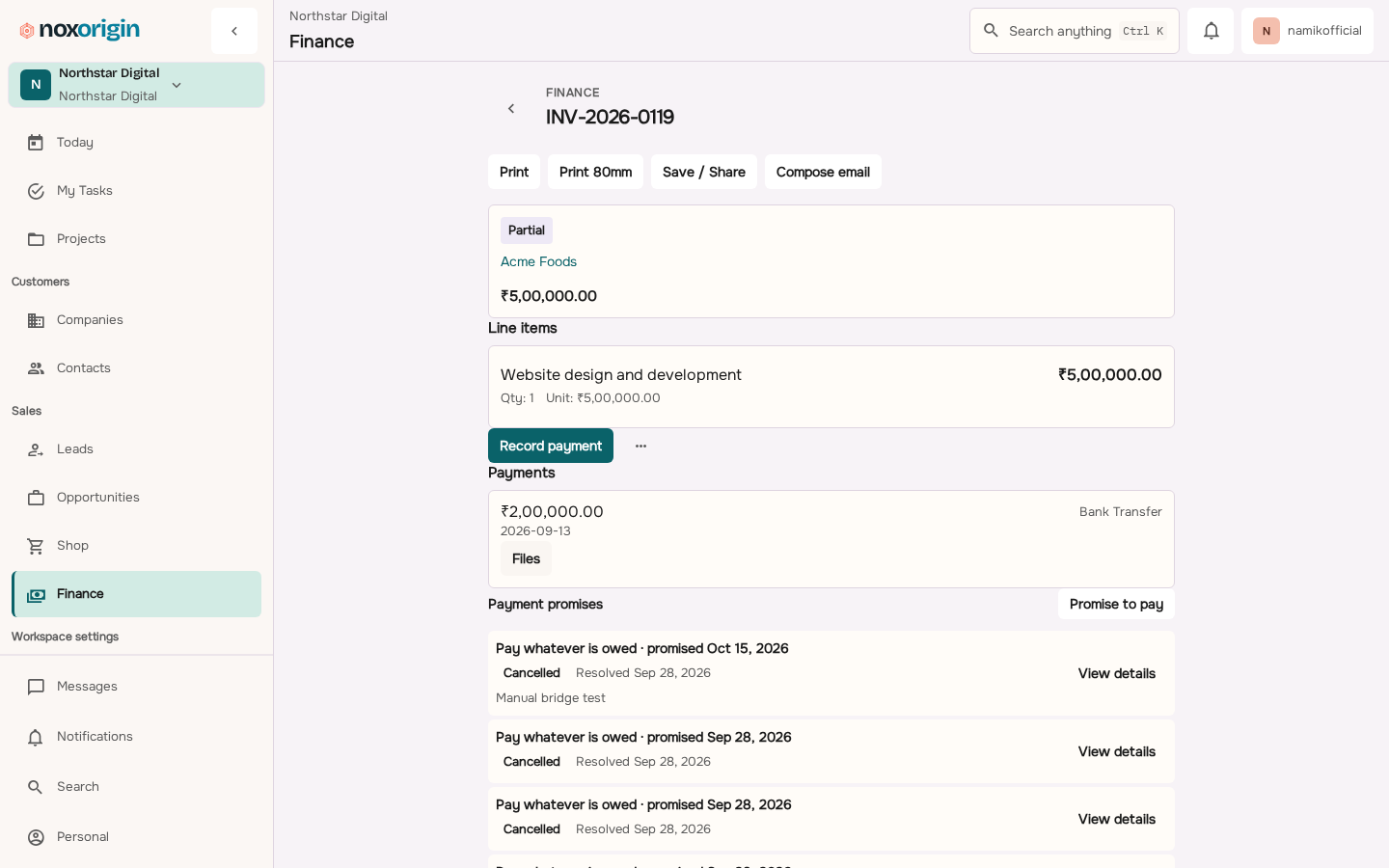
An invoice is a different record from a quote, and a payment is a different record from an invoice; paid is a projection of allocations rather than a stored status. The last check before raising the invoice is that the total on the invoice is the total on the accepted quote, because the difference between them is the amount you will be arguing about later.
One project, three quotes, and the figure nobody revisited
Every figure below is constructed for this page so the arithmetic can be checked by hand. It is not a NoxOrigin result, not a customer’s record, and not a benchmark. The rates, the quantities and the client are all chosen to make the arithmetic visible. The 18% GST appears only so the addition can be verified; it is not a tax position, and NoxOrigin does not file GST returns or any other statutory return. Nothing in this section is a price list, a margin, a win rate or a discount benchmark.
The first estimate, priced line by line
Interface design: 8 screens at a constructed rate of ₹6,000 is 8 × 6,000 = ₹48,000. Build: 40 pages at ₹2,500 is 40 × 2,500 = ₹1,00,000. Content: 12 pages at ₹900 is 12 × 900 = ₹10,800. Subtotal is 48,000 + 1,00,000 + 10,800 = ₹1,58,800. GST at 18% is 1,58,800 × 0.18 = ₹28,584. Total is 1,58,800 + 28,584 = ₹1,87,384. Nine lines of arithmetic, all of them somebody's decisions, and not one of them derived by the system.
The same work, when the customer is told more of it is needed
The estimate stands at ₹1,87,384. The customer asks for six more build pages at the same rate: 6 × 2,500 = ₹15,000. A correctly raised second quote has a subtotal of 1,58,800 + 15,000 = ₹1,73,800, GST of 1,73,800 × 0.18 = ₹31,284, and a total of 1,73,800 + 31,284 = ₹2,05,084. The difference from the first quote is 2,05,084 − 1,87,384 = ₹17,700, which is 15,000 × 1.18 = ₹17,700 — the same addition, checked twice.
The version that was agreed by telephone
What frequently gets invoiced is not that figure. It is ₹1,87,384 + ₹15,000 = ₹2,02,384, because the person who took the phone call added the pages to the total they could see and did not revisit the tax line. The two totals differ by 2,05,084 − 2,02,384 = ₹2,700, and ₹2,700 is exactly 15,000 × 0.18 — the tax on the addition. This is not a rounding dispute or a careless error; it is what happens when the scope changes in a place that is not the document. The new quote exists to make the addition happen in one place.
The estimate nobody revisited
Suppose the same estimate was raised eleven months earlier and a different two screens are now required. The original record says 8 screens at ₹6,000; the current need is 10. The tempting calculation is 2 × 6,000 = ₹12,000, GST 12,000 × 0.18 = ₹2,160, total ₹14,160 — and it is wrong in a way no software can detect, because the ₹6,000 was a rate for a set of eight screens, not a rate for a screen. Nobody holds the original estimate open for eleven months to be re-derived, and that is precisely why the second quote, raised at the time, with the rate stated on it, beats an old figure nobody has looked at.
Quoted against billed, on the same project
The accepted quote total is ₹1,87,384. Invoiced to date is ₹1,43,000. Unbilled quoted value is 1,87,384 − 1,43,000 = ₹44,384. That difference has several ordinary causes — work done and not yet invoiced, work invoiced and not yet paid, work that was never approved as in scope — and the record is the only thing that can tell them apart. NoxOrigin holds quoted value and billed value as separate states per project and does not guess which of the three causes applies.
The work that genuinely cannot be scoped in advance
Discovery is the honest case for a quotation. A capped discovery phase of 20 hours at a constructed rate of ₹3,500 is 20 × 3,500 = ₹70,000, GST 70,000 × 0.18 = ₹12,600, total ₹82,600 — quoted as its own scope on the same project, with a stated limit, before anybody commits to a build total they cannot support. A list of items cannot express a cap, which is why the discovery phase is a quote and not a line in a bigger quote.
The invoice that disagrees with the agreement
An invoice is a different record from a quote. Raise one for ₹2,05,084 when the accepted quote says ₹1,87,384 and the customer is refusing the difference of ₹17,700, and the two records now tell different stories about the same work. The record that settles it is not a note on the invoice: it is the second quote, with a number and a date, against the same project. A payment is a different record again, and paid is a projection of allocations rather than a stored status, so money received against a disputed invoice reduces nothing until a person allocates it.
The figure this page will not give you
There is no average margin, no win rate, no quote-to-close conversion percentage, no discounting benchmark and no quote-value statistic anywhere on this page. Each of those is a number against a chosen period and a chosen denominator, and the denominator gets chosen after the result is known. A 30% win rate and a 12% win rate can describe the same year of quoting in the same business, depending entirely on which opportunities were counted as a denominator.
Where this is the wrong tool
Quotation software is judged by what it refuses to imply. Most of the products below can be approximated by a well-formatted document, which is exactly why the distinction has to be stated before anything is bought.
If it has to be signed, with terms attached, this is the wrong product
No contract editor, no clause library, no e-signature, no signing order, no countersignature and no signed document stored against the record. The accepted quote is the agreement, and it is a good answer for a business whose customers buy from a person they know. It is not an answer for a procurement process that requires a signed agreement, and no plan on this site changes that.
Scope changes are new quotes, not amendments
There is no change-request record, no change-order document type, no reason field, no impact assessment and no approval attached to a change. A change of scope is a new quote on the same project. This is easier to run than a change-control module and harder to misread six months later, because the original scope was never edited out of existence — but it does mean the discipline of raising the new quote is entirely on the person who took the call.
Nothing here claims to be a delivery plan
No milestone record, no deliverable record, no progress against quoted lines, no schedule derived from a quote, and no line-level billed-versus-delivered state. Project status, tasks, assignments and due dates are separate records on the project. A quotation that could tell you a line was delivered would be claiming something about work it has no evidence of.
No timesheets, no payroll, and expense tracking sits elsewhere
There is no timesheet record and no payroll module, so if the real constraint on your estimate is the labour behind it, that number has to come from somewhere you keep it. Expense tracking is Nox-Billings; purchasing is in Commerce. NoxOrigin does not compute cost, margin, or an estimate from your own history, and this page publishes no margin figure or discount benchmark.
Nothing merges automatically, and paid is a projection
An invoice and a payment are different records; paid is derived from allocations rather than stored, and a payment received without an allocation has reduced nothing. Merge is a setup decision — detection flags candidate pairs and a person reviews them, so the same client sitting on two customer records splits the quoted, billed and collected figures exactly as thoroughly as it splits the record. Shift close and day-end reconciliation are assisted-setup maturity rather than switches you flip in an afternoon, and a counter that has not been reconciled through that conversation is reporting new numbers rather than correct ones.
This is not a tax product
NoxOrigin does not file GST returns or any other statutory return, and does not determine how a credit note, a discount, a write-off or a revision should be treated for tax. That question belongs to your chartered accountant. The 18% on this page is arithmetic to make an example checkable, nothing more.
Run quotes, projects and collections on the plan that matches your customer count
Growth is ₹1,600/month or ₹15,000/year, includes a 30-day trial, 10 users, 50 active projects, and 10,000 contacts. Say this plainly rather than let it be assumed: these are NoxOrigin platform plans. NoxCRM, Nox-Billings and Nox-Tickets are scoped custom deployments, quoted and priced separately against your own configuration, and the platform plan price never applies to any of them. If what you need is a signed contract with terms attached rather than a quote, say so in the conversation — that is a configuration question, not a plan question.
Quotation and estimate questions
Is a NoxOrigin quotation a contract?
It is the document your customer agreed to, and in a small business it is usually the whole of the agreement — but there is no contract editor, no clause library, no terms-and-conditions composer, no dunning terms, no liability text and no signature block. The accepted quote is the agreement. If what you send has to be signed, with terms attached and countersigned, that is a different category of product and you should be told so before you buy anything on the strength of this page.
Can the customer sign the quote inside NoxOrigin?
No. There is no e-signature, no typed or drawn signature, no OTP or email consent capture, no signing order, and no signed PDF stored against the quote. What NoxOrigin can tell you is whether a quote record was accepted and when it was raised, not whether a named person with authority signed anything. Do not treat an accepted state as proof of a signature — the accepted quote is the agreement, and it is an agreement between people who already know each other.
The customer changed the scope after the quote was sent. What do I do?
Raise a new quote against the same project. This is the single most important thing to understand about this page: a change of scope is not an edit, an amendment, or a note on the old quote. It is a second quote with its own number, its own line items, its own total and its own date, sitting beside the first on the same project. The first quote is not overwritten, so both the original scope and the revised scope stay reconstructable — which is what you want when the question at the end is whether the customer agreed to the thing they are now refusing to pay for.
Does it track the change requests and their reasons?
No. There is no change-request record, no change-order type, no reason field, no impact assessment, no schedule effect and no approval attached to a change. What exists is a second quote number and the comparison between two quoted totals on the same project. The reasoning behind a change — the phone call, the email, the thing the customer said in the meeting — stays where it was said, and if it matters later, somebody has to attach it by hand.
Can I see milestones, deliverables and progress against a quote?
No. There is no milestone record, no deliverable record, no percentage-complete against quoted lines, no delivery schedule generated from a quote, and no line-level billed-versus-delivered state. A quotation is a price and a list of what was priced; delivery is a separate set of records on the project — projects, tasks, assignments and due dates — and nothing on a quote line tells you whether that line has been delivered. The project delivery records describe the work; they do not claim to be the scope, and the quote does not claim to be the plan.
What is the difference between an estimate and a quote here?
Honest answer: the record is the same shape, and the difference is the state it is in. An estimate is a figure you formed; a quote is a figure you put in front of somebody. What NoxOrigin does not do is convert an estimate into a quote, version it against a later figure, or warn you that an estimate you raised eleven months ago has never been revisited — which is exactly the moment a stale price becomes somebody else's problem.
Will it work out whether my prices are profitable?
It will compare quoted value against billed value per project, so unbilled scope is findable. It will not compute cost, margin, or a win rate: there is no cost model, no margin calculation and no built-in expense allocation, and this page publishes no average margin figure and no percentage benchmark of any kind. A margin is your cost against your price over a period you name, and if the cost lives in a spreadsheet, the margin has to come from there.
Is this included in the platform plan price?
The plan prices on this page are NoxOrigin platform plans. NoxCRM, Nox-Billings and Nox-Tickets are scoped custom deployments, quoted and priced separately against your own configuration, and the platform plan price never applies to any of them. Quotation, invoicing and collections sit inside the platform record; if your requirement is a signed contract with terms attached, ask for a configuration conversation rather than assuming a plan list covers it.
Bring the quote that got revised by phone.
We will walk the arithmetic with you line by line, show which assumption each number is standing on, and put the two versions of the scope side by side as separate records — then be blunt about whether you need a quotation tool, a contract tool, or a delivery planner, because NoxOrigin is the first of those and not the other two.