Pipeline software that is not a marketing engine, a lead scorer, or a forecasting model
A pipeline is a set of claims about the future, which is exactly why it decays: the claims were true on the day somebody typed them, and nothing since has been true about them. A deal stays in the list because leaving it requires a decision, and a forecast built on claims nobody has revisited is not a forecast. NoxOrigin gives you three things and refuses the rest: a stage that means something the team agreed on, a dead deal removed by a person, and a forecast that names the number behind every row. There is no marketing automation, no lead scoring engine, no email sequence builder, no dialler, no CRM-native forecasting model, and no territory management here — and no conversion rate, no win rate and no forecast accuracy figure, because those are measured outcomes and NoxOrigin has no measured outcomes to produce them from.
Six products this is not, and the one thing it is
Almost everything sold under this name is one of the six below, plus a model that turns the resulting rows into a number. None of them exists here. The seventh item is what you get instead, and it is considerably smaller.
Marketing automation: the thing that was supposed to fill the top of the funnel
There is no campaign builder, no nurture sequence, no drip, no lead-source attribution model, no channel reporting, no form-capture automation, and no MQL or SQL definition anywhere in NoxOrigin. A pipeline row appears at the moment a person decides somebody is worth a record. If your problem is that leads do not arrive, this product cannot see the problem.
The lead scoring engine: a number that stands in for a judgement
There is no score, no fit grade, no behavioural scoring, no intent data, no demographic model, and no auto-promotion out of a score band. A lead is a person somebody recorded, at a stage somebody set. A score cannot be argued with, which is a feature right up until the day it is wrong — and a reason for the stage, written down, can.
The email sequence builder
There is no sequence builder, no template with merge fields, no send scheduler, no bounce handling, no open or click tracking, no wait-and-branch logic, and no message history in NoxOrigin. This platform does not send mail. Every message that left your office was sent by a person, and what was said and when is prose you wrote, so the campaign cannot be reconstructed from the system later.
The dialler
There is no call queue, no click-to-call, no call recording, no disposition codes, no call-back scheduling, no dialer campaign and no number in a list that rings by itself. Nor is there a next-best-action prompt, because a prompt is an instruction the software has no basis to give. Talking to the customer stays a person’s job, and the outcome of the call is a note you write against the deal.
The CRM-native forecasting model
There is no close-rate history, no regression over past periods, no pipeline-snapshot archive, no model-generated forecast, no automatic commit or best-case classification, and no quota or target roll-up. The forecast here is value multiplied by a percentage a person typed. It is not less accurate than a model, because it is not claiming to be a model — it is a sum you can audit back to the row it came from.
Territory management
There is no territory, region, franchise, desk or rep-split object, no assignment or routing rules, no territory overlap warning, no load balancing and no commission or payout calculation. Two people can work the same customer on purpose, which is usually a decision, and the system is not going to declare it a conflict.
What there is instead: agreed stages, a removal decision, and a forecast with a printed basis
A deal with a stage whose meaning is written down, a value, a close date, a probability with an author, and an outcome somebody recorded when the deal died. The forecast is the sum of those rows and can be printed with the name and date behind every number. Small, and every part of it checkable by a second person in under a minute.
A pipeline routine that ends in a decision somebody made
Six steps, in order. Every one of them is a person writing something down, and steps four and five are the two most products automate away.
Write down what each stage means before anyone uses it
Six stages, defined in prose once, each with a test the deal has to pass. A stage is a shared claim about the future, and a claim nobody agreed on is a label — a deal can sit in Negotiation for ninety-five days and nobody can say whether the last thing that happened was a call, a revised price or nothing. The written definition is what makes a pipeline readable by a second person.
One record per counterparty, or the pipeline counts one buyer twice
The same customer on two rows gives you two probabilities and one conversation, and a weighted total that quietly assumes two independent decisions where there is one. Detection flags the pair as merge candidates and a person reviews; merging is a setup decision, never automatic. Do this before the first forecast, because everything downstream multiplies the error.
Put a value and a close date on the deal, by hand
Value and date are commitments somebody made, entered by a person, and they are the only two inputs the forecast consumes. A date that has already passed is not a forecast and is not flagged as one — it is a row somebody has to look at. If the date is a guess, write the guess down as a guess, because a silent guess is the thing that survives a management meeting.
Write the probability yourself, and be able to say who wrote it
The percentage is your judgement, not a measurement, and the only thing that makes it useful is that a named person stands behind it. Retyping 70 to 85 improves the forecast without a single change to the customer, the price or the quote, which is why an unattributed probability is worse than none at all.
A dead deal is removed by a person, on the record
No inactivity rule, no auto-close, no automatic stage-out at N days, no archive. Somebody opens the deal and records the outcome, and the removal is visible as a decision with an author. A pipeline with no permitted deletion is a list of hopes with columns.
Publish the forecast with its basis printed next to it
The number, the date it was taken, the person who typed each probability, and the count of deals that have not been reviewed since. A forecast that cannot be read back to its inputs is a mood with a currency symbol, and the first time that is discovered is the week it is used to make a decision.
Four deals, one month, and a forecast nobody cleaned
Every figure below is constructed for this page so the arithmetic can be checked by hand. It is not a NoxOrigin result, not a customer’s pipeline, and not a benchmark — the percentages are judgements a person typed for this example, not measured close rates, and NoxOrigin publishes no rate of any kind. Replace all of it with your own records before drawing anything from it.
The four open deals at the start of the month
D1: 40 days in Proposal sent, value ₹2,00,000, close date 55 days ago, probability written as 70%. D2: 12 days in Proposal sent, value ₹1,20,000, close date 10 days ahead, probability 70%. D3: 95 days in Negotiation, value ₹4,00,000, close date 80 days ago, probability 40%. D4: 3 days in New enquiry, value ₹30,000, close date 20 days ahead, probability 10%. Total open value is ₹2,00,000 + ₹1,20,000 + ₹4,00,000 + ₹30,000 = ₹7,50,000. Two of those close dates are already in the past, and nothing in the system objects.
What the weighted number is made of
D1 contributes ₹2,00,000 × 0.70 = ₹1,40,000. D2 contributes ₹1,20,000 × 0.70 = ₹84,000. D3 contributes ₹4,00,000 × 0.40 = ₹1,60,000. D4 contributes ₹30,000 × 0.10 = ₹3,000. The forecast total is ₹1,40,000 + ₹84,000 + ₹1,60,000 + ₹3,000 = ₹3,87,000. The gap between the open value of ₹7,50,000 and the forecast of ₹3,87,000 is ₹7,50,000 − ₹3,87,000 = ₹3,63,000, and every rupee of that gap is four percentages somebody typed. That gap is judgement, not measurement.
The month nobody cleaned
A person opens D1 and D3 and records both as lost. Open value is now ₹7,50,000 − ₹2,00,000 − ₹4,00,000 = ₹1,50,000, which is D2 at ₹1,20,000 plus D4 at ₹30,000. The forecast is now ₹84,000 + ₹3,000 = ₹87,000, down from ₹3,87,000 — a fall of ₹3,87,000 − ₹87,000 = ₹3,00,000. No selling happened, no customer changed, no quote moved: the number fell ₹3,00,000 because two people were allowed to say a deal was dead. A pipeline where that is not permitted reports a figure that cannot be checked against anything.
The deal that improved the forecast by being retyped
D2 moves from Proposal sent to Negotiation and the probability goes from 70% to 85%. The value stays ₹1,20,000, the customer is the same, the quote is the same. The contribution changes from ₹1,20,000 × 0.70 = ₹84,000 to ₹1,20,000 × 0.85 = ₹1,02,000, which is an improvement of ₹1,02,000 − ₹84,000 = ₹18,000, or ₹1,20,000 × 0.15 = ₹18,000. Nineteen thousand rupees of forecast arrived from one edit. This is the whole argument for a printed basis: a probability with an author and a date can be examined, and one without cannot.
The quote that changed after the deal was won
The work was quoted at ₹1,20,000. Mid-delivery the customer asked for more, and because there is no change-request record, no milestone or deliverable record, no contract editor and no e-signature in NoxOrigin, the extra work becomes a new quote on the same project for ₹1,50,000. The pipeline row still says ₹1,20,000 while billing says ₹1,50,000, a difference of ₹1,50,000 − ₹1,20,000 = ₹30,000 that has to be reconciled on purpose. The invoice is then a separate record from the payment: a ₹1,50,000 invoice with ₹0 allocated is ₹1,50,000 outstanding, and a payment of ₹70,000 received and not yet allocated leaves it at ₹1,50,000, because paid is a projection of allocations rather than a flag.
The stage two people read differently
One person records Proposal sent on 12 March and moves the deal. Another reads the stage and cannot tell whether a proposal was sent, whether a price was revised afterwards, or whether the customer has simply not answered. There is no activity feed that settles it and no inference that can. A stage name is only a fact if the team wrote down what the stage means — which is why six written stage definitions, each with a test the deal has to pass, are the first thing to agree and not a detail to sort out later.
The same buyer on two rows
Record A holds the ₹2,00,000 proposal. Record B holds a ₹30,000 enquiry from the same person. The open value reads ₹2,00,000 + ₹30,000 = ₹2,30,000 across two rows and two probabilities, while in reality it is one buyer and one conversation. If both rows advance, the weighted total counts the same decision twice. Detection flags A and B as merge candidates and a person reviews them; merging is a setup decision and nothing merges automatically.
The figure this page will not give you
There is no conversion rate, no win rate, no forecast accuracy figure, no average deal size, no sales-cycle length and no pipeline benchmark anywhere in this page. Those are measured outcomes, and NoxOrigin produces none of them: there is no closed-deal history behind this page, no denominator anyone can inspect, and no period anyone has named. A percentage with no stated denominator is a decoration, and the one on a sales dashboard is almost always the flattering version of a number with a narrower base.
Where this is the wrong tool
A pipeline is judged by what it refuses to invent on your behalf. Everything below can be made to look helpful by a model that is guessing, and every one of those guesses then gets quoted in a meeting as though it were a measurement.
If you need the software to produce the forecast, this is not it
There is no close-rate model, no learned probability, no pipeline-snapshot history, no automatic commit or best-case roll-up, no quota tracking and no AI forecast. The number is value times a percentage a person typed, and the software’s entire contribution is refusing to change it. If you want a figure that arrives without a person deciding to type one, you want a different product — and you should ask to see its backtest.
If you need demand to create itself, this is not it
No marketing automation, no lead scoring, no email sequence builder, no dialler, and no territory or commission model. A row appears when a person decides somebody is worth a record, and a forecast built on rows nobody creates is a forecast about the past. The honest framing: this product starts where your marketing process hands you a name.
A stage change is not evidence, and nothing closes itself
There is no inactivity rule, no auto-close, no stage-out at N days, no lost reason code and no archive. Dead deals are removed by a person, which is slower than an automation and the only reason the pipeline still means anything. Any system that quietly rewrites your stages is also quietly rewriting the history you would need to learn whether the stages work.
Nothing merges automatically
Merge is a setup decision. Detection flags candidate pairs and a person reviews them; there is no automatic merging, so one customer on two records splits the pipeline, the weighting and the outcome history exactly as thoroughly as it splits the contact.
Paid is a projection, and a scope change is a new quote
An invoice and a payment are different records; paid is derived from allocations rather than stored, and money received without an allocation has reduced nothing. And there is no change-request, milestone or deliverable record, no contract editor and no e-signature — extra work after a deal is won is a new quote on the same project, not an amendment, which is exactly why a won pipeline figure and a billing figure can disagree.
This is not a timesheet, a payroll module or a capacity planner
There is no timesheet record, no payroll module and no hours to plan against. Expense tracking lives in Nox-Billings, and purchasing lives in Commerce. If the constraint on your forecast is how many hours your team can actually deliver, that figure has to come from somewhere you keep it — this platform will not manufacture it for you.
Not a tax product, and day-end is a setup conversation
NoxOrigin does not file GST returns or any other statutory return, and does not determine how a credit note or a written-off balance should be treated. Shift close and day-end reconciliation are assisted-setup maturity rather than switches you flip in an afternoon; what is set up with you, and how quickly, is agreed during implementation.
Where the stage has to land
Every claim in the pipeline is a claim about one person. If the stage cannot be traced to that record, the forecast is a column of numbers attached to nobody — and the first person to disagree with it will be the customer, who has one deal and does not remember agreeing to a stage.
Run it on the plan that matches your customer count
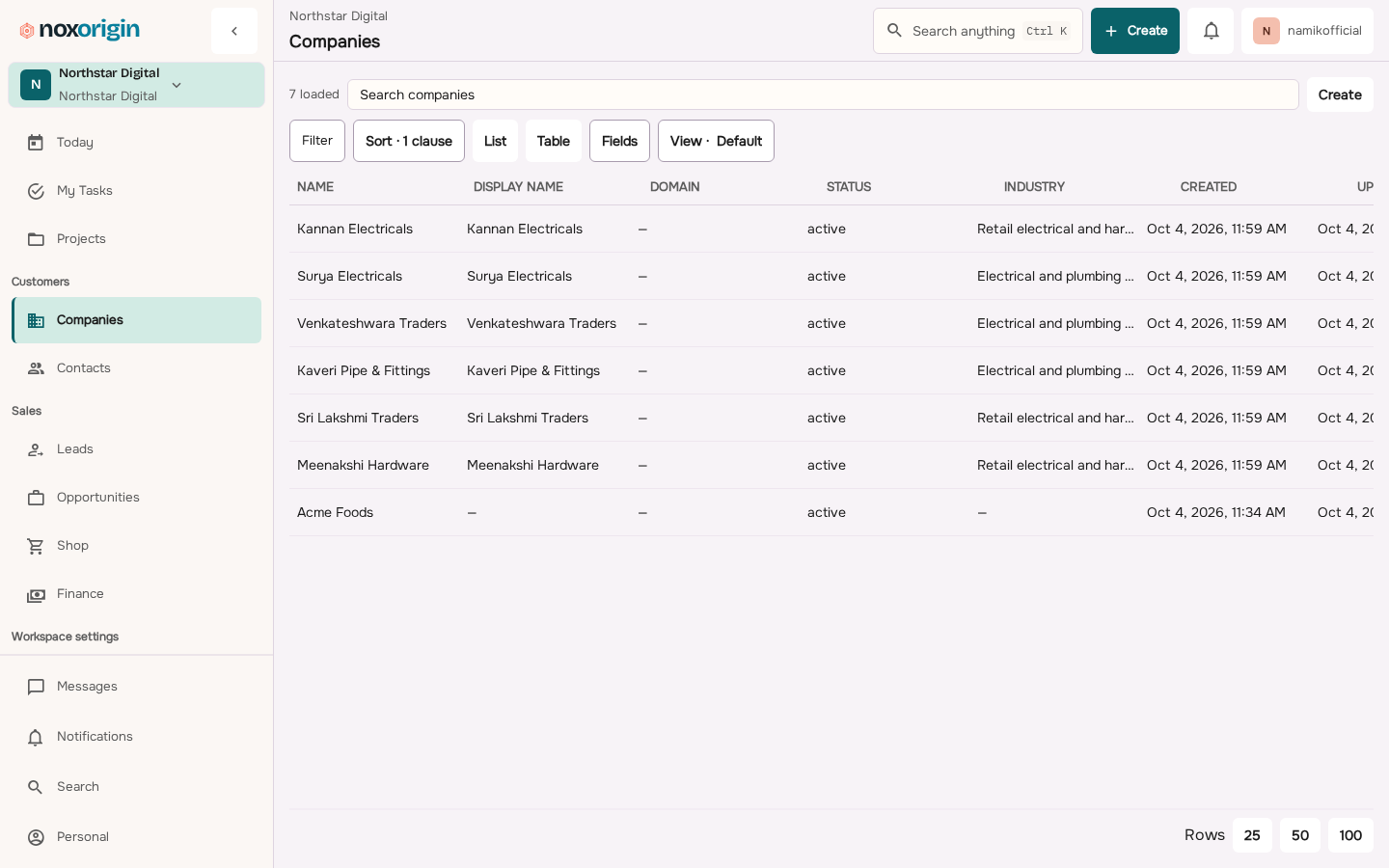
Growth is ₹1,600/month or ₹15,000/year, includes a 30-day trial, 10 users, 50 active projects, and 10,000 contacts. The customer, the deal, the quote, the invoice, the payment and the allocation are part of the workspace rather than an add-on. Be clear about what that means: these are NoxOrigin platform plans. NoxCRM is a scoped custom deployment, quoted and priced separately against your own configuration, so the platform plan price never applies to a NoxCRM deployment — the same is true of Nox-Billings and Nox-Tickets.
Sales pipeline and forecast questions
Is NoxOrigin sales pipeline and forecast software?
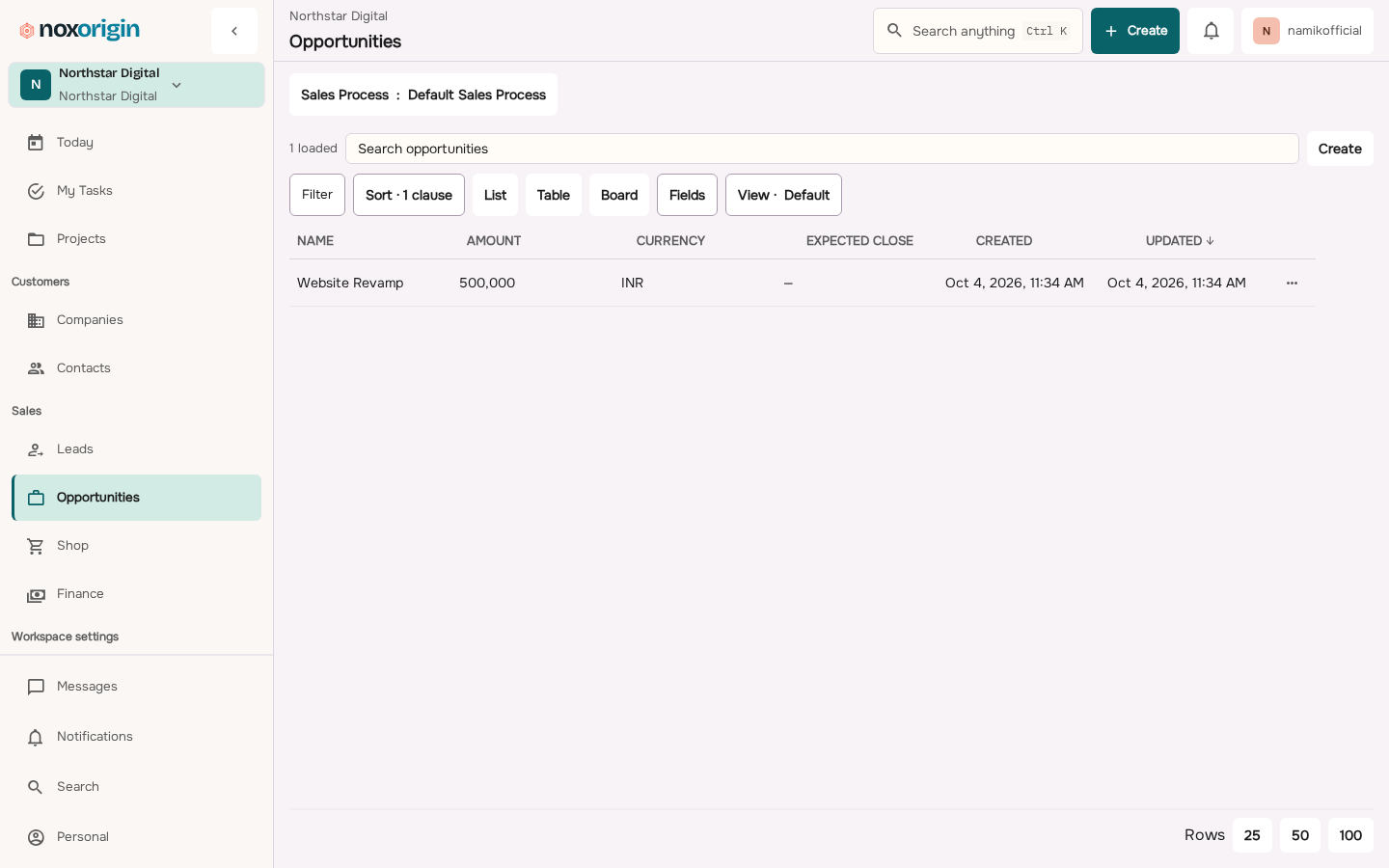
Only in the narrower sense, and the narrower sense is the point. There is no marketing automation, no lead scoring engine, no email sequence builder, no dialler, no CRM-native forecasting model, and no territory management in NoxOrigin. What there is: a deal with a stage, a value, a close date, a probability somebody typed, and an outcome somebody wrote. A stage means something because the team agreed in writing what that stage means, a dead deal leaves the pipeline because a person removed it, and a forecast can be read back to the person who wrote each number in it.
Will it tell me my conversion rate, win rate or forecast accuracy?
No, and this page will not print one either. NoxOrigin produces no conversion rate, no win rate, no forecast accuracy figure, no average deal size and no sales-cycle benchmark. Those are measured outcomes, and producing one would require a closed-deal history this page does not have and does not invent. A rate is also only meaningful against a stated denominator — closed over created, or closed over quoted, are two different numbers from the same file, and the flattering one is always the narrower. If you want a number, it has to come from your own closed records over a period you name.
Does it score leads?
No. There is no score, no fit grade, no behavioural scoring, no intent data, no demographic model and no MQL or SQL definition. A lead is a person somebody recorded, sitting at a stage somebody set. If a score would change what you do next, the decision is better written down as a reason than carried as a number, because a number cannot be argued with and a reason can.
Can it send email sequences or run a dialler for me?
No. There is no sequence builder, no template with merge fields, no send scheduler, no bounce handling, no open or click tracking, no step logic, no call queue, no click-to-call, no call recording, no disposition codes and no call-back scheduling. This platform does not send mail and does not place calls. What left the office was sent by a person, and what was said is a note you wrote — there is no message history here to reconstruct a campaign from.
Where does the forecast number actually come from?
From you, line by line. Each deal carries a value, a close date, and a probability that a person wrote down, and the forecast is the sum of value multiplied by that written probability. The platform does not learn from closed history, does not adjust the number, does not classify the deal as commit or upside, and does not roll it up against a quota. Which is the only reason a forecast here can be defended: you can name the person who typed every number in it and the date they typed it.
A deal has stopped moving. Will the system close it out?
No. There is no inactivity rule, no auto-close, no automatic stage-out at N days, no lost reason code and no archive. A deal leaves the pipeline because a person opens it and records the outcome. This is the part of pipeline discipline that most products automate away, and the reason a pipeline stays wrong for months: the number of deals in it stops describing anything the moment nobody is allowed to remove one.
What about marketing automation, attribution and territory management?
None of it. There is no campaign, no nurture, no drip, no lead-source attribution model, no channel reporting, and no territory, region, franchise or rep-split object with routing rules or commission calculation. A pipeline starts at the moment a person decides somebody is worth a record. If generating that record is the problem you are trying to solve, this is the wrong product and the honest answer is to say so.
The same buyer is on two deals. What then?
You get two rows, two probabilities and one counterparty. The open value reads as the sum of both while the conversation is a single one, so the weighted figure counts the same buyer twice and one person advancing the deal only once is invisible in the number. Detection flags the pair as merge candidates and a human reviews them; merging is a setup decision and nothing merges automatically.
The customer changed the scope after we quoted. How is that recorded?
As a new quote on the same project. There is no change-request record, no milestone or deliverable record, no contract editor and no e-signature in NoxOrigin, so extra work does not become an amended first quote — it becomes a second document. That is why the pipeline value and the billing can disagree with each other, and why the difference has to be reconciled deliberately rather than assumed away.
Is NoxCRM included in the platform plan price?
No, and it is worth being blunt about. The plan prices on this page are NoxOrigin platform plans. NoxCRM, Nox-Billings and Nox-Tickets are scoped custom deployments, quoted and priced separately against your own configuration, and the platform plan price never applies to a NoxCRM deployment. If you are comparing two numbers here, you are comparing the platform to itself.
Bring the pipeline you stopped trusting.
We will define the stages with you in writing, walk the list deal by deal, and show you exactly which number in the forecast came from which person’s typing — then be blunt about which of the six products above you actually need, because this is not one of them.