Clinic billing software with no patient record, no prescription, no appointment engine and no clinical history — a billing system that stays on its own side of the line from anything clinical
A clinic’s billing is entangled with the patient record, and the entanglement is exactly why the honest answer is that this is not a medical record system. NoxOrigin holds no patient or clinical record, no prescription, no appointment engine or scheduling, no clinical history, no insurance or TPA claim handling, and no doctor-roster logic. It is not a practice-management system. What it does do is invoice a consultation or procedure, allocate the payment, and keep the billing record separate from anything clinical — so that quoted, billed, collected and outstanding are four readable states of the practice instead of four figures reconstructed from memory.
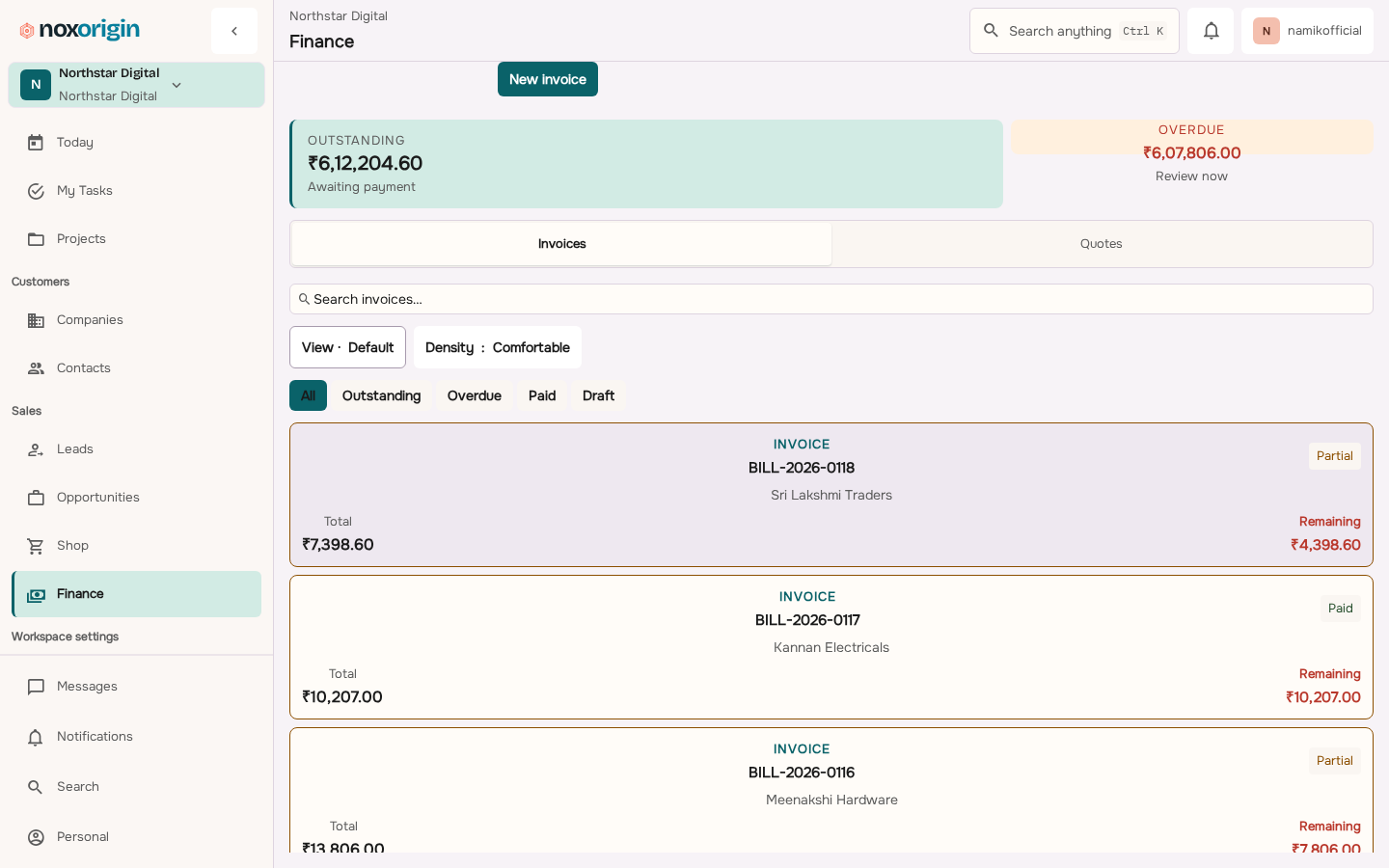
Five things a reader assumes this name means, and the one thing you get instead
Patient records, prescriptions, appointments, insurance claims and a doctor roster. None of the five exist in NoxOrigin in any form, and no plan on this site adds them. What is here instead is a smaller and genuinely useful thing: the money side of the practice, held as records, with a clear line drawn where the clinical record begins.
The patient record
There is no patient record, no patient number with clinical meaning, no demographic record, no allergy flag, no vitals and no clinical history. A party on an invoice is a party on an invoice, and this system holds nothing about the person beyond what the invoice needs.
The prescription and the clinical note
There is no prescription record, no drug, no dosage, no duration, no investigation, no diagnosis and no lab result. These are clinical documents, they belong in a clinical system, and a billing record that appeared to contain them would be a record nobody could safely rely on.
The appointment engine
There is no calendar, no slot, no room or chair allocation, no waiting list, no no-show record, no reschedule trail and no scheduling reminder. There are automations that act on a record, but they cannot know a patient is due tomorrow, because there is no appointment for them to know about.
Insurance, TPA claims and the doctor roster
There is no policy number, no pre-authorisation, no claim form, no claim lifecycle, no settlement against a sanctioned amount, and no doctor roster, specialisation, registration number, fee split or per-doctor revenue attribution. Claims adjudication and rota logic are both substantial products, and neither is here.
What there is instead: a consultation billed, a payment allocated, and the billing record kept apart from anything clinical
A quote for the work at a price, an invoice for the line or lines actually delivered, a payment recorded, and the allocation that makes the invoice read as settled. Quoted, billed, collected and outstanding become four readable states of the practice. It is a billing system and it stays on its own side of the line, deliberately, because the alternative is a record that looks clinical and is not.
A billing routine where the clinical side stays out of it on purpose
Six steps. Step three is the one that matters commercially: an invoice is raised for the line actually delivered, not for the plan quoted ahead of it, so the unbilled remainder stays visible instead of turning into something that was never a debt.
Keep the person on the invoice, and the patient in the clinical system
The invoice needs a name to bill and a party to bill. That is the whole of what this system holds about the person. Deciding what the billing record is allowed to contain is a real design decision, and it is the reason nothing clinical is written here: a record that appears to hold a diagnosis it cannot manage is worse than no record at all.
Price the work before it is done, as a quote with lines and a tax treatment
A consultation, a procedure or a planned course of treatment is quoted as lines with quantities, rates and a tax treatment, and the totals are arithmetic you can check by hand. Whether GST applies to a given healthcare service, at what rate, is a question for your chartered accountant — NoxOrigin does not determine the rate, the exemption, the place of supply or reverse charge.
Invoice the line actually delivered, not the whole plan
A plan quoted for later work is not an invoice for that work. Raising an invoice for the delivered line keeps quoted, billed and collected describing the same thing, and it keeps the unbilled remainder visible instead of quietly disappearing into a plan that was never a debt. This is the commercial discipline the page is about, and it has nothing to do with the visit itself.
Record the payment, and allocate it to that invoice
An invoice and a payment are different records, and paid is a projection of allocations rather than a stored flag. A counter payment of part of an invoice reduces nothing until somebody allocates it. Once allocated, the outstanding figure becomes an arithmetic remainder rather than an opinion, which is the entire value of doing this at the counter rather than at the end of the day.
Where money comes from more than one party, raise separate invoices
A corporate arrangement and the individual are two parties, so they are two invoices. That gives a clear allocation queue and a clear outstanding figure per party. What it deliberately does not give is a claim: there is no sanctioned amount, no pre-authorisation, no query trail and no settlement lifecycle, because a claim is a process between organisations and not a record inside your billing system.
Read billed against collected, and act on the outstanding
Billed is the invoices raised. Collected is the allocations. Outstanding is the difference, and it should be worked as a queue with a promised date on it rather than left to resurface. There is no dunning, no automatic escalation, no card-on-file and no auto-debit, so the follow-up is a person’s decision recorded as a date, not a rule firing on a schedule.
One plan, one delivered line, one part payment, and the second party
Every figure in this section is constructed for this page so the arithmetic can be checked by hand. It is not a NoxOrigin result, not a practice’s record, and not a benchmark. The 18% appears only so each addition can be verified; healthcare services are frequently exempt or specially treated, and which rate applies to a given service is your chartered accountant’s call, not something NoxOrigin determines. NoxOrigin does not file GST returns, does not generate e-invoices or e-way bills, does not handle reverse charge and does not determine place of supply. Nothing here is revenue per patient, a no-show rate, a collection ratio or a claim rejection rate, and this page publishes none of those.
The plan, priced before any of it is done
A course of treatment quoted at 24,000 in lines with a tax treatment. If 18% were to apply, the tax is 24,000 × 0.18 = 4,320 and the quote total is 24,000 + 4,320 = 28,320. Whether tax applies at all, at what rate, and whether reverse charge is in play is a question for your chartered accountant. NoxOrigin does not decide it, and it is not a number this page is asking you to take on trust.
The delivered line, and only the delivered line
A consultation at 1,200 is invoiced. If 18% applies, the tax is 1,200 × 0.18 = 216 and the invoice total is 1,200 + 216 = 1,416. The remaining treatment stays quoted and unbilled, because it has not been delivered. Note what is missing from the invoice: no diagnosis, no prescription, no drug, no test, no vitals and no visit date beyond whatever you choose to write, because there is no clinical record and no appointment engine to draw any of it from.
The part payment at the counter
A receipt of 1,000 against that 1,416 invoice leaves an outstanding of 1,416 − 1,000 = 416, and only once a person allocates it. An invoice and a payment are different records, and paid is a projection of allocations rather than a stored flag. A 1,000 received and unallocated has reduced nothing, which is why allocating at the counter rather than at the end of the day is the whole discipline in a practice where part payment is the normal case.
How much of the plan is still unbilled
Quoted at 28,320 and billed at 1,416 so far, so unbilled plan value is 28,320 − 1,416 = 26,904. That figure is commercially useful and clinically meaningless. Nothing in it says what was done, in what order, or what is still indicated, and NoxOrigin could not answer any of those questions even if you asked, because it holds no clinical record, no prescription and no appointment history.
The second party, which means a second invoice
A corporate arrangement is billed as its own invoice and the individual as another: the consultation line of 1,416, plus a procedure line at 800 where 800 × 0.18 = 144, giving 800 + 144 = 944. Total billed is 1,416 + 944 = 2,360, and against the 1,000 collected the outstanding is 2,360 − 1,000 = 1,360. What this does not produce is a claim: no policy number, no pre-authorisation, no sanctioned amount, no claim form, no query trail and no settlement against what the payer agreed to pay.
What the practice can read back
Quoted 28,320. Billed 2,360. Collected 1,000. Outstanding 1,360, held as two invoices across two parties. That is the honest total, and it is worth noticing what is absent from it: no visit count, no patient count, no follow-up due, no clinical outcome, because none of those can be derived from money records and this system will not pretend to derive them.
The figure this page will not give you
There is no average revenue per patient, no revenue per consultation, no no-show rate, no collection ratio, no claim rejection rate and no average bill value anywhere on this page. Each is a number about somebody else’s practice, computed on a denominator the reader cannot see, and a practice with a different payer mix and a different service list can show the same figure while doing something quite different. We would rather you compare the boundaries than borrow a number.
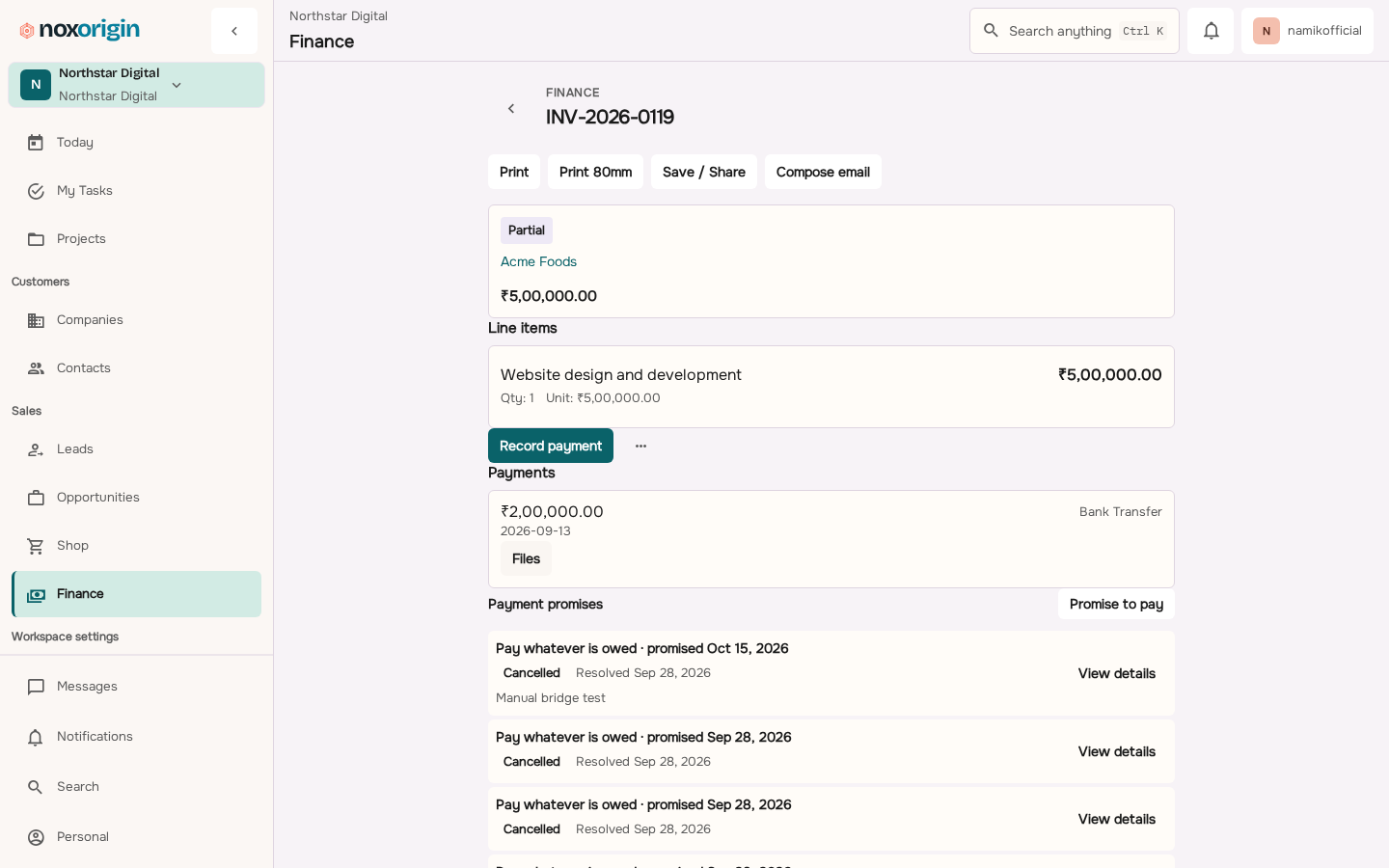
What a clinic buyer asks for, and the honest answer
If the first four rows apply to you, stop here and buy a practice-management system. A practice cannot be run on a billing screen, and pretending otherwise is what this page exists to prevent. The rest is what NoxOrigin does with a price, an invoice, a payment and an allocation somebody has made.
| What a buyer asks for | In NoxOrigin |
|---|---|
| Hold a patient record | No. No patient record, no patient identifier with clinical meaning, no demographics, no allergy flag, no vitals and no clinical history. A party on an invoice is a party on an invoice. |
| Record a prescription | No. No prescription, no drug, no dosage, no duration, no investigation, no diagnosis and no lab result. Those are clinical documents and belong in a clinical system. |
| Schedule appointments and chair time | No. No appointment engine, no calendar, no slots, no chair or room allocation, no waiting list, no no-show record and no reschedule trail. |
| Handle insurance and TPA claims | No. No policy number, no pre-authorisation, no claim form, no claim lifecycle, no settlement against a sanctioned amount and no rejection reason. A payer arrangement can be held as a party on an invoice and nothing more. |
| Manage a doctor roster and fee split | No. No roster, no specialisation, no registration number, no slot or session logic, no fee split and no per-doctor revenue attribution. |
| Invoice a consultation or a procedure | Yes. An invoice raised for the line actually delivered, with a tax treatment, against a party, as a record with its own number and date. |
| Price a course of treatment before it is delivered | Yes. A quote with lines, quantities, rates and a tax treatment. Whether GST applies to a given healthcare service is your chartered accountant’s determination, not a feature of this system. |
| Allocate a part payment at the counter | Yes. The payment is recorded and the allocation reduces the invoice, and paid is a projection of those allocations rather than a stored flag, so the outstanding is an arithmetic remainder. |
| Read billed against collected across the practice | Yes. Billed is the invoices raised, collected is the allocations, outstanding is the difference, and the outstanding queue carries a promised date so it is worked rather than remembered. |
| Post the bill to the statutory books | No. NoxOrigin does not file GST returns or any other statutory return, does not generate e-invoices or e-way bills, does not handle reverse charge, does not determine place of supply, and holds no bank connection or credential. |
Where this is the wrong tool
Clinic software is judged by what it refuses to imply. The list below is the set of things a reader is most likely to assume are present because the page title sounds like they are.
If you need a patient record, this is the wrong product
No patient record, no clinical history, no allergies, no vitals, no documents. A clinic that cannot run its day without a patient file needs a clinical system, and it needs one that is good at it rather than one that is a billing screen with a medical-sounding name.
If you need to write a prescription, this is the wrong product
No prescription record, no drug, no dosage, no investigation and no clinical note. Prescribing is a clinical act recorded in a clinical system, and a billing tool that stored it would be storing a document it cannot validate.
If you need an appointment engine, this is the wrong product
No calendar, no slots, no chair or room allocation, no waiting list, no no-show record, no reschedule trail. What a practice-management system does in a morning is built on its schedule, and there is no schedule here to build anything on.
This is not a practice-management system
No patient record, no scheduling, no clinical history, no doctor roster, no fee split and no per-doctor revenue attribution. Saying it plainly is more useful than a page that borrows the vocabulary of a PMS without the records to support it.
Insurance and TPA claims are not handled here
No policy number, no pre-authorisation, no claim form, no claim lifecycle, no settlement against a sanctioned amount and no rejection reason. A payer arrangement can be held as a party on an invoice. Everything after that is a process between organisations.
An invoice and a payment are different records, and paid is a projection
Money received reduces nothing until a person allocates it, and paid is derived from allocations rather than stored as a flag. In a clinic where part payment at the counter is the normal case, the allocation step is the discipline, and an unmanaged allocation queue makes the outstanding figure unreadable.
No dunning, no card-on-file, no auto-debit, no credit bureau
There is no automatic reminder escalation, no stored card, no scheduled debit and no recovery engine. What exists is an outstanding figure with a promised date on it. Nothing in NoxOrigin will contact a patient, because there is no patient record for it to contact.
Run the billing side on the plan that matches your invoice volume
Growth is ₹1,600/month or ₹15,000/year, includes a 30-day trial, 10 users, 50 active projects, and 10,000 contacts. Say this plainly rather than let it be assumed: these are NoxOrigin platform plans. NoxCRM, Nox-Billings and Nox-Tickets are scoped custom deployments, quoted and priced separately against your own configuration, and the platform plan price never applies to any of them. A patient record, an appointment engine or TPA claim handling is not a plan question, so if those are what you need, say so in the conversation — that is a different product conversation, not a pricing one.
Clinic billing questions, answered before you buy
Does NoxOrigin hold a patient record?
No. There is no patient record, no patient identifier with clinical meaning, no demographic record, no allergy flag, no clinical history and no vitals. A party on an invoice is a party on an invoice, and the system has no opinion about who walked in. Anything that identifies a person as a patient belongs in a clinical system, and pretending otherwise is the failure mode this page exists to prevent.
Can it record a prescription?
No. There is no prescription record, no drug, no dosage, no duration, no investigation, no diagnosis, no clinical note and no lab result. A prescription is a clinical document and a clinical document belongs in a clinical system with the record attached to it. If the medicine or the test is the reason for the invoice, the invoice names the service billed and nothing else — which is a limitation, not a shortened version of a medical record.
Does it schedule appointments?
No. There is no appointment engine, no calendar, no slot, no room or chair allocation, no waiting list, no no-show logic, no reschedule record and no reminder that is a scheduling reminder. There are automations that can act on a record, but they cannot know a patient is due at eleven tomorrow, because there is no appointment to know about. Scheduling is the function that makes a practice-management system a practice-management system, and this is not one.
Does it handle insurance or TPA claims?
No. There is no policy number, no TPA or payer mapping, no pre-authorisation record, no claim form, no claim lifecycle, no query-and-response trail, no settlement against a sanctioned amount and no rejection reason. A corporate or insurer arrangement can be held as a party on an invoice, and that is the whole of it. Adjudicating a claim, following it to settlement and reconciling a sanctioned amount against what you billed is a different product with a different body of rules.
Does it know anything about the doctors?
No. There is no doctor roster, no specialisation, no registration or council number, no fee split, no per-doctor revenue attribution, no slot or session logic and no on-duty calendar. A practitioner appears as a name on a record the same way a supplier does. If you bill per doctor and need to know who earned what, that is a rota and a rule set, and it is not what this system is.
What does it actually do for a clinic?
It prices the work as a quote with lines and a tax treatment, invoices the line or lines actually delivered, records the payment, and holds the allocation that makes the invoice read as settled. Quoted, billed, collected and outstanding are then four readable states of the practice rather than four figures reconstructed from memory. That is a billing system, and it is deliberately kept on its own side of the line from anything clinical.
Is the clinical record then somewhere in the platform?
No. NoxOrigin holds no patient or clinical record at all, so there is nowhere else in the platform for one to be. Expenses are Nox-Billings, purchasing and stock movement are in Commerce, and the clinical record is a separate system you run. A claim about a single connected clinical-and-billing record on this site would be false, and this page is written specifically so that you do not leave believing it.
Is this included in the platform plan price?
The plan prices on this page are NoxOrigin platform plans. NoxCRM, Nox-Billings and Nox-Tickets are scoped custom deployments, quoted and priced separately against your own configuration, and the platform plan price never applies to any of them. If what you need is a patient record, an appointment engine or TPA claim handling, say so in the conversation rather than assuming a plan price covers it, because no plan on this site adds them.
Tell us whether you need a patient record.
If you do, we will say so before you spend any more of your time here, because NoxOrigin has no patient or clinical record, no prescription, no appointment engine, no clinical history, no insurance or TPA claim handling and no doctor-roster logic, and no plan on this site changes that. It is not a practice-management system. What it does have is the money side, held cleanly: a price, an invoice for what was delivered, a payment, and an allocation somebody made — so that the outstanding figure is arithmetic rather than an opinion.